1. The Core Bottleneck: What Hard Wall Does It Hit?
AI compute development faces an increasingly painful split. Production inference throughput heavily relies on bespoke operators, such as sparse MLA kernels in DeepSeek V3.2, block-causal attention variants, and ultra-low-bit quantized GEMMs. System engineering teams find themselves trapped between two suboptimal paths:
Hand-writing CUDA C++ or raw CUTLASS maximizes register occupancy and compute density, but forces developers to manually orchestrate shared-memory bank conflict swizzling, register allocation, and warp-level synchronization primitives. The resulting codebases are extremely fragile. Migrating across hardware generations—such as adapting Hopper primitives to Blackwell SM120, or porting to AMD ROCm or Ascend 950—demands complete manual rewrites. Conversely, higher-level frameworks like Triton ease adoption, but struggle when expressing fine-grained non-standard memory access patterns, custom pipeline phases (such as TMA Gather/Scatter or cluster copies), or targeting heterogeneous non-NVIDIA silicon without significant runtime friction.
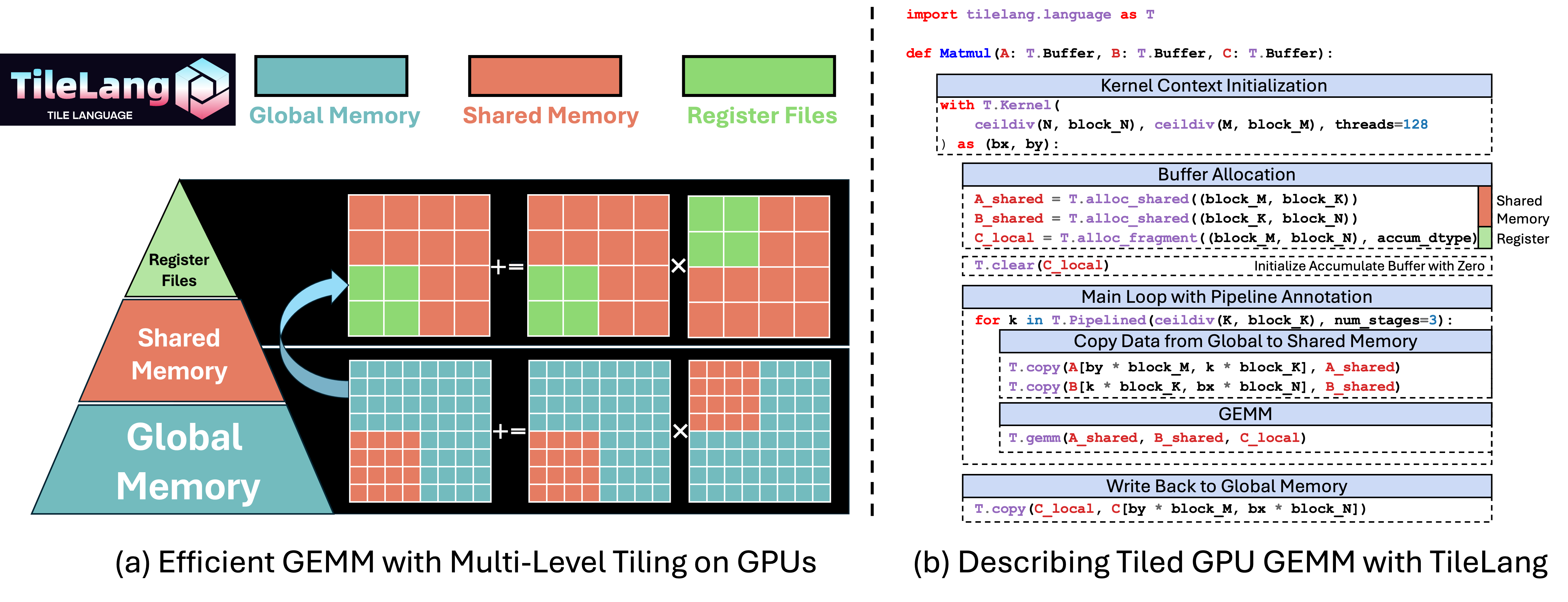
TileLang resolves this dilemma. Building directly on the Apache TVM TIRX compiler infrastructure, TileLang elevates the tile abstraction to a first-class citizen. Engineers avoid thread-level scalar programming and instead describe kernels strictly in terms of tile shapes, memory hierarchies, and data movement phases. The underlying compiler automates software pipelining, Tensor Core MMA mappings, asynchronous memory copies, and multi-backend lowering.
💡 Core Architectural Insight: By replacing thread-level scalar orchestration with tile-level tensor flows, TileLang establishes a deterministic lowering pipeline from Python AST directly to hardware MMA/TMA instructions, enabling unified operator logic across NVIDIA, AMD, Apple Metal, and Ascend hardware.
2. Architecture & Dataflow Mechanics
TileLang is designed as a decoupled, multi-stage compiler pipeline. The front end exposes a Pythonic DSL, the middle layer runs on extended TensorIR (TIRX), and the back end connects to a code generation registry.
[ Python DSL Kernel (T.prim_func) ]
                   │ (Parse AST & Inlay Layouts)
                   ▼
[ TIRX Multi-Backend Dialect IR ]
                   │
     ┌─────────────┴─────────────┐
     ▼                           ▼
[ Tile Scheduler ]       [ Layout & Swizzle Trans ]
(Pipeline / Auto-Sync)   (TMA Lowering / Bank Conflict)
     │                           │
     └─────────────┬─────────────┘
                   ▼
[ IR Lower Trace & Pass Optimization ]
(Scan / MMA Lowering / Cluster Trans)
                   │
                   ▼
[ Backend CodeGen Dispatch Registry ]
   ├── CUDA (SM75-SM120 NVF4 / TMA)
   ├── ROCm (CDNA3/CDNA4 MXFP4)
   ├── Metal (M5 Cooperative Tensor / Simdgroup)
   ├── Ascend (950 SIMD/SIMT Vector & Matrix)
   └── LLVM (x86 / ARM CPU Fallback)
The compilation pipeline is powered by several key components:
- Dialect Front-End and LSP Engine: Captures kernel definitions via Python decorators. The TileLang LSP provides compile-time inlay hints for buffer shapes, data types, and inferred memory layouts directly inside code editors.
- TIRX Transformation Pipeline: Translates coarse-grained operations like
T.copyandT.gemminto an intermediate representation with explicit memory dependencies. This stage analyzes access strides, rewrites shared-memory tile allocations to avoid bank conflicts, and constructs multi-stage software pipelines. - Backend CodeGen Registry: Separates device-level microcode emission from host-side execution. The lowered TIRX representations are dispatched to target-specific generators, yielding PTX/NVVM instructions for NVIDIA, HIP source for AMD gfx950, Metal Shading Language for Apple Silicon, and Ascend vector instructions.
From an engineering trade-off perspective, TileLang avoids complete black-box opacity. It allows kernel authors to directly invoke micro-architectural primitives, like T.mma_gemm_blockscaled or T.copy_cluster. While this requires an understanding of underlying hardware, it prevents the severe performance cliffs frequently encountered with black-box auto-schedulers.
3. Technical Trade-Offs & Head-to-Head Comparison
| Evaluation Metric | TileLang | Hand-Written CUDA / CUTLASS | OpenAI Triton | Classical TVM TensorIR | Production Advantage |
|---|---|---|---|---|---|
| Abstraction Level | Tile-first programmatic primitives | Explicit thread / warp scalar control | Block / program-level implicit tracking | Nested loop scalar abstractions | ~70% lower code footprint, zero scalar index bugs |
| Micro-architecture Access | Direct support for TMA/Cluster/NVF4 | Assembly-level precise control | Dependent on MLIR compiler passes | Limited to schedule transformations | Uncompromised peak hardware throughput |
| Hardware Portability | CUDA, ROCm, Metal, Ascend, LLVM | Bound primarily to NVIDIA | NVIDIA-centric, alternative backends lag | Universal, but high cost for deep MMA optimizations | Single source of truth across hardware architectures |
| Compiler Observability | IR Lower Trace / Pass Diff / LSP | GDB, Compute Sanitizer | Intermediate PTX / Triton IR dump | Internal TVM pass visualization | Instant debugging of layout transformations and lowerings |
TileLang's primary advantage lies in its design choice: rather than constructing an isolated execution engine, it rebuilds TVM's compilation pipeline for modern accelerators. Compared to Triton's heavy reliance on LLVM MLIR paths, TileLang uses TIRX to keep compiler passes transparent, letting developers inspect shared-memory allocations and loop unrolling across every lowering stage.
4. Hands-on Implementation: Minimal Working Pipeline
This walkthrough implements a high-performance FP16 matrix multiplication kernel using TileLang, featuring software pipelining and shared-memory tiling.
Environment Setup
# Prerequisites: Python >= 3.10, CUDA Toolkit >= 12.0
pip install torch tilelang

# Confirm runtime environment and compiler visibility
python -c "import tilelang; print(tilelang.__version__)"
Kernel Implementation
Save the following script as gemm_tilelang_demo.py:
import torch
import tilelang
import tilelang.language as T

# Dimension definitions for the GEMM problem
M, N, K = 1024, 1024, 1024
BLOCK_M, BLOCK_N, BLOCK_K = 128, 128, 32

@T.prim_func
def matmul_kernel(
    # Define global memory buffers for input matrices
    A: T.Buffer((M, K), "float16"),
    B: T.Buffer((K, N), "float16"),
    # Define destination buffer for output
    C: T.Buffer((M, N), "float16"),
):
    # Launch grid bounds matching outer tile dimensions
    with T.Kernel(T.ceildiv(N, BLOCK_N), T.ceildiv(M, BLOCK_M), threads=128) as (bx, by):
        # Shared memory buffers acting as cache lines for block tiles
        A_shared = T.alloc_shared((BLOCK_M, BLOCK_K), "float16")
        B_shared = T.alloc_shared((BLOCK_K, BLOCK_N), "float16")
        # Register accumulator buffer using float32 to prevent underflow
        C_local = T.alloc_fragment((BLOCK_M, BLOCK_N), "float32")

        # Reset accumulator fragment to zero
        T.clear(C_local)

        # Loop over reduction dimension with 2-stage async software pipelining
        for k in T.Pipelined(T.ceildiv(K, BLOCK_K), num_stages=2):
            # Asynchronous global to shared memory transfers
            T.copy(A[by * BLOCK_M : (by + 1) * BLOCK_M, k * BLOCK_K : (k + 1) * BLOCK_K], A_shared)
            T.copy(B[k * BLOCK_K : (k + 1) * BLOCK_K, bx * BLOCK_N : (bx + 1) * BLOCK_N], B_shared)
            # Hardware accelerated matrix multiply-accumulate
            T.gemm(A_shared, B_shared, C_local)

        # Store accumulated results back to global memory
        T.copy(C_local, C[by * BLOCK_M : (by + 1) * BLOCK_M, bx * BLOCK_N : (bx + 1) * BLOCK_N])

# Compile the TileLang kernel down to a target-specific executable
compiled_kernel = tilelang.compile(matmul_kernel, target="cuda")

# Allocate PyTorch tensors for functional validation
a = torch.randn(M, K, dtype=torch.float16, device="cuda")
b = torch.randn(K, N, dtype=torch.float16, device="cuda")
c = torch.empty(M, N, dtype=torch.float16, device="cuda")

# Execute compiled kernel directly
compiled_kernel(a, b, c)

# Validate against PyTorch reference implementation
torch_ref = torch.matmul(a, b)
max_err = torch.max(torch.abs(c - torch_ref)).item()
print(f"Execution success. Max absolute difference: {max_err:.4e}")
Running the Kernel
python gemm_tilelang_demo.py
Expected console output:
Execution success. Max absolute difference: 9.7656e-04
5. Production Deployment Gotchas
Deploying TileLang kernels into production clusters requires careful handling of low-level hardware constraints:
Shared Memory Swizzling & TMA Silent Fallbacks
On NVIDIA Hopper and Blackwell architectures, TMA (Tensor Memory Accelerator) instructions impose strict alignment and layout constraints. If a shared-memory buffer declared via T.alloc_shared does not satisfy 128-byte stride alignment, or if the loop index uses irregular non-contiguous slices, the compiler's TMA pass will silently fall back to legacy ldmatrix or standard scalar vector loads. This severely limits global-to-shared memory throughput.
⚠️ Production Gotcha [Silent TMA Degradation]:When deploying on Hopper or Blackwell targets, use
tilelang.tools.ir_lower_traceto verify that lowering outputs contain genuinetile::tma_loadprimitives. Ensure that leading tile dimensions map cleanly to multiples of 128 bytes to prevent pipeline degradation.
Software Pipelining Depth vs. Shared Memory Pressure
TileLang's T.Pipelined(num_stages=...) provides an easy way to interleave compute and memory access. However, each additional stage increases shared-memory utilization proportionally. Setting num_stages to 4 or 5 without monitoring total SM capacity can exceed physical shared memory limits, causing runtime launches to throw CUDA out of resources or heavily restrict active block occupancy per SM.
⚠️ Production Gotcha [Over-Subscribed Shared Memory]:Always compute total shared footprint via
num_stages * (sizeof(A_tile) + sizeof(B_tile))before scaling pipeline depth. Verify resource reservations using TileLang's pass profiler, and rely ontilelang.autotuneto find the empirical optimum between pipeline latency hiding and warp occupancy.