1. The Core Bottleneck: Shattering Skeleton Silos
Skeletal animation synthesis pipelines have long hit a wall imposed by rigid topological coupling. Diffusion models such as MotionDiffuse and MDM implicitly couple spatial parameters to specific humanoid kinematic hierarchies, primarily the 22-joint SMPL format defined by HumanML3D. Once applied to quadrupeds, avians, multi-legged insectoids, or mechanical chains, these models fail. Production teams are forced to curate bespoke datasets, rebuild joint indexing, and train isolated checkpoints for each skeleton type, resulting in operational fragmentation and redundant computational overhead.
Skeletons across biological and synthetic classes exhibit massive topological heterogeneity. Joint counts vary, kinematic depths diverge, and physical degrees of freedom differ drastically. Feeding these topologies into standard full self-attention modules forces the network to correlate unlinked spatial points across flattened sequences, discarding true structural kinematics and introducing severe coordinate tearing or sliding artifacts.
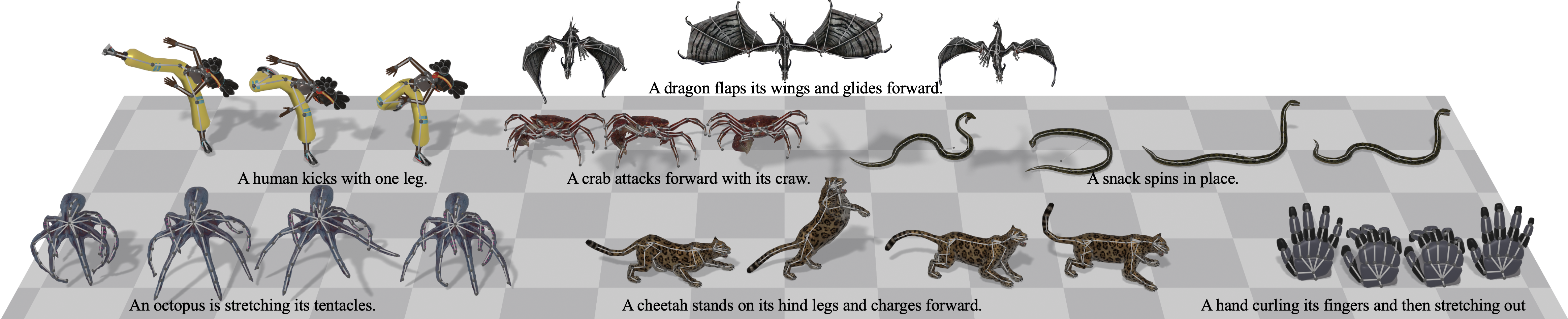
UniMate resolves this breakdown via a unified canonicalization framework coupled with spatio-temporal graph diffusion. Accompanied by the UniML3D dataset comprising 13,006 text-paired motion clips, the architecture standardizes diverse topologies into a canonical feature space. Using structural graph biases, a single checkpoint drives everything from 5-joint rigid levers to 100-joint quadruped kinematic trees.
💡 Core Architectural Insight: By restricting spatial attention via explicit kinematic graph-distance and depth biases while offloading trajectory evolution to temporal layers, UniMate casts heterogeneous motion synthesis as a generalized spatio-temporal diffusion process over graph manifolds.
2. Deep Architecture and Execution Dataflow
UniMate decouples motion generation into conditioning projections, graph-biased spatial attention, and joint-wise temporal modeling. Incoming motion sequences are derived from Stage 4 normalized NPZ features, where adjacency matrices provide kinematic distance and hierarchy depth as explicit attention masks.
The runtime dataflow proceeds as follows:
[ Text Prompt ] ──> [ Frozen CLIP / T5 ] ──> [ Text Embeddings ]
                                                    │
[ Raw Skeleton ] ──> [ Canonicalization ]           │ (adaLN Modulation / Cross-Attn)
       │                    │                       │
       ▼                    ▼                       ▼
[ Graph Topology ] ──> [ Adjacency & Depth ] ──> [ Spatial Graph-Attention ] (Per-frame Joints)
                                                    │
                                                    ▼
[ Latent Noisy Motion ] (B, T, J, C) ───────────> [ Temporal Joint-Attention ] (Per-joint Time)
                                                    │
                                                    ▼
[ Denoised Trajectory ] <── [ Un-canonicalize ] <── [ Residual FFN Block ]
The tensor representation maintains a four-dimensional layout (Batch, Time, Joints, Channels). UniMate configures two principal computational paths:
graph_adaln: Spatial and temporal passes are factored. The spatial pass evaluates joints per frame, modulated by shortest-path graph distances, edge direction types, and kinematic depth biases. Text context modulates the diffusion layer dynamics through Adaptive Layer Normalization (adaLN).full_cross_attn: The temporal and joint dimensions are flattened into a single sequence(Batch, Time * Joints, Channels). The network executes unconstrained self-attention, injecting text prompt embeddings across all blocks via standard cross-attention Key-Value projections.
Engineering trade-offs dictate this split. While full_cross_attn imposes an $O((T \times J)^2)$ memory complexity that scales poorly and risks high-frequency spatial jitter, graph_adaln restricts operational complexity to $O(T \cdot J^2 + J \cdot T^2)$, preserving skeletal kinematic integrity under strict GPU memory budgets.
3. Technical Trade-offs & Benchmark Landscape
Evaluating UniMate against standard generative motion workflows reveals key architectural and performance differentiators:
| Evaluation Dimension | UniMate | Traditional Diffusion (e.g., MDM) | Classical Retargeting Pipeline | Production Benefit |
|---|---|---|---|---|
| Topology Support | Arbitrary graphs (5 to 100 joints) | Bound to fixed 22-joint SMPL format | Requires explicit 1-to-1 bone mapping | Eliminates bespoke model retrain cycles |
| Attention Core | Factored graph-bias spatio-temporal | Flattened temporal-joint attention | Inverse Kinematics (IK) solvers only | Reduces GPU footprint; prevents joint tearing |
| Asset Coverage | Bipeds, quadrupeds, avians, robotics | Humanoid bipeds only | Restricted by kinematic similarity | Single pipeline drives multi-category 3D rigs |
| Runtime Complexity | $O(T \cdot J^2 + J \cdot T^2)$ | $O((T \cdot J)^2)$ | Instantaneous $O(J)$ (Lacks generative capacity) | Predictable, bounded memory at 60 frames |
UniMate bypasses bespoke checkpoint management. The explicit integration of graph topological biases enables invariant structural modeling, allowing game studios and VFX pipelines to replace complex retargeting graphs with a single serving container.
4. Hands-on Implementation: Minimal Working Pipeline
4.1 Environment Initialization
UniMate relies on legacy setup tools for internal CUDA extensions, mandating --no-build-isolation:
# Initialize conda isolate
conda create -n unimate python=3.10 -y
conda activate unimate

# Enforce setuptools upper-bound and install dependencies
pip install "setuptools<81"
pip install -r requirements.txt --no-build-isolation
4.2 Minimal End-to-End Simulation Script
This script initializes model weights, constructs kinematic graph bias matrices for an arbitrary skeleton, and runs a single forward denoising pass:
import torch
import json
from unimate.models.motion_model import MotionModel
from unimate.utils.graph import build_skeleton_graph_bias

# 1. Load production model configuration
config_path = "configs/uniml3d_60frames_graph_adaln.json"
with open(config_path, "r") as f:
    cfg = json.load(f)

# 2. Establish dimensional shapes for synthetic workload
batch_size = 2
frames = cfg["dataset"]["max_motion_length"]       # Standardized 60 frames
num_joints = 24                                     # Arbitrary joint topology
feat_dim = 12                                       # State feature length per joint
embed_dim = 512                                     # Context projection dimensionality

# 3. Define parent kinematic array for custom rig (-1 indicates root)
parents = [-1, 0, 1, 2, 0, 4, 5, 0, 7, 8, 0, 10, 11, 2, 13, 14, 5, 16, 17, 8, 19, 20, 11, 22]
parents_tensor = torch.tensor(parents, dtype=torch.long)

# 4. Generate topology distance and depth bias matrices
graph_bias = build_skeleton_graph_bias(
    parents=parents_tensor,
    max_joints=cfg["dataset"].get("max_joints", 60)
)
graph_bias = graph_bias.unsqueeze(0).repeat(batch_size, 1, 1).cuda()

# 5. Populate synthetic latent states and conditions
noisy_motion = torch.randn(batch_size, frames, num_joints, feat_dim).cuda()
timestep = torch.randint(0, 1000, (batch_size,)).cuda()       # Diffusion timesteps
text_embeddings = torch.randn(batch_size, 77, embed_dim).cuda() # CLIP pooled features

# 6. Instantiate UniMate backbone
model = MotionModel(
    feat_dim=feat_dim,
    embed_dim=embed_dim,
    num_layers=cfg["model"]["num_layers"],         # 10 layers for UniML3D mixture
    attention_type="graph",                         # Factored spatio-temporal pass
    text_cond_type="adaln"                          # Adaptive LayerNorm routing
).cuda()

# 7. Execute forward denoising estimation
model.eval()
with torch.no_grad():
    predicted_noise = model(
        x=noisy_motion,                             # (B, T, J, C)
        timestep=timestep,                           # (B,)
        text_emb=text_embeddings,                    # (B, 77, D)
        graph_bias=graph_bias                        # (B, J, J) topology bias
    )

print(f"[*] Successfully evaluated output tensor: {list(predicted_noise.shape)}")
assert predicted_noise.shape == (batch_size, frames, num_joints, feat_dim)
4.3 Training Invocation
Execute distributed training across available devices using 🤗 Accelerate:
accelerate launch --num_processes 1 -m unimate.training.train \
    --config configs/uniml3d_60frames_graph_adaln.json \
    --batch_size 16 \
    --output_dir outputs/exp_uniml3d_graph_adaln
Expected output stream:
[INFO] Accelerate Environment Initialized. Process count: 1
[INFO] Loading dataset UniML3D with auto-bounds: min_joints=5, max_joints=60
[INFO] BalancedSampler: applying power-law sampling over skeletal categories.
[INFO] Model instantiated: 10 layers, attention=graph, text_cond=adaln
[INFO] Restored dataset statistics from outputs/exp_uniml3d_graph_adaln/dataset_stats.npy
Step [0/200000] - Loss: 0.8412 - GradNorm: 1.204 - LR: 1.00e-04
Step [500/200000] - Loss: 0.2458 - GradNorm: 0.651 - LR: 9.98e-05
[INFO] Checkpoint saved: outputs/exp_uniml3d_graph_adaln/checkpoints/checkpoint_step_500.pt
5. Production Gotchas & Implementation Traps
Deploying UniMate into asset pipelines requires vigilance across specific structural boundaries:
⚠️ Production Trap [Joint Count Bounds and Truncation]:
dataset.max_jointsdiffers between configurations. Single-source configurations (mixamo_*,truebones_*) allow up to100joints, while composite runs (uniml3d_*,objaverse_*) enforce a ceiling of60. Any ingested rig with more than 60 joints under the unified configuration causes runtime shape exceptions or silent truncation. Skeletons with fewer thanmin_joints=5are dropped silently by the loader. Verify input topological scales prior to ingestion.⚠️ Production Trap [Build Isolation Failures via setuptools>=81]: The repository dependencies depend on legacy setuptools hooks. Allowing pip to build packages under isolation or using
setuptools>=81causes compilation failures for geometry packages relying on legacydistutilsheaders. Fix this in continuous integration pipelines by explicitly pinningsetuptools<81prior to executing package builds.⚠️ Production Trap [Commercial Asset Entitlements in UniML3D]: The full UniML3D mixture includes data from Truebones ZOO. The HuggingFace repository contains only text prompts, renders, and joint metadata for this split due to commercial licensing restrictions. Training a model with
uniml3d_*configurations without separately purchasing and mounting the originalTruebone_Z-OOfolder structure breaks Stage 4 preprocessing, causing missing animal motion distributions and degraded non-humanoid performance.