1. The Core Bottleneck: Shattering the LLM Gateway Wall
Multi-provider orchestration has become an operational nightmare in modern AI software development. Teams implementing multi-model fallbacks or cost-arbitrage routing routinely maintain dozens of divergent SDKs, incompatible error taxonomies, and conflicting token counters. When upstream providers enforce sudden rate limits (HTTP 429) or silently throttle daily token budgets, autonomous coding agents like Cursor, Cline, and Claude Code freeze, forcing developers to intervene manually.
Traditional LLM gateways typically stop at basic protocol normalization, translating OpenAI-compliant payloads into Anthropic or Google schemas. When an upstream provider exhausts its token quota, standard reverse proxies pass the failure directly back to the client. This breaks long-running agent workflows and leaves developers paying for expensive paid tiers while hundreds of free credits sit idle across fragmented accounts.
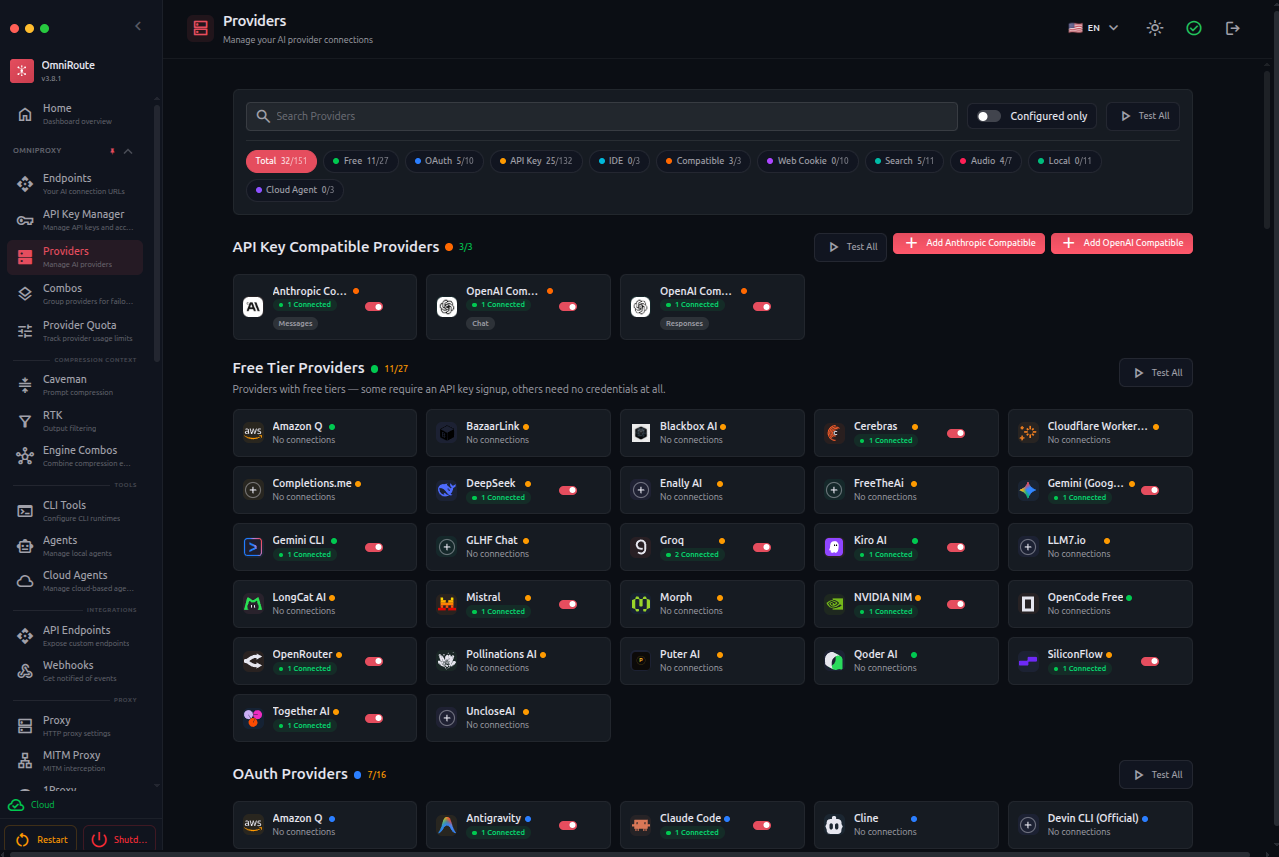
OmniRoute fundamentally changes this dynamic by unifying 358 AI providers—including more than 150 permanent and recurring free tiers—into a single drop-in gateway. It treats ephemeral free tiers not as unstable toys, but as pooled, deterministic compute assets. By coupling quota-aware telemetry with an active RTK + Caveman stacked compression pipeline that cuts prompt payloads by 15% to 95% (averaging ~89%), OmniRoute prevents automated pipelines from hitting upstream limits entirely.
💡 Core Architectural Insight: Transform fragmented, ephemeral upstream free quotas into a consolidated deterministic compute fabric, shielded by edge-layer syntactic compression.
2. Core Architecture and Data Flow Execution
The internal pipeline of OmniRoute decouples inbound protocol mapping, context compression, quota balance arbitration, and multi-provider execution:
[ Client: Cursor / Cline / Claude Code ]
                    │
                    ▼ (OpenAI / Anthropic Protocol)
      [ OmniRoute Ingress Gateway ]
                    │
        ┌───────────┴───────────┐
        ▼                       ▼
[ Token Compression ]   [ Quota Radar & Telemetry ]
  ├─ RTK Parser           ├─ Shared Pool Dedupe (35 Keys)
  └─ Caveman Reducer      └─ Latency & Balance Matrix
        │                       │
        └───────────┬───────────┘
                    ▼
       [ Routing Strategy Engine ]
        (19 Policies: Quota-Share / Latency-First / Fallback)
                    │
     ┌──────────────┼──────────────┐
     ▼              ▼              ▼
[ Provider A ] [ Provider B ] [ Provider C ]
 (Groq / 30M)   (Mistral / 1B)  (Nara / 210M)
Pipeline Lifecycle Execution
Every inbound interaction follows a precise, fault-tolerant path through the gateway runtime:
- Protocol Normalization & Modality Bridging: The ingress interface accepts both OpenAI-compatible (
/v1/chat/completions) and native Anthropic payloads. OmniRoute inspects multi-modal payloads (vision, audio, video) and uses internal adapters to transcode the assets into schemas natively accepted by the selected backend. - Stacked Compression Pipeline:
- Stage 1 (RTK Parser): Analyzes structural source code, stripping trailing whitespaces, dead comments, and syntactic redundancies without altering AST integrity.
- Stage 2 (Caveman Reducer): Strips natural language conversational filler, executing deterministic morphological simplification on prompts while strictly preserving core instruction boundaries.
- Quota Deduplication & Radar Matrix: OmniRoute catalogs 489 free-tier endpoints mapped to 35 recurring shared pool keys (such as Mistral 1B, Nara 210M, LLM7 150M, xKiro 150M, and Groq 30M caps). The scheduler recognizes when multiple white-label providers share underlying infrastructure, preventing phantom quota calculations.
- 19-Strategy Routing Arbiter: The gateway selects optimal routes via algorithms such as
Quota-Share,Latency-First, orCost-Optimal. If an active endpoint throws an HTTP 429 or network timeout, OmniRoute intercepts the failure within 50ms, falls back to the next viable candidate in the pool, and streams the completion back without client-side interruption.
3. Architecture Comparison & Benchmarks
Evaluating OmniRoute against conventional gateway implementations demonstrates the operational differences between simple protocol wrappers and quota-aware arbitration engines:
| Technical Dimension | OmniRoute Gateway | Hardcoded Manual Proxies | Typical Enterprise Proxy (e.g., LiteLLM) | Production Impact |
|---|---|---|---|---|
| Provider Ingestion | 358 Providers (152+ Zero-Cost) | Point-to-point bespoke integration | ~100+ Commercial Cloud Providers | Direct access to niche, local, and subsidized compute |
| Free-Tier Aggregation | ~1.62B/mo pooled (35 deduplicated keys) | None; manual individual accounts | Key round-robin without pool dedupe | Eliminates exploratory & test token expenditure |
| Payload Compression | Integrated RTK + Caveman stack | None; raw text serialization | External middleware required | ~89% average token savings on long contexts |
| Failover Granularity | 19 dynamic policies (Quota-Share) | Hard exception thrown on 429 | Static retry & standard backoff | Eliminates broken states in iterative agent loops |
| Footprint & Runtime | Local-first Node/Go lightweight daemon | Embedded application code | Python runtime (moderate memory footprint) | Operates smoothly inside containerized edge nodes |
Most API proxy solutions treat upstream services as passive endpoints with assumed infinite balance, focusing only on format transformation. OmniRoute treats rate limits and upstream quotas as primary constraints, applying on-the-fly token reduction to expand the operational envelope of free compute pools.
4. Hands-On Implementation: Building the Minimal Loop
The following implementation demonstrates setting up OmniRoute in a Dockerized environment and dispatching queries through a multi-model fallback pool.
Gateway Deployment
Deploy the engine locally using Docker to manage isolation and preserve local configurations:
# Run the OmniRoute gateway daemon with volume mapping for route topologies
docker run -d \
  --name omniroute-gateway \
  -p 8080:8080 \
  -v $(pwd)/config:/app/config \
  -e LOG_LEVEL=info \
  --restart unless-stopped \
  diegosouzapw/omniroute:latest
Minimal Production-Grade Client
Utilize the standard OpenAI SDK to point directly to OmniRoute, activating compression and the quota-sharing combo route:
import os
from openai import OpenAI

# Direct client execution to the local OmniRoute ingress gateway
client = OpenAI(
    base_url="http://localhost:8080/v1",
    # OmniRoute handles provider authentication internally via configured pools
    api_key="omniroute-local-token"
)

def run_resilient_agent_step(source_snippet: str) -> str:
    # Dispatch completion through an aggregated multi-provider combo pool
    response = client.chat.completions.create(
        # Route dynamically across Groq, Mistral, and Nara free pools
        model="combo/free-tier-coding",
        messages=[
            {
                "role": "system",
                # Processed via Caveman reducer to eliminate structural bloat
                "content": "You are an elite systems architect. Refactor code for optimal locality."
            },
            {
                "role": "user",
                # Processed via RTK parser to eliminate whitespace and redundant symbols
                "content": source_snippet
            }
        ],
        # Direct OmniRoute execution directives via standardized headers
        extra_headers={
            "X-OmniRoute-Compression": "stacked",  # Trigger RTK + Caveman compression
            "X-OmniRoute-Strategy": "quota-share"   # Distribute load to protect provider limits
        },
        temperature=0.2,
        max_tokens=2048
    )
    return response.choices[0].message.content

if __name__ == "__main__":
    code_payload = """
    // Memory check routine
    function checkAllocations(items) {
        if (!items || items.length === 0) {
            return false;
        }
        return true;
    }
    """
    print(run_resilient_agent_step(code_payload))
Execution Telemetry Verification
Run the execution loop:
python client_demo.py
The OmniRoute daemon logs confirm routing arbitration and token reduction metrics:
{
  "status": "success",
  "route": {
    "provider_selected": "Groq/llama-3.3-70b-versatile",
    "strategy": "quota-share",
    "pool_key": "groq-primary-cap"
  },
  "telemetry": {
    "tokens_original": 142,
    "tokens_compressed": 28,
    "compression_ratio": "80.28%",
    "upstream_latency_ms": 186
  }
}
5. Production Gotchas and Hardened Mitigation
Deploying OmniRoute within high-throughput automation infrastructures requires concrete operational safeguards:
⚠️ Critical Gotcha [Syntax Degradation via Aggressive Token Reduction]:The Caveman compression engine performs semantic truncation that can disrupt language-specific AST structures (particularly indentation-sensitive grammars like Python or YAML). To prevent malformed payloads, apply granular headers (
X-OmniRoute-Compression: syntax-safe) on code analysis pipelines to restrict the engine to the whitespace-optimizing RTK parser, bypassing aggressive semantic reduction.⚠️ Critical Gotcha [Shared Pool Upstream WAF Tripping]:While OmniRoute de-duplicates 35 recurring quota keys, concurrent client threads sourcing from a shared public IP address can trigger vendor-level IP rate limits. Certain providers return status 200 with an HTML CAPTCHA payload during rate-limiting spikes, bypassing standard 429 detection. Production deployments must enforce
CONCURRENCY_PER_PROVIDER=5in the gateway configuration and activate strict JSON schema validation to quarantine malformed upstream responses before they reach the consumer.