1. The Core Bottleneck: What Engineering Friction Does It Break?
Media asset scraping and archiving has remained divided between two hostile extremes. Engineers looking to retrieve a reference video frequently resort to third-party web extractors inundated with malicious popups, synthetic download triggers, and erratic redirect loops. Beyond widening the attack surface, these websites execute lossy server-side transcoding, degrading bitrates and corrupting audio-visual synchronization.
Power users and backend developers migrate toward raw yt-dlp, but the interaction tax remains steep. A typical high-fidelity extraction demands a multi-step CLI dance. The engineer executes yt-dlp -F <url>, parses a wall of format identifiers to balance audio and video streams, and manually constructs brittle strings such as yt-dlp -f "137+140" --merge-output-format mp4 <url>. If the host lacks an aligned Python environment or carries a broken ffmpeg symlink, the process halts on stream multiplexing failures.
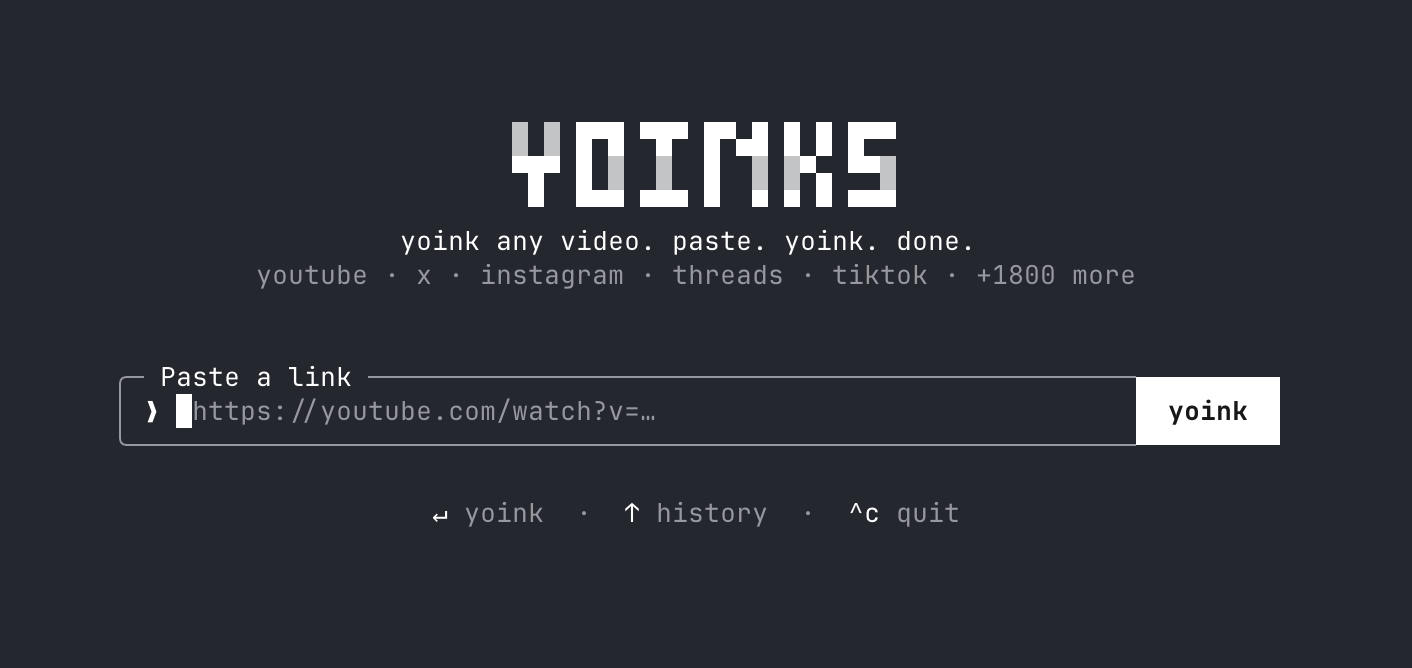
yoinks eliminates this workflow fragmentation. Built as a terminal-native application on Node.js, it bundles media stream probing, format resolution, and binary lifecycle orchestration behind a unified declarative TUI. Pointing the CLI at any target URL opens a full-screen, centered selection matrix that presents human-readable resolutions alongside estimated footprints, collapsing parameter generation into a single keystroke.
💡 Architectural Insight: Decouple the low-level media multiplexer into an isolated subprocess layer, collapsing multi-stage stream parameter negotiation into a declarative, single-interaction terminal state machine.
2. Architecture and Data Flow Pipeline
yoinks combines three decoupled tiers: an Ink-powered declarative UI, an orchestration controller, and an isolated runtime dependency resolver. State transitions remain strictly unidirectional throughout the extraction lifecycle.
+-------------------------------------------------------------------------+
|                        yoinks Client Execution                          |
+-------------------------------------------------------------------------+
                                     │ (url input / paste)
                                     ▼
+─────────────────────────────────────────────────────────────────────────+
|                     Runtime Environment Resolution                      |
|  - Check System PATH for yt-dlp -> Fallback: Auto-fetch to ~/.yoinks/bin|
|  - Check System PATH for ffmpeg -> Fallback: ffmpeg-static bundle      |
+─────────────────────────────────────────────────────────────────────────+
                                     │
                                     ▼
+─────────────────────────────────────────────────────────────────────────+
|                Stream Probe & Metadata Extraction Pipeline               |
|             Executes: yt-dlp --dump-json --no-playlist <url>            |
+─────────────────────────────────────────────────────────────────────────+
                                     │
                                     ▼ (Parse formats JSON array)
+─────────────────────────────────────────────────────────────────────────+
|                      Ink Declarative Terminal State                     |
|  - Auto-theme sensor (Matches host terminal palette or ^t toggle)       |
|  - Resolution & Estimated Size Mapping (1080p, 720p, Audio-only MP3)   |
|  - Mouse & Keyboard event routing (j/k, 1..9, Enter, Mouse Click)       |
+─────────────────────────────────────────────────────────────────────────+
                                     │
                                     ▼ (User Selection Dispatched)
+─────────────────────────────────────────────────────────────────────────+
|                    Downloader & Multiplexing Engine                     |
|  - Spawn yt-dlp process with dynamic format flags                        |
|  - Pipe A/V streams to ffmpeg multiplexer                               |
|  - Stream progress percentage to Ink progress component                 |
+─────────────────────────────────────────────────────────────────────────+
                                     │
                                     ▼
+─────────────────────────────────────────────────────────────────────────+
|           Finalization & Clean Terminal Buffer Restoration              |
|  - Flush artifact to ~/Downloads                                        |
|  - Exit alternate screen buffer (Restore user scrollback history)       |
+─────────────────────────────────────────────────────────────────────────+
Execution initiates with environment discovery. When the host shell lacks a native yt-dlp binary, yoinks retrieves an isolated, standalone build and writes it to ~/.yoinks/bin, bypassing OS-level Python package managers entirely. For media multiplexing, it probes PATH for ffmpeg, falling back automatically to a bundled ffmpeg-static distribution if absent.
Metadata extraction executes downstream via an asynchronous JSON probe against the platform manifest. The Ink component tree transforms raw format telemetry into formatted resolution slots with calculated storage bounds, syncing colors to the terminal profile through ANSI introspection. Once the operator selects a format, the runner spawns the download process, streams progress chunks back into Ink's reactive components, writes the finished file to ~/Downloads, and cleanly releases the alternate screen buffer without polluting terminal scrollback history.
3. Technical Specs and Comparative Benchmark
Evaluating yoinks requires positioning its structural trade-offs against conventional extractors and raw CLI tooling:
| Dimension | yoinks | Web-Based Scrapers | Raw yt-dlp CLI | Production Impact |
|---|---|---|---|---|
| Runtime Footprint | Node 18+ engine with self-managed binaries | Zero local client footprint; server-dependent | Requires Python runtime & configured PATH | Eliminates runtime conflicts and virtualenv overhead |
| Stream Selection | Interactive TUI with dynamic size estimation | Opaque, enforced lossy re-encoding | Manual -F inspection and format code math |
Reduces parameter formulation latency to under 3 seconds |
| Multiplexing Layer | Deterministic fallback via ffmpeg-static |
Remote server queue bottlenecks | Requires external system FFmpeg configuration | Removes container missing-codec exceptions |
| TTY Lifecycle | Alternate screen buffer with full restoration | Context switch to browser window | Direct standard stream logs over current terminal | Maintains scrollback integrity for clean shell workflows |
| Network Privacy | Direct machine-to-CDN encrypted pipeline | Intermediated by third-party proxies | Direct machine-to-CDN encrypted pipeline | Eliminates data exfiltration risks and token interception |
Selecting React Ink as the UI engine gives developers reactive layout primitives and declarative state management for terminal interfaces, superseding verbose imperative TUI libraries. While this introduces standard Node.js runtime initialization latency, the operational ergonomics deliver substantial workflow velocity improvements.
4. Hands-on Implementation: Building the Minimal Loop
Deployment requires no pre-configured virtual environments or system-level dependencies outside of Node.js.
Global and Ephemeral Execution
Global registry installation:
npm install -g yoinks
Ephemeral execution via NPX:
npx yoinks
Programmatic Automation Harness
This implementation demonstrates how to orchestrate the internal binary patterns established by yoinks inside a TypeScript automation pipeline:
import { execa } from "execa";
import { existsSync } from "node:fs";
import { homedir } from "node:os";
import { join } from "node:path";

// Target video link
const targetMediaUrl = "https://youtu.be/dQw4w9WgXcQ";

// Resolve local yoinks binary directory
const yoinksBinDir = join(homedir(), ".yoinks", "bin");
const fallbackYtDlp = join(yoinksBinDir, process.platform === "win32" ? "yt-dlp.exe" : "yt-dlp");

/**
 * Resolve binary location with yoinks fallback logic
 */
function resolveExtractorBinary(): string {
  // Prefer the standalone binary managed by yoinks
  if (existsSync(fallbackYtDlp)) {
    return fallbackYtDlp;
  }
  // Fall back to system-wide binary in PATH
  return "yt-dlp";
}

async function runHeadlessExtraction() {
  const bin = resolveExtractorBinary();
  console.log(`[Engine] Active binary path: ${bin}`);

  // Execute downstream download and merge video/audio streams
  const subprocess = execa(bin, [
    targetMediaUrl,
    "--format", "bestvideo[ext=mp4]+bestaudio[ext=m4a]/best[ext=mp4]/best",
    "--paths", join(homedir(), "Downloads"),
    "--output", "%(title)s.%(ext)s",
    "--newline", // Force line breaks for deterministic progress tracking
  ]);

  // Intercept standard output stream
  subprocess.stdout?.on("data", (chunk: Buffer) => {
    const logLine = chunk.toString().trim();
    if (logLine.includes("[download]")) {
      console.log(`[Stream Sync] ${logLine}`);
    }
  });

  await subprocess;
  console.log("[Engine] Asset materialized in ~/Downloads");
}

runHeadlessExtraction().catch((err) => {
  console.error("[Engine Failure] Subprocess encountered fatal error:", err.message);
  process.exit(1);
});
CLI Invocation and Layout Anatomy
Passing a direct link invokes the format matrix immediately:
yoinks https://youtu.be/dQw4w9WgXcQ
The tool initializes the alternate terminal buffer, rendering the interactive selector:
   __  __      _         _
  |  \/  | ___| | _____ | | __ ___
  | |\/| |/ _ \ |/ / _ \| |/ // _ \
  | |  | |  __/   < (_) |   <  (_) |
  |_|  |_|\___|_|\_\___/|_|\_\\___/

  Rick Astley - Never Gonna Give You Up (Official Music Video)
  ─────────────────────────────────────────────────────────────
  > 1080p  (60fps)  • ~42.5 MB  [MP4 / H.264]
    720p   (30fps)  • ~21.2 MB  [MP4 / H.264]
    480p   (30fps)  • ~11.0 MB  [MP4 / H.264]
    Audio  (Only)   • ~3.4 MB   [MP3 / 320kbps]
  ─────────────────────────────────────────────────────────────
  [↑/↓, j/k, 1-4] Navigate  [Enter] Select  [^t] Toggle Theme  [^c] Quit
Confirming the format streams the bytes, restores the prior shell state, and prints the resolved artifact path:
✓ Saved to ~/Downloads/Rick Astley - Never Gonna Give You Up.mp4
5. Production Realities and Gotchas
Deploying terminal download tooling in scriptable or enterprise contexts surfaces distinct operational vulnerabilities.
⚠️ Gotcha Warning [Platform Signature Drifts and Binary Desynchronization]:Platform providers alter web client payloads and obfuscation ciphers on a weekly cadence, precipitating sudden
403 Forbiddenresponses.yoinksvendors a standalone binary into~/.yoinks/bin. Without an automated self-update loop (yt-dlp -U), this cached binary inevitably decays. Production support must maintain this binary manually viacd ~/.yoinks/bin && ./yt-dlp -Uwhen encountering upstream signature rejection.⚠️ Gotcha Warning [Headless Execution Failure in CI/CD Environments]:The underlying Ink engine relies on an attached TTY device to initialize its raw-mode event multiplexer and mouse click listeners. Executing
yoinksinside non-interactive containers, detached background jobs, or CI pipelines producesstdin is not a TTYexceptions or hangs the runner indefinitely. Purely programmatic pipelines should execute direct subprocess wrappers rather than interactive TUI entrypoints.⚠️ Gotcha Warning [I/O Amplification During Concurrent Multiplexing]:High-resolution formats stream separate audio and video tracks into temporary chunks before FFmpeg executes the multiplexing pass. This architectural pattern demands at least twice the storage volume of the final artifact to stage intermediary
.mp4and.m4afiles. On constrained root partitions or transient ephemeral mounts, large downloads trigger total I/O depletion, aborting the merge step and leaving fragmented orphans on disk.