
1. The Core Bottleneck: What Architectural Flaw Does It Break?
The practical execution ceiling of LLM agents is fundamentally bounded by the granularity of the external tools they can invoke. Building a production-grade agent requires wiring up dozens of heterogeneous APIs—backlink intelligence, company enrichment, social trend monitoring, and media generation. These endpoints are locked behind commercial vendors such as Semrush, Moz, Crunchbase, and Apollo, each enforcing rigid monthly subscriptions ranging from ninety-nine to hundreds of dollars, or requiring opaque, invite-only onboarding processes.
This commercial friction prices individual developers and small engineering teams out of high-value capabilities. More critically, the engineering debt of credential sprawl introduces severe security vulnerabilities. Distributing multiple vendor API keys across engineering teams or storing them insecurely within agent execution contexts risks catastrophic credential leakage. Furthermore, when upstream APIs modify their schemas, brittle client-side integrations break immediately.
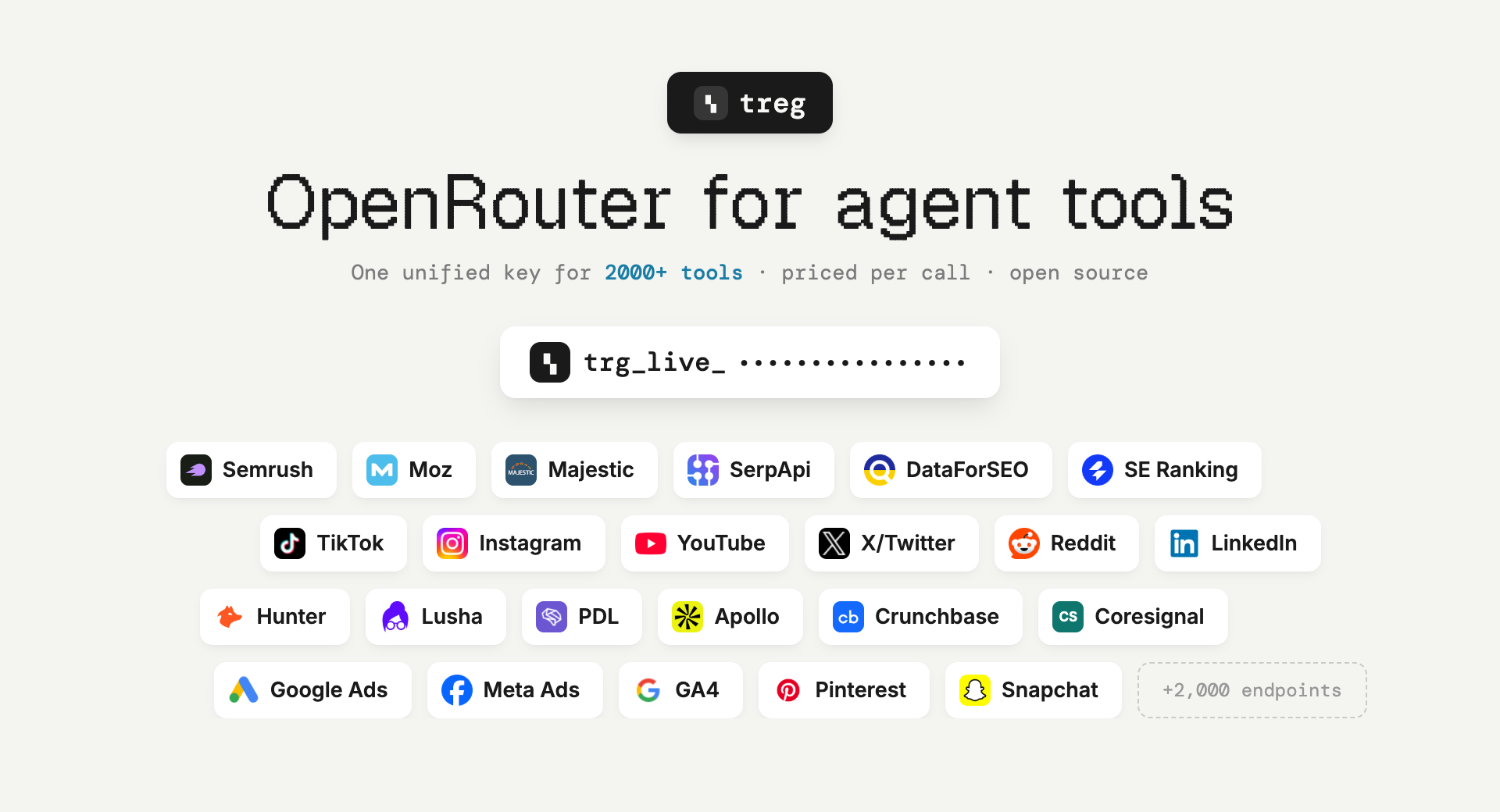
treg solves this by porting the OpenRouter architectural model directly to the agent tool layer. The entire system exposes a single base URL and a single token. A server-side gateway manages all vendor accounts, handles micro-billing per call, and injects authentication dynamically.
💡 Core Architectural Insight: By centralizing credential custody and upstream relaying into a server-side gateway, treg severs the direct contractual bond between callers and commercial vendors, allowing agents to consume premium private APIs as standard functions.
2. Core Architecture and Data Flow Breakdown
Sticking strictly to a pure relay philosophy, treg never attempts to wrap upstream APIs with secondary LLM layers or semantic abstractions. It operates as a high-speed, stateless proxy gateway comprising credential bindings, an endpoint catalog index, a local CLI runner, and an MCP protocol adaptation layer.
When an agent executes an external tool call, the request lifecycle follows a strict unidirectional pipeline topology:
[ Agent / Claude Code ] ---> [ treg CLI / SDK ] ---> [ treg Gateway Parser ]
                                                            │
                                                            ▼
[ Upstream Vendor API ] <--- [ Credential Injection Engine ] <-
upon receiving an invocation request, the gateway validates the caller token. For catalog endpoints, it deducts the micro-fee from the team's prepaid balance and injects the corresponding API secret or OAuth bearer token into the request headers right before dispatching. For tools registered directly by the team or developer, the system prioritizes the local custom key, bypassing metering entirely.
This design minimizes state synchronization overhead. Any upstream rate limits, schema updates, or deprecations are absorbed entirely at the gateway layer, keeping client-side agent prompt contexts isolated and stable.
3. Technology Selection and Hardcore Benchmarks
| Evaluation Metric | This Solution (treg) | Traditional Paradigm | Typical Competitor | Production Benefit |
|---|---|---|---|---|
| Credential Management | Server-side managed injection, zero leak risk | Client-side plain-text storage of multiple vendor keys | Shared team password manager, prone to abuse | Eliminates privilege escalation and key leakage |
| Billing Structure | Per-call micro-billing (fractions of a cent) | Fixed monthly SaaS subscriptions | Unused pre-funded balance wastage | Zero idle sink costs, elastic R&D budgeting |
| Integration Friction | Single Base URL and unified Token | Multiple SDKs and dozens of fragmented API docs | Manual onboarding per vendor with credit cards | Reduces feature delivery from weeks to minutes |
| Extensibility | Dynamic catalog search + custom CLI & SKILL.md | Hardcoded static API client integrations | Locked inside single-vendor walled gardens | Combines high-quality public assets with custom tools |
As shown in the comparative matrix, traditional architectures impose heavy engineering debt by forcing clients to maintain complex auth state machines. treg strips away this complexity, collapsing thousands of heterogeneous APIs into a standardized REST contract.
4. Minimal Production Bootstrap Guide
In a standard POSIX production environment, deploying and exercising treg requires only a few streamlined steps. Initialize the CLI and configure the registry target using the official install script.
# 1. Install the CLI and point it to the hosted registry
curl -fsSL https://treg.to/install.sh | sh

# 2. Authenticate your session (GitHub default, --email for one-time code, --token for CI/agents)
treg login

# 3. Search the catalog instantly for domain backlink endpoints without holding vendor accounts
treg catalog search "backlinks for a domain"

# 4. Execute a production API call directly; the gateway injects credentials and meters usage
treg call tikhub.tiktok.user.profile --query uniqueId=tiktok

# 5. Inspect exact micro-billing costs for the executed call
treg balance
To embed treg into automated workflows or Claude Code environments, load the corresponding plugin directly via the package registry:
/plugin marketplace add superdesigndev/treg
/plugin install treg@treg
Once installed, the agent dynamically discovers and invokes all registry-exposed tool assets without requiring manual glue code.
5. Production Gotchas and Failure Modes
Deploying treg into high-concurrency production environments requires vigilance regarding network jitter and local credential overriding rules.
⚠️ Gotcha Warning [Private Key Override Failures]: If a team member registers a custom tool bearing the exact same identifier as a public catalog endpoint, the system enforces local key priority. Always verify local credential health via
treg health. If the local key exhausts its quota or expires, requests will not gracefully fall back to the public pool and will instead trigger immediate upstream authentication rejections.⚠️ Gotcha Warning [Strict Query Validation]: Catalog endpoints marked with
strict_queryenforce rigid parameter validation rules. Any undeclared, duplicated, or malformed query parameters are intercepted by the gateway and rejected with a 400 error. When constructing automated agent scripts, strictly adhere to the schemas returned bytreg catalog get <id>, and avoid injecting arbitrary runtime payload fields.