
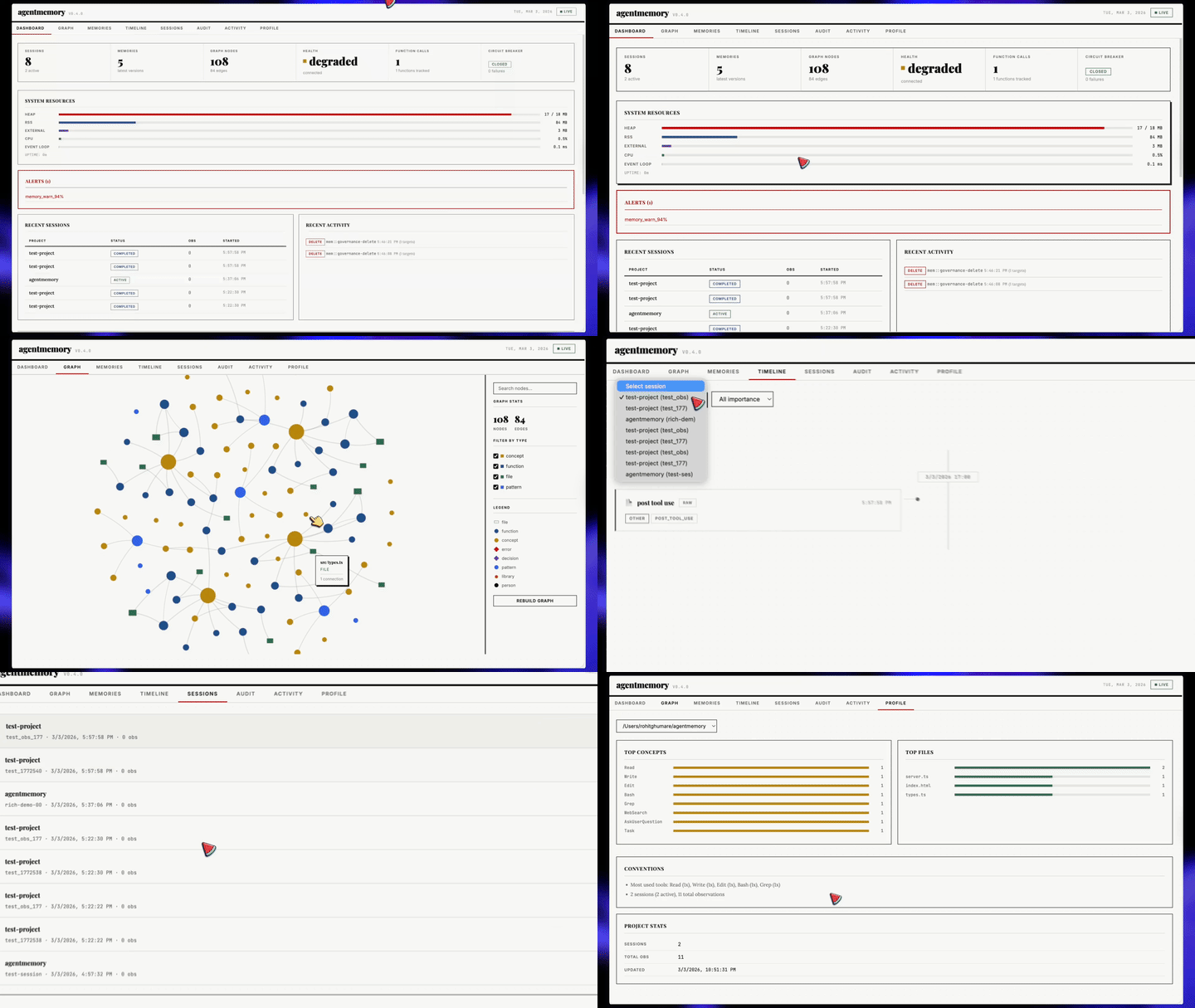
1. The Core Bottleneck: What Architectural Flaw Does It Break?
Engineers utilizing Claude Code, Cursor, or GitHub Copilot CLI for complex software development face a persistent operational tax. Every time a new terminal session initializes, the underlying LLM loses its entire history. Project architecture specifications, workarounds for legacy codebase debt, and the specific context of a bug fixed minutes prior vanish instantly. This continuous explanation loop burns through token allocations and stalls development velocity.
Previous community attempts relied on rudimentary Markdown file drops or naive vector database setups, lacking dynamic lifecycle management and structured knowledge graphs. rohitg00's agentmemory operationalizes Andrej Karpathy's LLM Wiki pattern into an execution-grade standard. By combining confidence scoring, knowledge graphs, and hybrid search strategies, it grants coding agents true persistent memory across sessions.
💡 Architectural Insight: agentmemory treats memory not as simple text retrieval, but as an autonomous memory distillation system complete with lifecycle states and knowledge graphs, preserving context integrity across isolated execution sessions.
2. Core Architecture & Underlying Data Flow
The runtime relies on the high-performance iii engine, utilizing a client-daemon decoupled topology. Four dedicated local ports coordinate protocol translation, state persistence, and real-time viewer rendering. The entire persistent state maps directly to local storage volumes, removing external database dependencies entirely.
[ MCP Client / Cursor ] ---> [ Gateway / Port 3111 ] ---> [ Memory Layer & iii Engine ]
                                        │
                                        ▼
                            [ Hybrid Search Router ]
                        (BM25 Lexical + Vector + Graph)
                                        │
                                        ▼
                            [ Local State Store / Disk ]
Agents interact with the local service through 54 Model Context Protocol (MCP) tools. When code observations occur, event hooks trigger automated LLM observation distillation if configured. Retrieval queries combine BM25 lexical matching with graph traversals, achieving high recall while compressing context volume by up to 92%. The pipeline transforms raw text streams into high-density structured knowledge nodes with minimal latency overhead.
3. Technology Selection & Hardcore Performance Benchmarks
| Evaluation Dimension | This Solution (agentmemory) | Plain Markdown Files | Traditional Vector DB (Pinecone/Milvus) | Production ROI |
|---|---|---|---|---|
| External Dependencies | Zero external DB, embeds iii engine | None, pure text files | Requires standalone cloud/local DB | Simplified deployment, zero DB ops overhead |
| Retrieval Accuracy | 95.2% (R@5 Hybrid Search) | Manual search, unverified | ~75%-85% (Semantic only) | Precision recall of past decisions, zero hallucination |
| Token Consumption | 92% fewer tokens vs raw prompts | Unquantified, context bloat | Varies by chunk size payload | Drastically reduced API billing costs |
| Tool Ecosystem | Native support for 54 MCP tools | No dynamic tooling | Requires custom wrapper glue code | Out-of-the-box integration with major coding assistants |
The architectural choices eliminate operational friction. By embedding the iii engine and discarding heavy external databases, the project reduces a distributed memory stack into a single-machine binary runtime. The hybrid search strategy mitigates the exact-match failures inherent in pure vector approaches.
4. Hands-on Engineering: Building a Minimal Closed-Loop
Ensure Node.js 20 or newer, npm, and npx are available in the local environment.
Execute the canonical installation command to initialize the interactive setup wizard:
npx -y @agentmemory/agentmemory@latest
The initial run prompts for agent selection (Claude Code, Cursor, etc.) and LLM provider configuration. This seeds the config, starts the memory server, and binds the iii engine. Execute the following commands to seed sample state and attach memory skills:
# Seed sample sessions and verify recall mechanics
npx -y @agentmemory/agentmemory@latest demo

# Add native skills so agents recognize memory boundaries
nskills add rohitg00/agentmemory -y
In keyless mode, vector embeddings are disabled, falling back to BM25. To enable free on-device semantic recall, set EMBEDDING_PROVIDER=local in ~/.agentmemory/.env and restart. The runtime automatically downloads Xenova/all-MiniLM-L6-v2 on first request, running subsequent inference locally.
5. Production Gotchas & Failure Mitigation
Deploying agentmemory in production requires navigating specific process and storage constraints.
⚠️ Gotcha Warning 1 (Data Directory Contention): The iii engine stores persistent state in user application directories by default. When running multiple concurrent terminal agents, failing to explicitly override paths via
--data-dir <path>orAGENTMEMORY_DATA_DIRresults in lock contention and potential store corruption.⚠️ Gotcha Warning 2 (Keyless Functional Limits): Keyless execution disables vector embeddings, neutralizing structural graph matches in
memory_smart_search. To achieve the advertised 95.2% recall rate, configure a local embedding provider or API key, and ensureAGENTMEMORY_AUTO_COMPRESS=trueis set.