
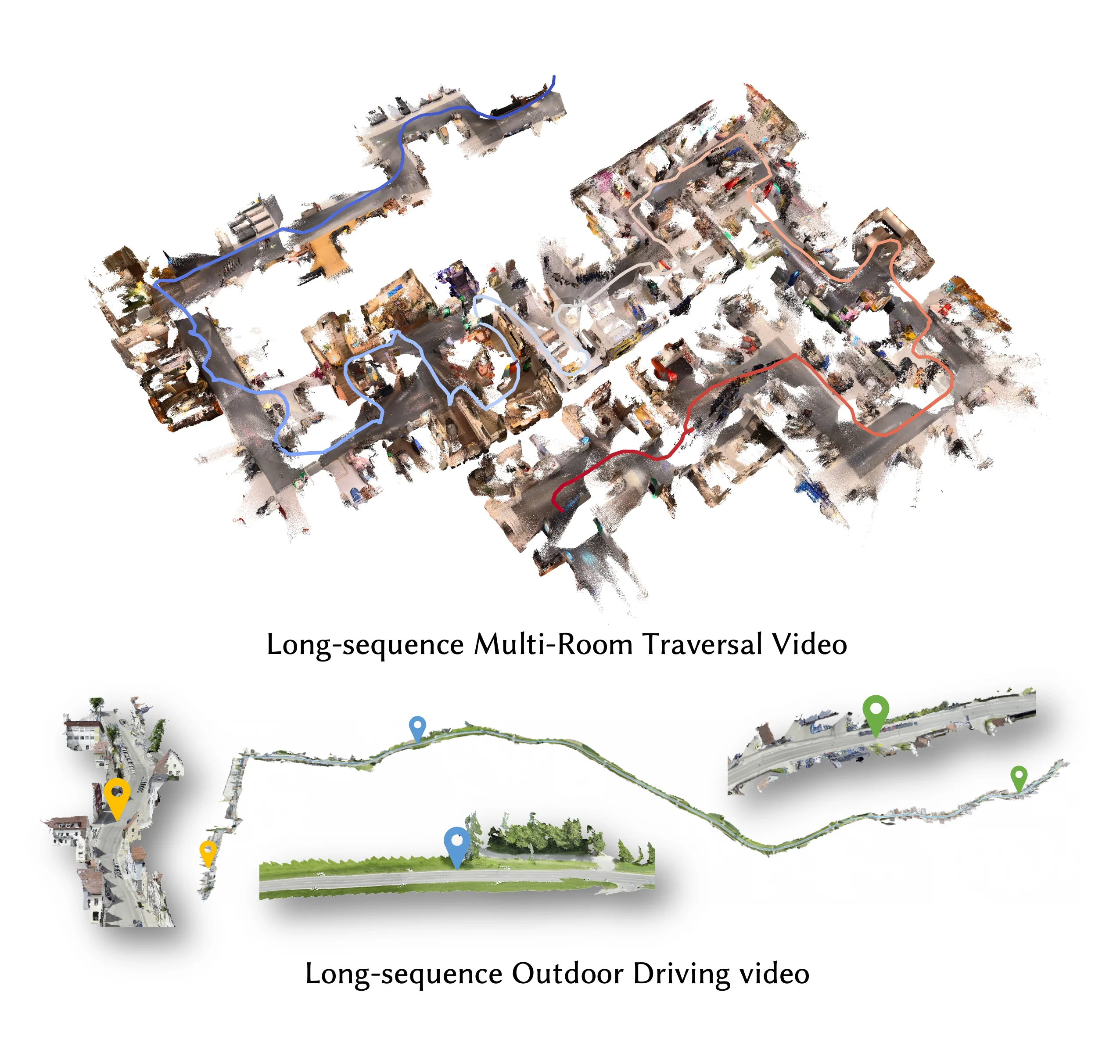
1. The Core Bottleneck: What Engineering Flaws Does It Shatter?
Traditional 3D reconstruction pipelines rely heavily on iterative optimization-based Structure from Motion (SfM) algorithms. When processing video inputs exceeding a thousand frames, computational complexity and memory footprint explode exponentially, rendering real-time indoor-outdoor mapping virtually impossible in production. Robbyant's LingBot-Map bypasses traditional offline optimization paradigms entirely, adopting a feed-forward 3D foundation model to break through streaming reconstruction bottlenecks.
💡 Architectural Insight: LingBot-Map unifies coordinate grounding, dense geometric cues, and long-range drift correction within a single streaming framework, eliminating dependency on global bundle adjustment.
2. Core Architecture and Low-Level Data Flow Analysis
The core of LingBot-Map is the Geometric Context Transformer (GCT). Three interlocking components operate in sync: anchor context, pose-reference window, and trajectory memory. Incoming video frames pass through a parsing layer managed by FlashInfer's Paged KV Cache, preventing memory fragmentation and overflows during long sequences.
[ Video Stream ] ---> [ Frame Parser & Masking ] ---> [ Paged KV Cache Engine ]
                                                            │
                                                            ▼
[ 3D Viser Client ] <--- [ Rendering Pipeline ] <--- [ Geometric Context Transformer ]
During execution, the system dynamically crops attention spans via the Pose-Reference Window instead of caching full historical attention weights, while Trajectory Memory compresses and preserves global geometric constraints. This maintains ~20 FPS inference speeds while preventing spatial drift over walking paths exceeding 10,000 frames.
3. Technical Selection and Hardcore Benchmarking
| Dimension | This Solution (lingbot-map) | Traditional SfM (COLMAP) | Lightweight Competitors | Production Benefit |
|---|---|---|---|---|
| Throughput | ~20 FPS (518×378) | Minutes/frame (Offline) | ~10 FPS | Real-time interactive robotic mapping |
| Memory Footprint | Paged KV Cache (Linear) | Quadratic growth on frames | Full caching causes OOM | Eliminates long-video memory crashes |
| Drift Control | Trajectory Memory & Anchors | Global Bundle Adjustment | High accumulated error | Stable sequences over 10,000+ frames |
| Deployment | Single Conda/Pip package | Complex C++ toolchains | Platform-dependent | Reduced integration and maintenance overhead |
Benchmarking data reveals that LingBot-Map cuts out offline iterative overhead, delivering a paradigm shift for streaming and industrial real-time applications. The FlashInfer backend brings memory usage down to production thresholds.
4. Hands-on Geek Guide: Building the Minimal Loop
Ensure CUDA 12.8 drivers are installed before setting up the environment. Execute the following commands to replicate the official environment:
# Create and activate a dedicated Python 3.10 virtual environment
conda create -n lingbot-map python=3.10 -y
conda activate lingbot-map

# Install PyTorch 2.8.0 locked to CUDA 12.8
pip install torch==2.8.0 torchvision==0.23.0 --index-url https://download.pytorch.org/whl/cu128

# Install lingbot-map in editable mode locally
pip install -e .

# Install FlashInfer for paged KV cache streaming acceleration
pip install --index-url https://pypi.org/simple flashinfer-python
Download the model checkpoints and launch the Viser-based interactive browser visualization via demo.py:
# Launch interactive demo with sky masking enabled to filter background noise
python demo.py \
    --model_path /path/to/lingbot-map.pt \
    --image_folder example/courthouse \
    --mask_sky
Access http://localhost:8080 in your browser to inspect the real-time 3D reconstruction mesh growth.
5. Production Gotchas and Troubleshooting
Engineering teams often encounter subtle configuration traps when processing long videos or custom datasets.
⚠️ Gotcha 1: PyTorch and Kaolin Version Locking: Official documentation notes that PyTorch 2.8.0 is a hard requirement for the batch rendering pipeline due to prebuilt NVIDIA Kaolin wheels. Upgrading PyTorch blindly forces source compilation of Kaolin, often breaking due to GCC mismatches.
⚠️ Gotcha 2: FlashInfer KV Cache Silent Failure: When running long sequences with
--keyframe_interval > 1, ensure you pull the latest repository updates to verify FlashInfer cache index logic. Older revisions contained a bug that silently cached non-keyframes, degrading pose quality after 320 frames.