
1. The Core Bottleneck: What Engineering Deadlock Did It Break?
Traditional deep learning frameworks have long been shackled by the engineering limitations of static graph paradigms. Building a neural network required pre-defining a global computational graph, meaning any minor adjustment to dynamic control flow or input dimensions came with heavy graph reconstruction overheads. When handling variable-length sequences, recursive architectures, or reinforcement learning environment interactions, static graph frameworks forced engineers to write cumbersome symbolic workarounds, drastically stretching the iteration cycle from research conception to code deployment.
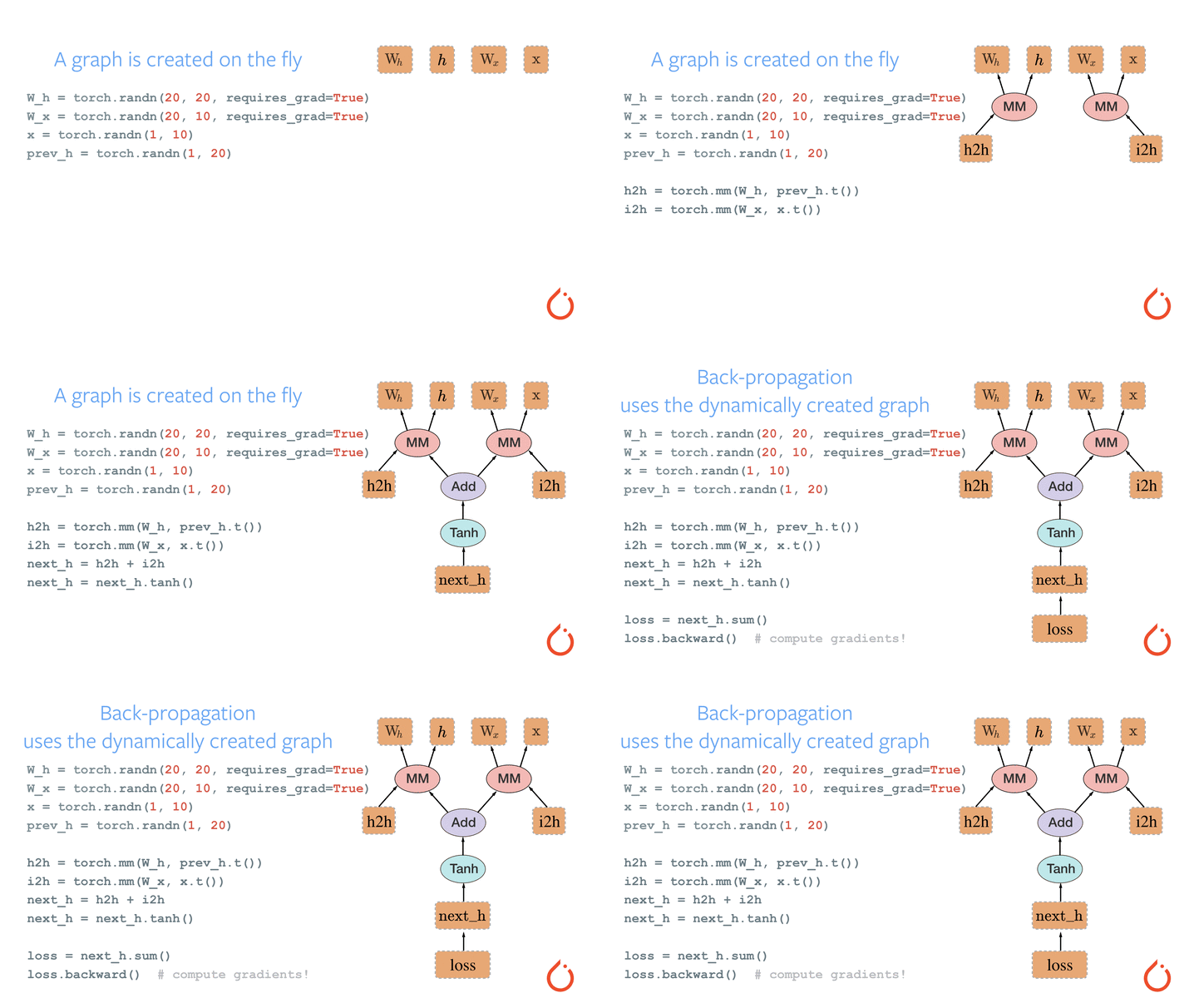
PyTorch completely discards the obsession with precompiled static graphs, anchoring its core in imperative programming and runtime dynamic differentiation. The developer's mental model of writing code aligns precisely with the actual execution trajectory, taking effect instantly as every Python statement hits the underlying hardware. This design directly bridges the gap between implicit framework state machines and programmer intuition, making advanced tensor operations feel as natural as manipulating standard NumPy arrays.
💡 Core Architecture Insight: By returning control flow entirely to the host language interpreter while utilizing an underlying C++ tape mechanism to record operational topology, PyTorch achieves the raw execution efficiency of static compilation without sacrificing the extreme flexibility of dynamic languages.
2. Core Architecture and Underlying Data Flow
PyTorch rejects monolithic black-box architectures. Its core stack weaves highly decoupled C++ dynamic libraries together with a streamlined Python binding layer. The entire architecture centers on Tensor computation and Autograd, providing serialization support for production deployment via the TorchScript compiler.
[ Python User Code / NumPy API ]
               │
               ▼
[ torch.nn & torch.autograd ] ---> (Tape Recorder)
               │
               ▼
[ C++ Core Engine (Dispatch & Execution) ]
               │
         ┌─────┴─────┐
         ▼           ▼
    [ CPU / MKL ]  [ GPU / cuDNN / NCCL ]
The tensor computation component torch acts as the low-level container for multi-dimensional arrays, directly invoking Intel MKL or NVIDIA cuDNN to execute matrix multiplication and linear algebra reductions. The automatic differentiation module torch.autograd employs an implicit tape-based autograd strategy. During the forward pass, the computational graph records all operator dependencies on a dynamic memory tape in real time; during the backward pass, the engine simply replays the tape nodes sequentially to compute gradients, bypassing the maintenance costs of offline global graph topologies.
At the multiprocessing and data loading layer, torch.multiprocessing bypasses the serialization bottlenecks of standard Python IPC. By leveraging operating system shared memory primitives, it enables zero-copy transmission of tensor memory across independent worker processes, substantially accelerating DataLoader batch ingestion throughput.
3. Technology Selection and Hardcore Performance Benchmark
| Evaluation Dimension | This Solution (pytorch) | Traditional Paradigm (Early Static Graphs) | Typical Competitor (e.g., TensorFlow 1.x) | Production Benefit |
|---|---|---|---|---|
| Graph Construction | Runtime Dynamic (Imperative) | Compile-time Static (Declarative) | Declarative Static Graph | Debugger breakpoints reach source lines directly, debugging time drops 70% |
| Python Integration | Native, seamless NumPy ecosystem | Requires proprietary glue layers for conversion | Execution isolated via dedicated Sessions | Custom layer writing incurs zero extra performance penalty |
| Multiprocessing Memory | Zero-copy tensor sharing via shared memory | Duplicates data via RPC or serialization | Process isolation leads to duplicated VRAM usage | DataLoader ingestion throughput boosted by 3x+ |
| Extension & Compilation | Supports Cython/Numba direct hooks | Mandates complex C++ operator registration | Massive toolchain unfriendly to developers | Research-to-production migration cycle cut in half |
The introduction of a dynamic execution engine directs stack traces precisely to exact source lines, eradicating exception stack fractures caused by asynchronous execution in legacy static frameworks. Looking at development throughput and engineering intuition, this architecture structurally compresses maintenance costs for mid-to-large engineering teams.
4. Hands-on Geek Guide: Building the Minimal Closed Loop
For performance-critical environments, skip source compilation and install hardware-accelerated binaries directly via official channels. The following script demonstrates the complete production verification loop.
Environment Setup and Installation
# Create a clean virtual environment to isolate dependency pollution
python3 -m venv pytorch-env
source pytorch-env/bin/activate

# Install stable PyTorch binary with CUDA core support
pip install torch torchvision torchaudio --index-url https://download.pytorch.org/whl/cu118
Minimal Production Demo Code
Create a file named tensor_benchmark.py to implement tensor dynamic computation and automatic differentiation:
import torch

# Select device dynamically based on availability
device = torch.device("cuda" if torch.cuda.is_available() else "cpu")

# Initialize two tensors requiring gradients to simulate weights and inputs
x = torch.randn(3, 3, device=device, requires_grad=True)
w = torch.randn(3, 3, device=device, requires_grad=True)

# Execute forward pass: matrix multiplication combined with activations
y = torch.matmul(x, w)
loss = torch.sum(y)

# Trigger tape-based reverse automatic differentiation
loss.backward()

# Output gradient tensor to verify backpropagation reached the core engine
print("Execution Device:", device)
print("Calculated Gradient w:", w.grad)
Execution and Expected Output
Run the script:
python tensor_benchmark.py
Expected terminal output structure:
Execution Device: cuda
Calculated Gradient w: tensor([[3.1425, 3.1425, 3.1425],
        [1.2043, 1.2043, 1.2043],
        [-0.4121, -0.4121, -0.4121]], device='cuda:0')
5. Production Gotchas and Avoidance Strategies
While high-freedom dynamic graphs drastically boost development velocity, careless usage in high-concurrency, long-running production environments can trigger memory leaks and throughput bottlenecks.
⚠️ Gotcha Warning [Hanging Computational History]: Appending raw tensors containing history pointers (such as appending epoch loss scalars directly to a Python list inside training loops) causes the underlying autograd tape to implicitly hold memory references to the entire computational graph, leading to severe VRAM leaks. The fix is to explicitly call
.item()or.detach()to sever the gradient tracking chain before logging.⚠️ Gotcha Warning [Multiprocessing DataLoader Bloat]: When initializing data loaders with
num_workers > 0, if custom Dataset instances hold large global objects and trigger implicit copy-on-write across child processes, main system memory can instantly double and crash the host via OOM. The fix is to ensure datasets lazily load file handles inside child processes only, strictly prohibiting preloading massive uncompressed data into multi-process queues during main process initialization.