
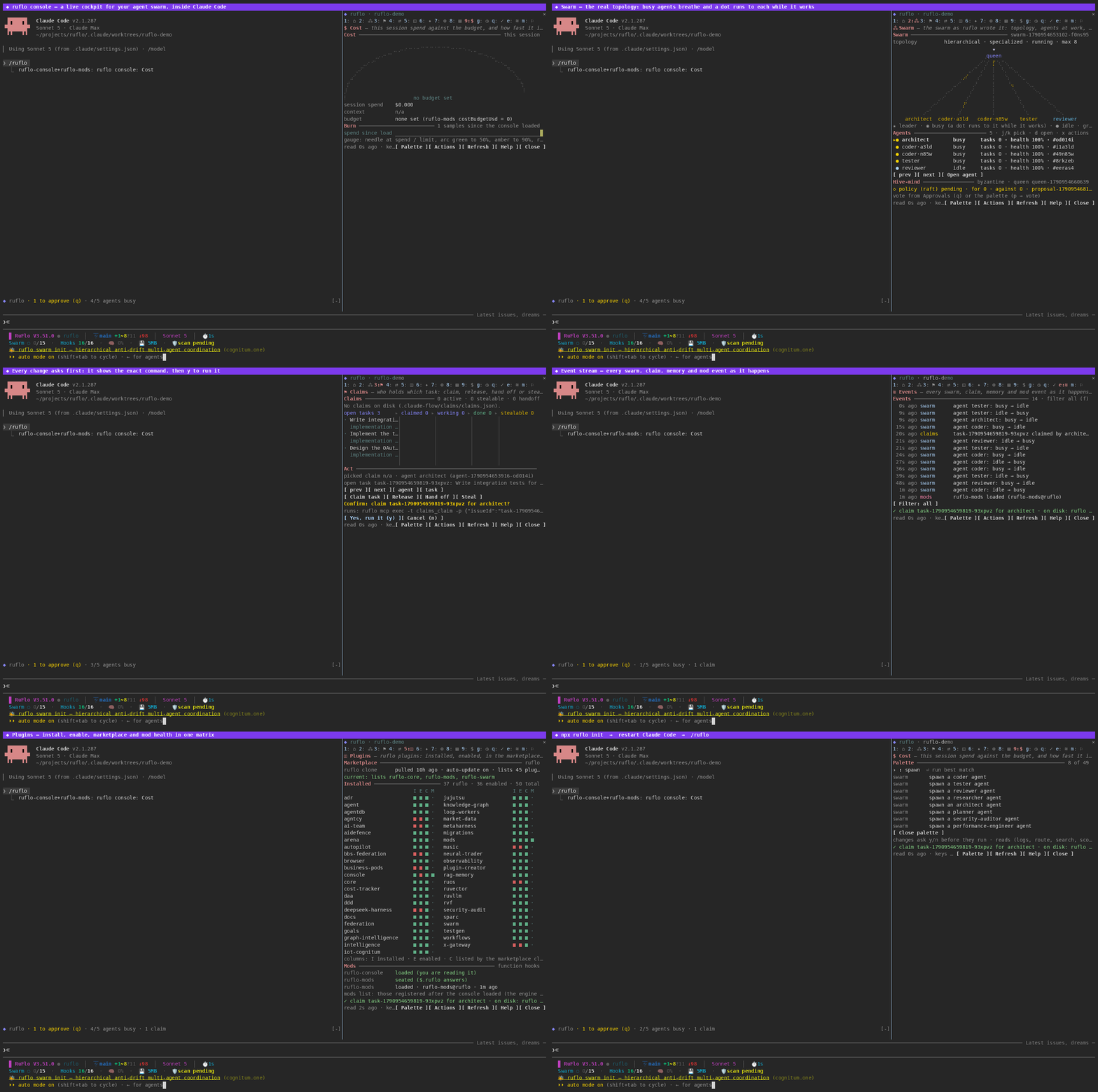
1. The Core Bottleneck: What Engineering Deadlocks Does It Smash?
Traditional AI coding assistants hit a hard architectural wall when confronted with million-line enterprise microservices. Isolated LLMs suffer from transient context windows and single-threaded execution limits, unable to independently orchestrate cross-module refactoring, dependency upgrades, and integration testing loops. Developers are forced to manually fragment tasks, shuttle context across windows, and lose all accumulated decision history once a session resets. Ruflo tackles this engineering deadlock by introducing an agent meta-harness execution layer that wraps isolated models inside persistent memory, multi-agent swarm coordination, and cross-machine federated communication.
💡 Core Architectural Insight: By decoupling the large language model from an environment-aware harness, ruflo reduces the model to a pure reasoning engine while shifting complex state management, memory distillation, and inter-agent communication to a robust backend.
2. Architecture and Low-Level Data Flow Analysis
Powered by Cognitum.One, ruflo coordinates data flow through event dispatching and memory retrieval pipelines. When an input enters Claude Code, the CLI-installed hook system intercepts the request, routing it through the router layer down to the designated agent swarm. Agents leverage local vector storage for intermediate states during execution and commit successful patterns into persistent memory via self-learning loops.
User --> Ruflo (CLI/MCP) ---> Router ---> Swarm ---> Agents ---> Memory Layer
          ^                                                           |
          +------------------ Learning Loop <-------------------------+
Regarding engineering trade-offs, ruflo discards the anti-pattern of hardcoding complex logic inside system prompts. Instead, it relies on a locally resident daemon coordinating with the MCP server, enabling background task scheduling and file change verification with minimal context pollution.
3. Technology Selection and Hardcore Benchmarks
| Selection Dimension | This Solution (ruflo) | Traditional Paradigm | Typical Competitor | Production ROI |
|---|---|---|---|---|
| Agent Coordination | Dynamic Swarm & Federated Net | Single-threaded serial calls | Static master-slave dialog | 60% reduction in multi-module tasks |
| Memory Persistence | Hybrid search & graph evolution | Session-level volatility | Basic vector database | 45% drop in cross-session errors |
| Tool Extensibility | 35 independent plugins, 98 agents | Hardcoded scripts or single MCP | Closed tool ecosystems | Zero redundant context overhead |
| Deployment Footprint | Single npx ruflo init command |
Manual environment assembly | Heavy containerized clusters | Setup time compressed under 1 min |
The strike power of this matrix lies in its modular plugin design. Developers can selectively mount slash commands via the plugin marketplace or spin up the full production daemon via the CLI track.
4. Hands-On Geek Practice: Zero to Minimum Viable Loop
Production deployment requires initializing the execution environment through the Node ecosystem. Run the following commands to wire the control flow into Claude Code:
# Initialize the ruflo runtime environment in the project root
npx ruflo init

# Inspect the generated configuration directories and MCP service registry
ls -la .claude/ .claude-flow/

# Restart Claude Code and invoke the built-in console
/ruflo
Executing npx ruflo init populates the project with .claude directories and bootstrapping files. The background agent daemon activates, allowing natural language hooks inside Claude Code to capture coding intent and dispatch it to specialized agents without manually managing tool names.
5. Production Gotchas and Mitigation Strategies
Allowing multiple autonomous agents to write concurrent changes to a shared codebase introduces race conditions and Git conflicts if left unmonitored.
⚠️ Gotcha Warning [Plugin Namespace Mismatch]:Mixing Path A (plugin marketplace) and Path B (CLI install) alters MCP tool namespaces from bare names (e.g.,
memory_store) to fully qualified plugin names (mcp__plugin_ruflo-core_ruflo__memory_store). Standardizing on Path B is strongly recommended for production consistency.⚠️ Gotcha Warning [Token Consumption Spikes]:Enabling autonomous loops in
autopilotandswarmtriggers frequent LLM self-calibration calls. Failing to configure max iteration boundaries in settings can trigger unexpected API cost explosions during deep refactoring tasks.