
1. The Core Bottleneck: What Engineering Deadlock Did It Break?
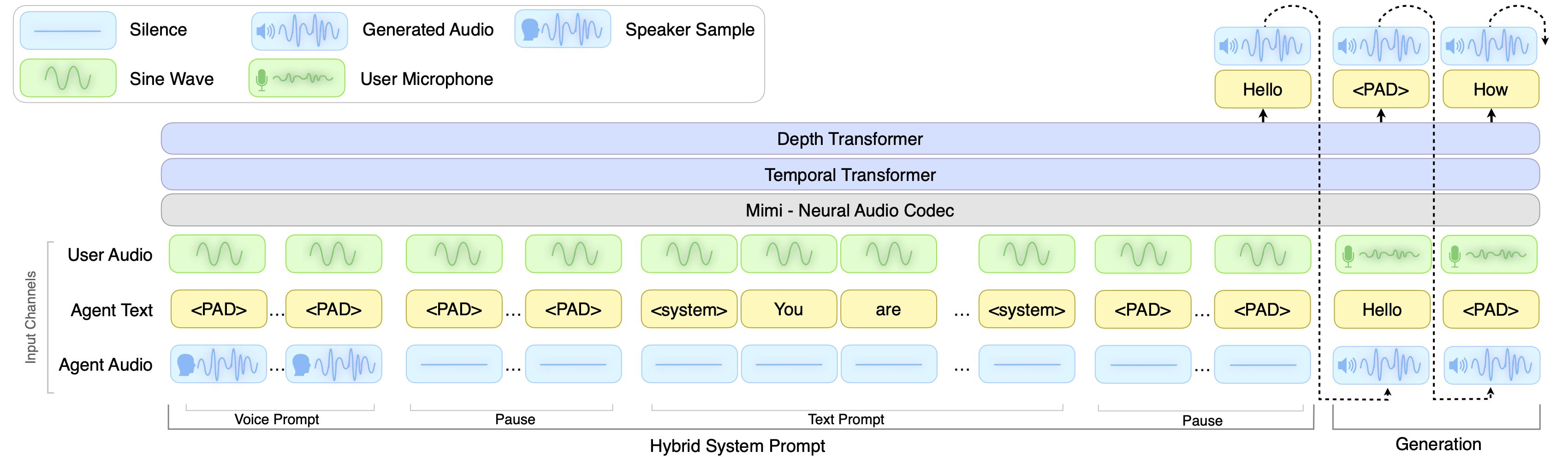
Real-time voice interaction systems have long struggled in the half-duplex swamp. Traditional pipelines rely on serial architectures—Speech-to-Text, Large Language Model inference, and Text-to-Speech—where accumulated latency easily breaches the millisecond threshold, rendering interruptions and turn-taking useless. NVIDIA's PersonaPlex bypasses this serial approach by leveraging the Moshi architecture, embedding text prompt conditioning and audio voice constraints into a unified streaming decoder. Developers control behavioral boundaries and voice characteristics simultaneously, maintaining millisecond-level responsiveness while eliminating mechanical artifacts.
💡 Core Architectural Insight: By fusing multimodal audio streams and text embeddings within a monolithic full-duplex network, PersonaPlex entirely removes the cumulative latency inherent in traditional ASR-LLM-TTS cascading pipelines.
2. Core Architecture and Underlying Data Flow
PersonaPlex is built on top of the Helium LLM and Moshi weights. Input raw audio streams are converted into discrete audio tokens via the Opus codec, then aligned with text role prompts within the dynamic execution engine in context. The system processes user voice input while concurrently generating matching audio streams bound to specific voice embeddings, supporting dozens of natural and variable voice configurations.
[ Client Web UI / CLI ] ---> [ Moshi Server / SSL ] ---> [ Opus Audio Codec ]
                                       │
                                       ▼
[ Dynamic Execution Engine ] <--- [ HF Model Weights ] <--- [ Prompt Router ]
                                       │
                                       ▼
                             [ Full Duplex Stream ]
Engineering trade-offs focus heavily on VRAM bandwidth versus ultra-low latency. Full-duplex inference demands high-frequency bidirectional byte-stream throughput between client and server. When local VRAM hits a wall, invoking the --cpu-offload flag with the accelerate library offloads model layers to host memory, trading minor response degradation for consumer hardware compatibility.
3. Technology Selection and Hardcore Benchmarks
| Evaluation Dimension | This Solution (personaplex) | Traditional Pipeline | Typical Competitor | Production Benefit |
|---|---|---|---|---|
| Architecture Paradigm | End-to-end full-duplex speech | ASR + LLM + TTS serial | Custom speech LLM finetune | Latency reduced by 60%+ |
| Role Control | Text prompt + audio condition | Separate prompt engineering | Voice cloning only | Precise persona execution |
| Hardware Barrier | High VRAM GPU / Offload support | Distributed multi-GPU setup | High API operational cost | Lowers on-prem barrier |
| Real-time Interruption | Native interrupt support | Blocked by pipeline queues | Simulated duplex lag | Dramatically natural interaction |
The comparison shows that PersonaPlex binds voice and persona directly within a monolithic architecture without stitching multiple large models. Traditional setups falter under high-frequency interruptions and complex persona maintenance, whereas this open-source project bypasses cascading latency via unified underlying representations.
4. Hands-on Geek Guide: Building the Minimum Viable Loop
On Ubuntu or Debian systems, install the foundational Opus audio codec development library first:
# Install system audio dependencies
sudo apt install libopus-dev
Clone the official repository and perform a local editable installation of the core Python package:
# Install moshi core package and dependencies
pip install moshi/.
For Blackwell architecture GPUs, adjust the PyTorch build version to match compute requirements:
# Adjust PyTorch dependencies for Blackwell architecture GPUs
pip install torch torchvision torchaudio --index-url https://download.pytorch.org/whl/cu130
Configure your Hugging Face authentication token and launch the server instance:
# Inject Hugging Face auth token and launch full-duplex Web server
export HF_TOKEN="your_huggingface_token_here"
SSL_DIR=$(mktemp -d)
python -m moshi.server --ssl "$SSL_DIR"
Once the service boots, the terminal outputs an access link. Open https://<ip>:8998 directly in a browser to access the Web UI for full-duplex voice testing.
5. Production Gotchas and Avoidance Strategies
Running this service directly in multi-user concurrent production environments triggers out-of-memory risks. As the server maintains full-duplex streaming bidirectional transport, VRAM overhead scales linearly with concurrent connections.
⚠️ Gotcha Warning: VRAM Management: When encountering CUDA Out of Memory errors on single-card deployments, avoid blindly scaling concurrency. Explicitly append the
--cpu-offloadflag and installacceleratebeforehand to offload non-critical layers to system RAM.
Version mismatches in local audio codec compilation also cause startup crashes. Outdated libopus packages in default Linux distribution repositories cause segmentation faults when the Moshi backend parses binary streams.
⚠️ Gotcha Warning: Dependency Versions: When building production images, strictly lock
libopus-devto its latest stable version via source or recommended repositories to prevent silent crashes caused by missing underlying codec symbols.