
1. The Core Bottleneck: What Engineering Dead Ends Does It Break?
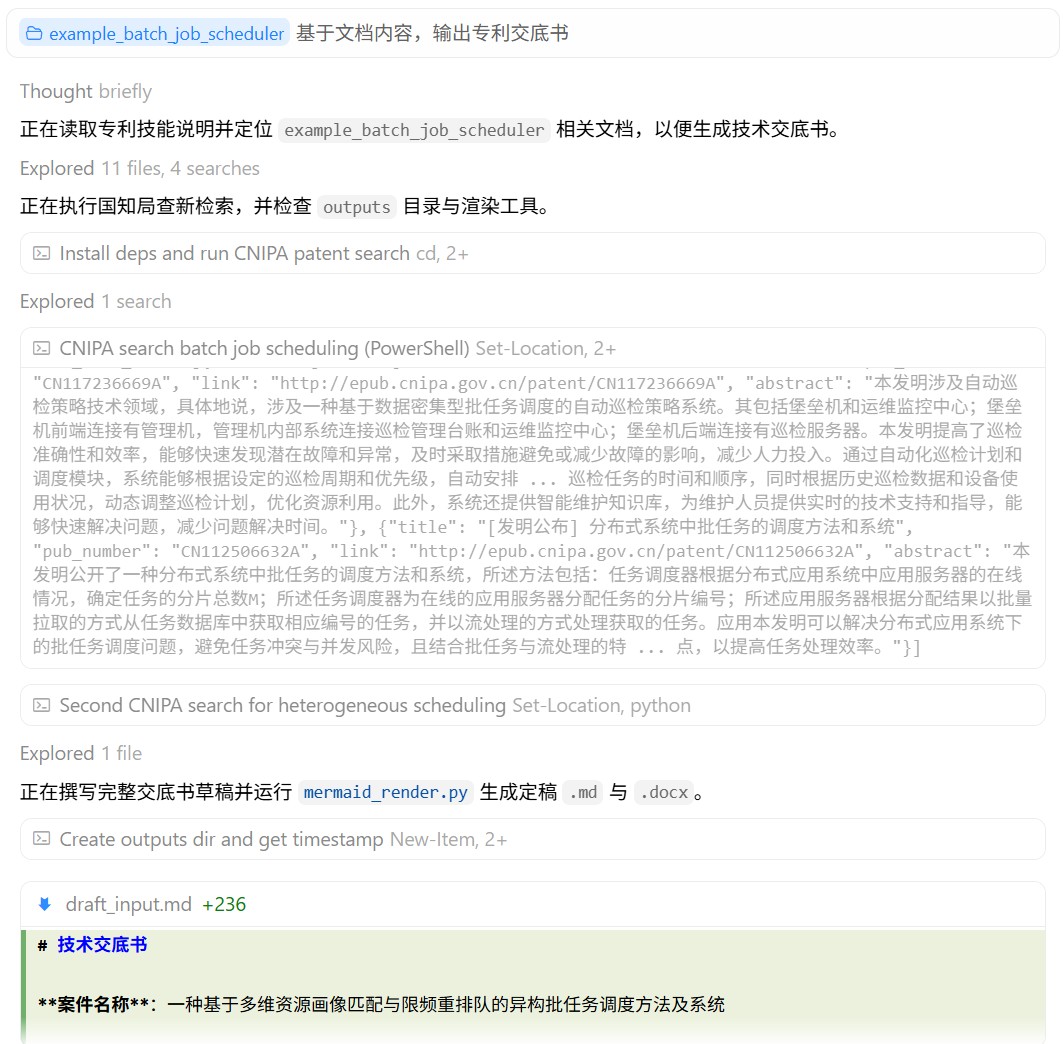
For years, core R&D engineers have been stuck in an awkward position. They write the architecture and code, but when it comes to patent filing, the drafting process is monopolized by patent attorneys and legal teams. Engineers are unfamiliar with legal jargon, while attorneys struggle to comprehend low-level code logic and engineering trade-offs, leading to superficial disclosures that fail to protect true technical barriers. The patent-disclosure-skill repository shatters this divide. Rather than acting as a superficial wrapper, it provides a fully codified, agentic workflow for patent engineering. The project intercepts the gap between code and patent documents, utilizing structured parsers to extract technical features, perform prior art searches, handle desensitization, and manage multi-version iterations, allowing the actual builders to drive intellectual property asset creation.
💡 Core Architectural Insight: By compiling a patent attorney's expertise into multi-agent workflows, the project achieves seamless translation from technical implementations to legal documents, eliminating information loss between R&D and IP protection.
2. Core Architecture and Data Flow Analysis
The foundation of this open-source project lies in its modular skill orchestration. The system organizes tasks through a Modular Skills architecture where each skill corresponds to a specific phase of the patent lifecycle. When developers input raw code, architecture diagrams, or product designs, the patent-disclosure skill steps in first to extract technical features and compare them against prior art. Data then flows through context routers to patent-application for generating structured claims and descriptions, or routes to patent-reader to translate complex published patents into readable notes synced directly into an Obsidian knowledge base.
[ Raw Code / Design Docs ] ---> [ patent-disclosure / Parser ] ---> [ Feature Extraction ]
                                                                          │
                                                                          ▼
[ Obsidian Knowledge Graph ] <--- [ patent-map / Semantic Index ] <--- [ patent-application ]
Within the underlying state machine transitions, the system incorporates timestamp-based versioning and multi-turn dialogue traceability. Every generated disclosure or application file lands in the outputs directory alongside mermaid structure diagrams or CAD projection drawings. This design ensures traceability across document revisions, preventing context forgetting or critical parameter drift during long-form iterations with large language models.
3. Technology Selection and Hardcore Benchmarking
| Evaluation Dimension | This Solution (patent-disclosure-skill) | Traditional Manual Drafting | Generic LLM Chatbots | Commercial Patent Search Suites |
|---|---|---|---|---|
| Drafting Velocity | Automated extraction, initial draft in hours | Weeks of work, heavy cross-department friction | Fragmented output, lacks patent structures | Search-only, zero disclosure generation |
| Diagram Support | Auto-generates utility/design outlines & CAD | Relies on external mechanical drafters | Incapable of structured engineering projections | Displays static PDF patent figures only |
| Knowledge Retention | Native Obsidian integration for private graphs | Scattered across local disks and cloud drives | Isolated sessions, zero persistent assets | Hosted on third-party clouds with privacy risks |
| Compliance Loop | Built-in examination policy briefings & OA aids | High dependency on costly human attorneys | Lacks CNIPA examination standard calibration | Provides static statutory code queries only |
| Deployment Footprint | Modular local Skill deployment, data sovereign | Manual service, zero code automation | Cloud SaaS constrained by provider quotas | Enterprise systems with exorbitant annual fees |
These comparisons highlight how traditional methods suffer from high labor costs and information silos, while generic LLMs lack structural constraints in the patent domain. By tightly binding knowledge bases, graphic processors, and agent workflows, this project achieves industrial-grade output of professional patent documents while maintaining local control.
4. Hands-On Geek Practice: Building a Minimal Closed Loop from Scratch
To rapidly spin up the skill system in a local environment, clone the official repository and configure the corresponding agent runtime. The following steps demonstrate disclosure generation and Obsidian vault mounting.
# 1. Clone the official patent skill repository to the local working directory
git clone https://github.com/handsomestWei/patent-disclosure-skill.git

# 2. Enter the project root directory to inspect sub-skill structures
cd patent-disclosure-skill

# 3. Initialize the Obsidian knowledge base association path (Linux / macOS)
export PATENT_VAULT_PATH="$HOME/Documents/PatentVault"
mkdir -p "$PATENT_VAULT_PATH/outputs"

# 4. Invoke the core skill to generate the initial patent disclosure
# Pass target code and design doc paths to trigger the patent-disclosure agent
python3 -m patent_skill.runner \
    --skill="patent-disclosure" \
    --input="./examples/design_spec.md" \
    --output="$PATENT_VAULT_PATH/outputs/disclosure_v1.docx"
Upon successful execution, the outputs directory populates with a timestamped disclosure document alongside automatically parsed Mermaid structure diagram files, ready for import into Obsidian or subsequent conversion into claims.
5. Production Gotchas and Deployment Recommendations
During practical deployment and high-frequency patent mining, developers must remain mindful of specific operational risks. Large language models processing lengthy patent specifications can easily approach context window limits, resulting in logical fractures between patent claims.
⚠️ Gotcha Warning [Context Window Overflow]: When processing massive open-source repositories or hundreds of pages of prior art references, avoid dumping entire codebases into the model all at once. Use
patent-searchor architecture parsers to extract core class diagrams and interface definitions before modular ingestion.
Another overlooked hazard is the mapping accuracy between legal terminology and technical features. While this skill suite produces structured disclosures and claim charts, its output fundamentally serves as an engineering assistance and technical sorting tool. It does not replace final legal reviews by registered patent attorneys at the China National Intellectual Property Administration (CNIPA). Professional legal oversight remains mandatory for boundary reviews of claim protection scopes prior to official submission.