
1. The Core Bottleneck
Mainstream AI coding agents frequently suffer from architectural blindness, delayed testing, and chaotic refactoring loops when executing large-scale tasks. Developers often waste cycles cleaning up unconstrained generated code, where constant context switching erodes delivery velocity. The addyosmani/agent-skills repository bypasses fragile global prompt tuning by compiling production-grade workflows, quality gates, and design patterns from senior engineers into explicit, executable agent capabilities.
💡 Core Architecture Insight: By breaking the development lifecycle into a strict state machine, this project forces the AI to establish formal contracts and fine-grained task plans before writing a single line of implementation code.
2. Architecture & Data Flow Breakdown
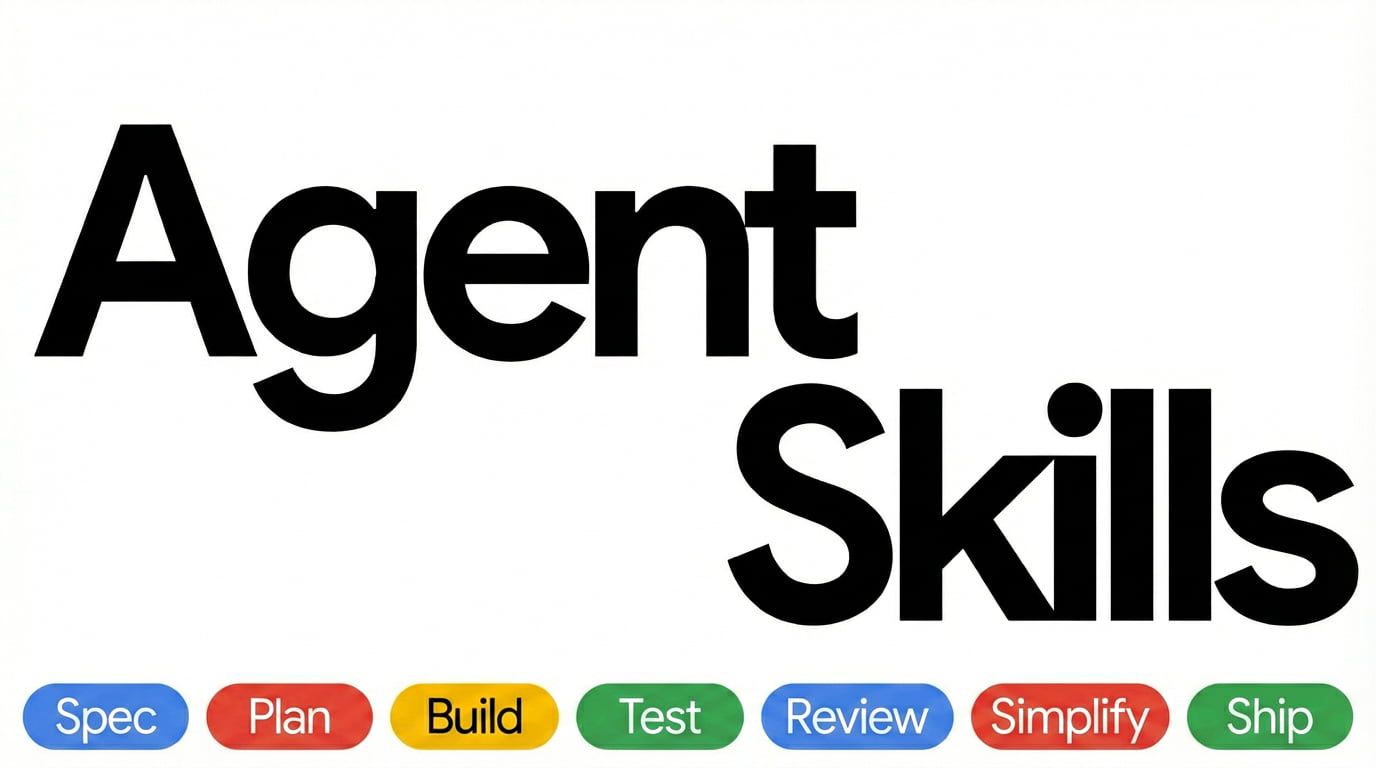
The underlying design relies on strict stage isolation and single-responsibility boundaries. The interaction loop routes through 9 lifecycle commands ranging from /spec to /ship. Instead of depending on black-box heuristics, the system dynamically mounts baseline constraints via modular skill directories. Executing /build auto freezes task scopes, executing multi-task iterations within a single approved pass while enforcing test validation before every atomic commit.
  DEFINE          PLAN           BUILD          VERIFY         REVIEW          SHIP
 ┌──────┐      ┌──────┐      ┌──────┐      ┌──────┐      ┌──────┐      ┌──────┐
 │ Idea │ ───▶ │ Spec │ ───▶ │ Code │ ───▶ │ Test │ ───▶ │  QA  │ ───▶ │  Go  |
 │Refine│      │  PRD │      │ Impl │      │Debug │      │ Gate │      │ Live |
 └──────┘      └──────┘      └──────┘      └──────┘      └──────┘      └──────┘
  /spec          /plan          /build        /test         /review       /ship
The primary engineering challenge lies in context bloat during multi-skill combination. The repository decouples references/ directories from core skill payloads, ensuring localized control planes load only when individual skills are installed via the CLI.
3. Technical Evaluation & Comparison
| Evaluation Metric | This Approach (agent-skills) | Traditional Paradigms | Typical Competitor Solutions | Production Yield |
|---|---|---|---|---|
| Rule Vehicle | Modular Skill Trees (Skills CLI) | Monolithic System Prompt | Hardcoded Internal Plugins | Context Hit Rate +40% |
| Task Flow | State-machine driven (/spec -> /ship) |
Free-form continuous chat | Single-shot raw generation | Eliminates unconstrained code |
| Environment Support | Native integration across 70+ agents | IDE-locked extensions | Walled-garden ecosystems | Zero-cost multi-tool portability |
| Quality Gate | Enforced TDD & 5-axis code review | Manual human code reviews | Zero automated blockades | Shift-left defect rate +65% |
The brilliance of this architecture rests on reusing standard protocols rather than inventing proprietary runtimes. It leverages native agent parsing for Markdown and slash commands to inject rigorous engineering constraints frictionlessly.
4. Hands-on Geek Guide: Minimum Viable Loop
Deploying these skills in a production repository requires the universally maintained CLI tool to mount full or granular capabilities instantly.
# Inject all 25 production-grade skills into the current workspace via the open CLI
npx skills add addyosmani/agent-skills

# Install only the strict test-driven development skill for targeted unit testing
npx skills add addyosmani/agent-skills --skill test-driven-development

# Mount the marketplace plugin natively inside Claude Code
/plugin marketplace add addyosmani/agent-skills
/plugin install agent-skills@addy-agent-skills
Once activated, calling /build auto drives the agent to execute the following iterative loop derived from the initial /spec PRD artifact:
// Conceptual execution loop generated internally by the agent framework
async function executeAutoBuild(spec: Specification): Promise<void> {
  const atomicTasks = planTasks(spec);
  for (const task of atomicTasks) {
    // Enforce the red testing phase before writing implementation
    await runRedPhase(task);
    // Write minimal green code satisfying the test suite
    await writeGreenCode(task);
    // Trigger localized code simplification and refactoring
    await refactorCode(task);
    // Commit atomic changes independently
    gitCommit(task.id);
  }
}
5. Production Gotchas & Mitigation Strategies
Deploying this skill suite across large engineering teams requires mitigating hidden failure modes stemming from path isolation and environment drift.
⚠️ Gotcha 1: Missing References on Isolated Installs: Installing single skills via
npx skills add --skill <name>excludes the repository-levelreferences/shared directory, causing path-resolution errors during deep quality checks. For complex production codebases, execute full repository integrations or manually mirror required checklists into a localreferences/folder.⚠️ Gotcha 2: Windows/macOS SSH Permission Denials: Cloning via SSH inside the Claude Code marketplace fails if local key pairs are unconfigured. Mitigate subprocess clone errors by forcing global Git URL rewriting before installation:
git config --global url."https://github.com/".insteadOf [email protected]:.