
1. The Core Bottleneck: What Engineering Deadlocks Does It Break?
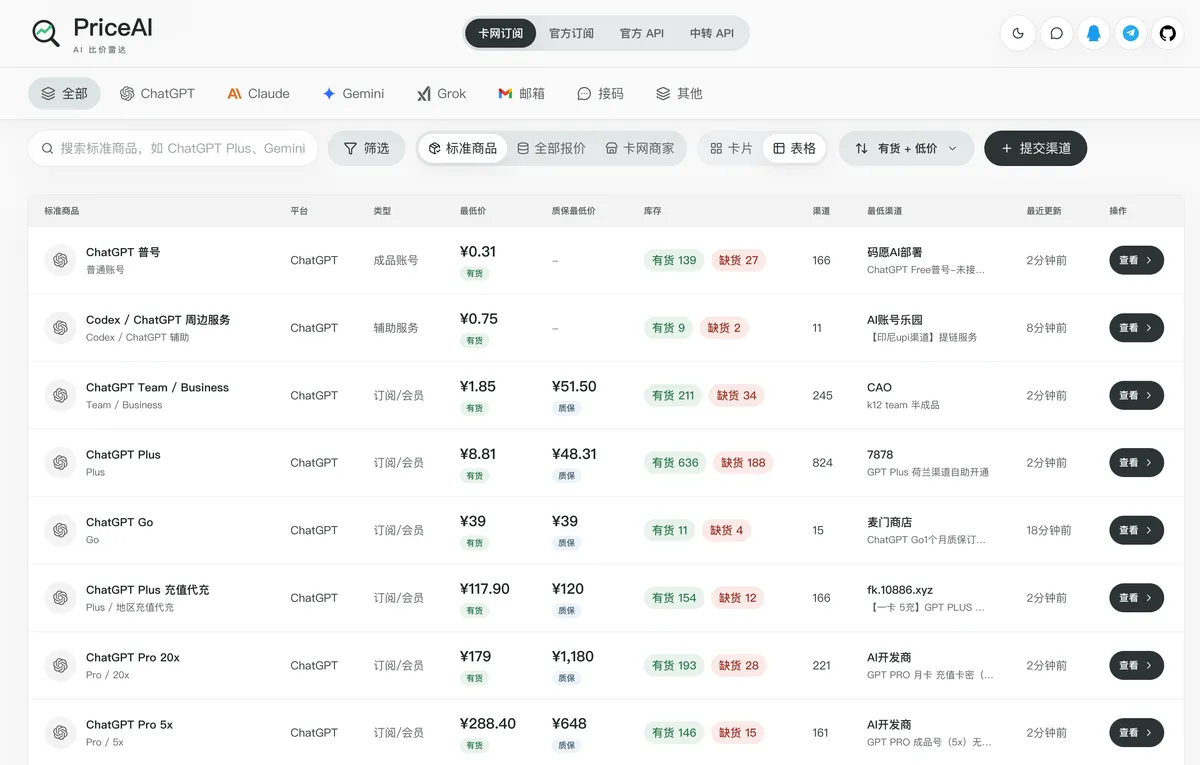
Implicit costs in AI production environments have long been severely underestimated. For full-stack developers, team leads, and independent makers running high-frequency LLM workflows, maintaining official subscriptions like ChatGPT Plus, Claude Pro, and Gemini Advanced, or bulk-purchasing official APIs and third-party transit quotas from DeepSeek, Qwen, and Kimi, requires crossing a massive information asymmetry chasm. Official regional prices fluctuate with exchange rates and channel policies, App Store and Google Play exhibit regional pricing variances, and over 200 automated card shops, Telegram channels, secondary-market resellers, and gateway sites feature chaotic naming conventions. Product titles containing top-ups, finished accounts, card keys, and CDKs routinely obscure underlying delivery security boundaries.
The breakthrough of PriceAI lies in abandoning the transactional closure model, positioning itself purely as pre-purchase decision infrastructure. It does not handle funds, process payments, or vouch for any third-party channels. Instead, through data collection, structured sanitization, and in-stock lowest-price filtering, it aligns scattered non-standard quotes across the web onto a unified baseline. Before integrating any AI resources, developers can clearly inspect official base prices versus third-party markup spaces, finding a pragmatic engineering balance between compute consumption and financial budgets.
💡 Core Architecture Insight: Replacing traditional visual price comparison with metadata normalization and independent model probes, translating non-standard card subscriptions and gateway multipliers into programmable, verifiable consumer-grade evidence chains.
2. Core Architecture and Underlying Data Flow Analysis
PriceAI leverages Next.js for the frontend interface and admin dashboard, paired with Supabase to power the structured persistence layer. The core architectural challenge lies in cleaning and correlating non-standard heterogeneous data. Official subscriptions, card shops, official API billing models, and transit gateway multipliers exhibit entirely different data schemas and update frequencies in the physical world.
Scheduled collection scripts or manual review pipelines ingest external quotes. Once data enters the core normalization pipeline, it is parsed and mapped into standard products, standard models, and standard sites. The filtering layer strips out out-of-stock, hidden, unreviewed, or persistently unresponsive anomalous entries, ensuring that the lowest-price indicators exposed to the frontend possess genuine transaction relevance.
[ Public Sources / User Submissions ] ---> [ Collector & Parser ] ---> [ Admin Review Pipeline ]
                                                                           │
                                                                           ▼
[ Detection Service Engine ] <---> [ Supabase DB & Standard Mapping ] <---> [ Next.js Frontend ]
To address API transit station verification demands, the system independently maintains a detection service modified from the veridrop protocol. When the frontend submits a temporary API key and target model name to /api-transit/detector, the main app dispatches requests to an independent container cluster. This independent service executes multi-protocol probes for OpenAI, Claude, and Gemini, performing black-box detection on the transit station's response latency, supported protocols, capability boundaries, and billing multipliers, ultimately generating structured evidence reports written back to the presentation page.
3. Technology Selection and Hardcore Performance Benchmarking
| Evaluation Dimension | This Solution (PriceAI) | Traditional Paradigm (Telegram/Resellers) | Traditional Spreadsheets (Notion/Excel) | Manual Blind Testing | Production Environmental Yield |
|---|---|---|---|---|---|
| Data Update Frequency | Automated scripts & scheduled jobs | Manual scrolling, extreme lag | Manual upkeep, daily latency | Ad-hoc testing, zero retention | Prevents purchasing expired low-cost quotas |
| Risk Disclosure Mechanism | Strict ad stripping, independent risk tags | Unbounded packaging, distorted info | No automated risk interception | Unable to quantify upstream sources | Lowers account ban & data leak probabilities |
| Heterogeneous Data Alignment | Standard product, model & site mapping | Chaotic naming, uncomparable | Primitive custom fields, unlinked | No unified protocol probes | Eliminates same-name different-quality traps |
| Verification Integration | Integrated independent transit model probes | Relies on vendor verbal promises | Incapable of verifying transit multipliers | Incurs massive API debugging costs | Millisecond insight into gateway protocols & billing |
| Deployment & Extensibility | Open-source self-hosting with Supabase | Closed black-market or private chat | Low collaboration efficiency, version conflicts | Incapable of sharing decision assets across teams | Highly extensible engineering infrastructure base |
This technology stack permanently pulls gray-market AI resource procurement into the orbit of engineering management. By transforming unstructured text into filterable database records, the system eliminates blind trial-and-error costs generated during manual information gathering.
4. Hands-on Geek Practice: Building a Minimum Viable Loop from Scratch
Spinning up this price radar in a local development environment requires installing base dependencies and configuring corresponding Supabase environment variables. If external databases are unconfigured, the system automatically falls back to loading built-in demo data, allowing developers to directly evaluate frontend interactions and admin management logic.
# Clone the official repository to local workspace
git clone https://github.com/dimthink/PriceAI.git
cd PriceAI

# Install npm dependency packages required by the project
npm install

# Copy environment variable template and populate local config
cp .env.example .env.local

# Start the local development server
npm run dev
Below is a typical code snippet utilizing Node.js scripts to trigger price collection or execute backend tasks. Developers can invoke data collectors via the CLI to execute incremental scraping and persistent pushing for specific channels:
import { execSync } from 'child_process';

/**
 * Trigger price collection script for a specified card shop channel
 * @param sourceId Unique identifier of the target channel matching the source code table
 * @param postFlag Whether to directly push to review or published status upon collection completion
 */
function runPriceCollector(sourceId: string, postFlag: boolean = true): void {
  const command = `npm run collect:prices -- --source ${sourceId} ${postFlag ? '--post' : ''}`;

  console.log(`[PriceAI Engine] Executing collection task for source: ${sourceId}`);

  try {
    const output = execSync(command, { encoding: 'utf-8' });
    console.log('[Collector Output]:\n', output);
  } catch (error: any) {
    console.error(`[Collector Error] Failed to execute source ${sourceId}:`, error.message);
    process.exit(1);
  }
}

// Execution example: Collect aisou-pro channel quotes and auto-publish
runPriceCollector('aisou-pro', true);
Once executed successfully, access http://localhost:3000 to enter the frontend price radar page, and navigate to http://localhost:3000/admin to access the admin management panel for source review and site profile maintenance.
5. Production Gotchas and Pitfalls to Avoid
When deploying PriceAI in production environments or reusing its collection and detection logic, engineering traps must be carefully navigated. Due to frequent changes in web structures and API endpoints across third-party card shops and API transit stations, automated collection modules are highly susceptible to anti-scraping defenses or DOM structure drift.
⚠️ Gotcha Warning 1: Third-Party Card Shop Anti-Scraping & IP Blocking: High-frequency scraping of 200+ card shops and fulfillment sites easily triggers Cloudflare or station-specific WAF defenses. The mitigation is configuring a dynamic proxy pool for collectors and expanding single-station scraping intervals to reasonable ranges to prevent local outbound IPs from being permanently blacklisted due to centralized concurrency.
⚠️ Gotcha Warning 2: Token Consumption & Abuse in Transit Model Detection Services: The built-in
priceai-detector-servicedispatches live test requests to target transit stations. Exposing this unauthenticated to public anonymous users invites malicious actors to exploit it as a free testing utility, instantly exhausting test key quotas or triggering DDoS attacks. Production environments must enforce strict rate-limiting and CAPTCHA gates at the main gateway layer.
Maintaining clean data sources and low-cost validity requires continuous human intervention from the team. Automated scripts solve 80% of structured ingestion, while the remaining 20% risk boundary and terms-of-service verification still rely on community members and architect-level prudential judgment.