
1. The Core Bottleneck
General-purpose coding agents deployed for enterprise code reviews suffer from a severe architectural flaw. When processing pull requests with dozens of files and thousands of line changes, prompt-driven agents exhibit attention decay due to a lack of hard topological constraints. Developers adopting these tools frequently encounter missed issues, misaligned line numbers, and a flood of false positives.
These failures stem from the stateless and unbounded text-generation mechanics of large language models. Without deterministic routing logic, general agents tend to truncate file contents arbitrarily, losing crucial cross-file references and type definitions. Open Code Review reframes this approach by anchoring the system in engineering-driven constraints while utilizing language models strictly as local computation engines, keeping token overhead minimal.
💡 Core Architectural Insight: Splitting code review into deterministic engineering tasks and dynamic agent decisions removes context loss and position drift by utilizing hard code logic for file routing and boundaries.
2. Architecture & Data Flow Analysis
The runtime mechanics rely on tight coupling between Git diff parsers and a dynamic task dispatch engine. Upon startup, the CLI client invokes Git 2.41 primitives to extract structured diffs. The parsing gateway strips binary and lock files, passing modified chunks to the smart file bundling module.
The bundling engine groups related files by directory structure, naming convention, and language type into isolated execution units. Each unit operates within an independent sub-agent context. External positioning and reflection modules validate line coordinates against actual source code before generating final review remarks.
[ Git Diff / Source Files ] ---> [ Parser & File Selector ] ---> [ Smart File Bundling ]
                                                                          │
                                                                          ▼
[ Structured Review Comments ] <--- [ Positioning & Reflection ] <--- [ Sub-Agent Execution ]
This architecture trades away theoretical recall for high precision. Stripping peripheral noise suppresses false alarms, saving engineers from wasting time validating AI hallucinations inside CI pipelines.
3. Technical Selection & Performance Benchmarking
| Evaluation Metric | This Project (open-code-review) | Traditional Implementation | Typical Competitor (Claude Code Skills) | Production Impact |
|---|---|---|---|---|
| F1 Score | Validated across 50 OSS repos and 200 PRs | Unstable recall driven by plain prompts | Degrades on long contexts via general skills | Multiplies overall review accuracy |
| Precision | Hard engineering constraints filter noise | Prone to hallucinations and drift | Surface-level rule matching causes false hits | Eliminates time spent triaging bad alerts |
| Recall | Deliberately trades edge cases for precision | Broad coverage with high interference | Autonomous traversal misses deep logic | Focuses strictly on high-severity defects |
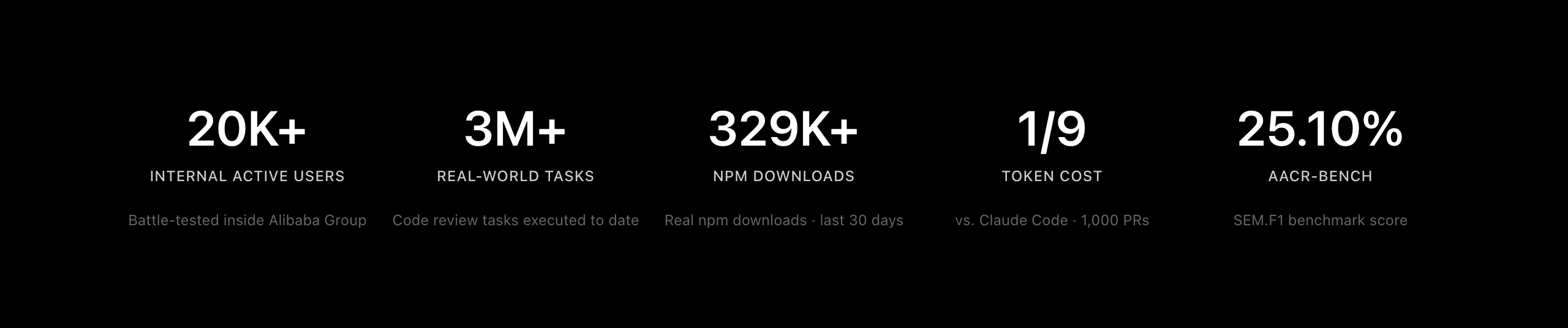
| Token Consumption | Consumes ~1/9 the tokens of general agents | Unbounded context pushes up API bills | Full context transmission per interaction | Lowers CI/CD AI operational budget by 88% |
| Execution Latency | Fast file routing with parallel sub-agents | Linear single-threaded processing | Limited by LLM speed and context limits | Reduces total pipeline execution delay |
This engineering profile favors determinism over creative generation, making it uniquely suited for production code auditing.
4. Hands-on Geek Guide: Building the Minimal Loop
Running Open Code Review requires Git >= 2.41 to support advanced repository traversal and diff operations. Install the CLI globally via your package manager:
# Install the official core CLI tool globally via npm
npm install -g @alibaba-group/open-code-review
After installation, configure your LLM API endpoint and run full or incremental diff audits against any local Git repository. Below is a production-ready script wrapping the process:
import { execSync } from 'child_process';
import * as process from 'process';

// Verify that the local Git version meets the 2.41 minimum requirement
function verifyGitVersion(): void {
    const versionOutput = execSync('git --version').toString();
    const match = versionOutput.match(/git version (\d+)\.(\d+)/);
    if (!match || parseInt(match[1]) < 2 || (parseInt(match[1]) === 2 && parseInt(match[2]) < 41)) {
        throw new Error('Open Code Review requires Git >= 2.41 for advanced diff parsing.');
    }
}

// Execute the ocr scan command against the active repository
function runCodeAudit(): void {
    verifyGitVersion();
    try {
        // Invoke the globally registered ocr CLI tool with JSON output formatting
        const output = execSync('ocr scan --model=openai/gpt-4o --format=json', {
            encoding: 'utf-8',
            env: { ...process.env }
        });
        console.log('Audit completed successfully. Results:', output.substring(0, 200));
    } catch (error: any) {
        console.error('Audit execution failed:', error.message);
        process.exit(1);
    }
}

runCodeAudit();
Executing ocr scan outputs a structured JSON report containing line numbers, severity ratings, and actionable refactoring guidance ready for CI integration.
5. Production Gotchas & Mitigation Strategies
Deploying Open Code Review into enterprise CI pipelines requires managing local Git caching and API rate limits. Large changesets can spawn high volumes of parallel sub-agents that exhaust LLM quotas.
⚠️ Gotcha Warning [Concurrency Throttling]: Running
ocr scaninside massive monorepos with thousands of file changes spawns intensive sub-agent clusters. Explicitly limit concurrency using the--concurrencyflag in CI configurations to avoid 429 Too Many Requests errors from LLM providers.⚠️ Gotcha Warning [Outdated Git Binaries]: Containerized CI environments running outdated base images often ship with ancient Git binaries. Ensure your base image explicitly installs Git 2.41+ to prevent tree-parsing exceptions during complex merge request audits.