
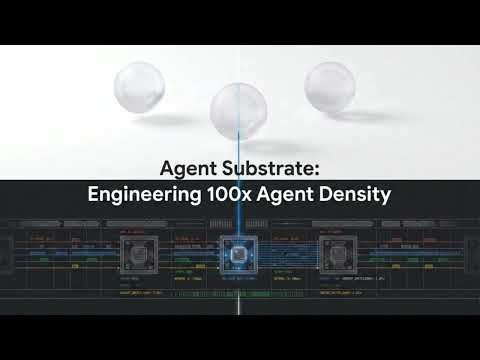
1. The Core Bottleneck: What Engineering Trap Does It Break?
Standard container runtimes impose heavy resource overheads and prohibitive startup latencies when managing long-running, stateful agentic applications. Standard Kubernetes pods fail to handle high frequencies of short-lived, frequently idle agent tasks efficiently. Agent Substrate bypasses application-level framework constraints by intervening directly at the kernel and virtualization boundary, mapping higher-level actors onto a shared pool of physical worker nodes. This architecture addresses the inherent idle-heavy characteristic of agent workloads through fine-grained multiplexing, scaling up concurrent instances per unit of hardware.
💡 Architectural Insight: Agent Substrate abandons application-level agent abstractions entirely, focusing instead on aggressive, low-level suspension and resumption mechanisms to reclaim sandbox lifecycles.
2. Core Architecture and Data Flow Mechanics
Agent Substrate leverages Kubernetes pods as the infrastructure provisioning layer, combining microVMs and gVisor isolation sandboxes to build an orchestration plane tailored for stateful actors. Long-running, intermittently active programs are modeled as actors. Incoming traffic routes through the gateway to dynamically assign actors to ready workers, restoring volatile memory and filesystem states from persistent storage on demand.
[ Client / CLI ] ---> [ Gateway / Ingress Router ] ---> [ ATE Control Plane ]
                                                                │
                                                 ┌──────────────┴──────────────┐
                                                 ▼                             ▼
                                        [ Worker Pool Pod 1 ]         [ Worker Pool Pod N ]
                                        (gVisor / MicroVM Sandbox)    (gVisor / MicroVM Sandbox)
The core data flow relies on full-state snapshots to eliminate cold-start penalties. When a worker receives a suspend command, it serializes the sandbox's volatile RAM and filesystem deltas into backend storage. A resume request immediately pushes the image back into the sandbox using memory mapping and zero-copy techniques, bypassing standard language runtime initialization and dependency loading to achieve sub-500ms activation.
3. Technology Selection and Hardcore Benchmarks
| Evaluation Metric | This Framework (substrate) | Traditional Paradigm | Typical Competitor | Production Benefit |
|---|---|---|---|---|
| Isolation Boundary | Kernel-level (gVisor / MicroVM) | Process or Namespace | Standard Docker Container | Eliminates multi-tenant state leaks and escalation |
| Cold-Start Latency | Sub-second (< 500ms) | Seconds to Tens (5s - 30s) | Standard K8s Pod Boot | Eradicates blank-screen delays for end-users |
| Density & Oversubscription | High multiplexing (> 30x) | 1:1 Binding (1 container/app) | Dynamic Serverless Functions | Drastically cuts physical infrastructure costs |
| State Persistence | Native full-state snapshot & migration | External DB or Object Store | Stateless + External Storage | Enables seamless actor migration across workers |
| Framework Coupling | Framework agnostic (OCI compatible) | Deeply bound SDK / Framework | Custom Agent Runtime Framework | Smooth migration of existing agent stacks with zero edits |
Behind these metrics lies a straightforward engineering trade-off: deep runtime customization at the kernel sandbox layer trades complexity for absolute control over concurrent, stateful instances.
4. Minimal Production Closed-Loop: Step-by-Step Practical Guide
Setting up the local development environment requires standard tools including Go, kubectl, and Docker. Automated scripts handle cluster creation and control plane injection via Kind.
Initialize the local cluster infrastructure:
# Create a Kind cluster with local registry support
hack/create-kind-cluster.sh

# Deploy the control plane, PostgreSQL, and storage backends
hack/install-ate-kind.sh --deploy-ate-system

# Install the built-in counter demonstration payload
hack/install-ate-kind.sh --deploy-demo-counter

# Install the specialized kubectl extension CLI
go install ./cmd/kubectl-ate
Verify the minimum closed-loop by interacting with the control plane through kubectl-ate to instantiate a stateful actor within the target atespace:
# Create a stateful actor instance named counter-agent
kubectl ate create actor counter-agent --template=counter

# Invoke an increment command against the target actor
kubectl ate invoke counter-agent --method=increment
The command returns a structured JSON payload with execution state versions and latency figures, confirming that volatile memory states remain intact across hibernation boundaries.
5. Production Gotchas and Failure Mitigations
Pushing this runtime into pre-production or high-load clusters requires managing specific engineering risks arising from tight control-plane and sandbox coupling. The codebase remains pre-1.0, with backward API compatibility subject to change.
⚠️ Gotcha Warning [Snapshot Storage IOPS Bottleneck]: When high densities of actors trigger simultaneous suspend cycles, backend storage layers experience massive concurrent write spikes. Without IOPS tuning on underlying persistence volumes, the suspension queue blocks and triggers worker node cascades.
⚠️ Gotcha Warning [Kernel Sandbox Syscall Compatibility]: gVisor sandbox filters can occasionally block low-level networking primitives or hardware acceleration hooks required by custom agent plugins. Execute comprehensive integration tests within Kind clusters prior to production migration to prevent unexpected sandbox terminations.