
1. The Core Bottleneck: What Engineering Pain Points Does It Solve?
Traditional financial analysis setups suffer from three major physical hurdles: fragmented data sources make cross-market ingestion expensive; LLM context windows get overwhelmed by raw financial reports leading to severe token waste; and maintaining self-hosted servers for cron jobs consumes unnecessary operational overhead. daily_stock_analysis bypasses traditional server clusters by anchoring its pipeline directly into GitHub Actions. Developers avoid cloud host expenses entirely by configuring a set of Secrets, achieving a fully automated loop from data collection and LLM inference to instant IM message delivery.
💡 Core Architecture Insight: Offloading state-free computation tasks to free CI/CD pipelines replaces complex microservice orchestration with YAML files, bringing absolute lightweight execution to asset monitoring.
2. Core Architecture & Data Flow Breakdown
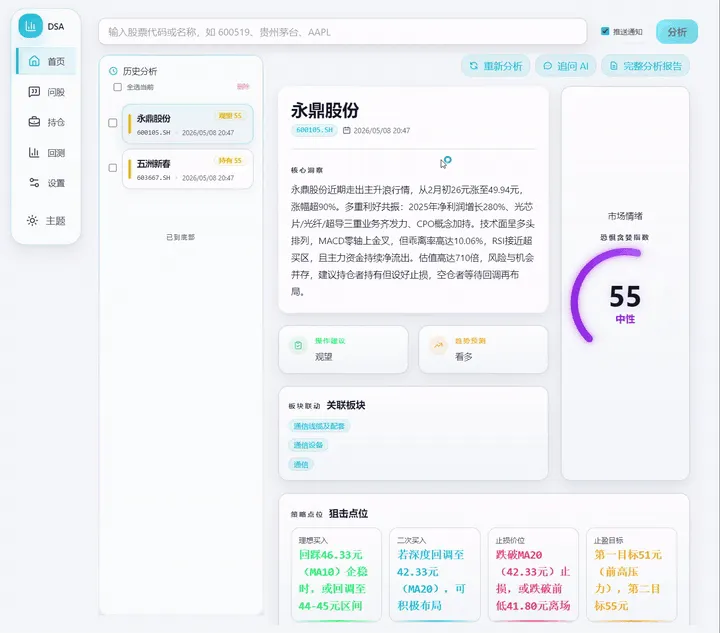
The system utilizes a classic pipeline pattern: Data Ingestion -> LLM Parsing -> Multi-Channel Dispatch. The core logic resides in Python adapters communicating with various data providers. By default, it calls AkShare, Baostock, and YFinance for raw quotes, while plugging in search APIs (such as SerpAPI, Tavily) to fetch real-time financial news and social sentiment. Cleaned data feeds into the specified LLM, where structured prompts enforce strict output schemas including ratings, entry/exit price points, and risk alerts.
[ AkShare / YFinance / SerpAPI ] ---> [ Python Core Parser ] ---> [ LLM Gateway Engine ]
                                              │
                                              ▼
[ WeChat / Feishu / Telegram / Slack ] <--- [ Markdown & Dashboard Formatter ]
Within the execution flow, rigorous fallback and timeout error-handling mechanisms mitigate upstream API instability. When free market data endpoints fluctuate, token-based data sources seamlessly take over. By vectorizing or structurally summarizing historical candles and fundamental indicators, the LLM outputs precise technical calculations and actionable checklists rather than vague generalizations.
3. Technology Selection & Hardcore Performance Matrix
| Evaluation Dimension | daily_stock_analysis | Traditional Setup | Typical Commercial Competitor | Production Benefit |
|---|---|---|---|---|
| Execution Runtime | GitHub Actions / Docker | Standalone VPS / K8s | Local Python scripts | Zero server maintenance, 7x24 availability |
| Data Ingestion | Multi-source Fallback Matrix | Single Broker SDK | Commercial Financial Terminals | Eliminates single-point-of-failure rate limits |
| Dispatch Channels | IM Webhook + Multi-email | Single SMTP Gateway | Manual Web Dashboards | Instant mobile-side delivery of decision dashboards |
| Deployment Barrier | 5-minute YAML config | Hours of dependency tuning | Complex SaaS Subscriptions | Minimal learning curve with complete codebase ownership |
This comparison draws a clear line between open-source agility and bloated commercial terminals. It avoids chasing microsecond quantitative execution, focusing instead on medium-to-long-term developers and tech-savvy investors who demand maximum information density with minimal overhead.
4. Hands-On Geek Guide: Building the Minimal Loop from Scratch
Running this repository locally or within a CI environment requires a straightforward dependency installation process. The following steps initialize the execution environment:
# Clone the repository into your local workspace
git clone https://github.com/ZhuLinsen/daily_stock_analysis.git && cd daily_stock_analysis

# Install all required Python packages specified in requirements.txt
pip install -r requirements.txt

# Copy the environment variable template
cp .env.example .env

# Execute local debug analysis for specific target tickers
python main.py --stocks 600519,AAPL,2330.TW --debug
Upon execution, the script fetches recent market data for Kweichow Moutai (600519), Apple (AAPL), and TSMC (2330.TW), combines it with the configured LLM gateway to generate a comprehensive Markdown report containing aggregated scores and risk alerts, and prints the structured output to the terminal.
5. Production Gotchas & Failure Prevention
Long-term execution reveals specific operational pitfalls driven by upstream data provider volatility and LLM token limits.
⚠️ Gotcha Warning [Free Market Data Rate Limits]: Default endpoints like AkShare or YFinance occasionally trigger connection timeouts during peak hours or network jitters. If tracking more than 20 symbols concurrently, configure Tushare Tokens or Longbridge OAuth credentials via Secrets to ensure throughput stability.
⚠️ Gotcha Warning [LLM Timeout & Token Overflow]: Supplying excessively large ticker lists alongside massive news search payloads can rapidly saturate context windows and trigger timeout exceptions. Keep single-run symbol counts reasonable, and leverage environment variables to fine-tune search summaries and model caching strategies.