1. The Core Bottleneck: What Engineering Flaws Does It Shatter?
Vector databases are hitting severe throughput and accuracy walls when processing long financial reports, legal filings, and dense technical manuals. Traditional RAG relies on vector cosine similarity to fetch matching fragments, completely bypassing the multi-step reasoning dependencies required by professional documents. Similarity does not equal relevance, resulting in retrieval pipelines returning semantically close but functionally useless snippets.
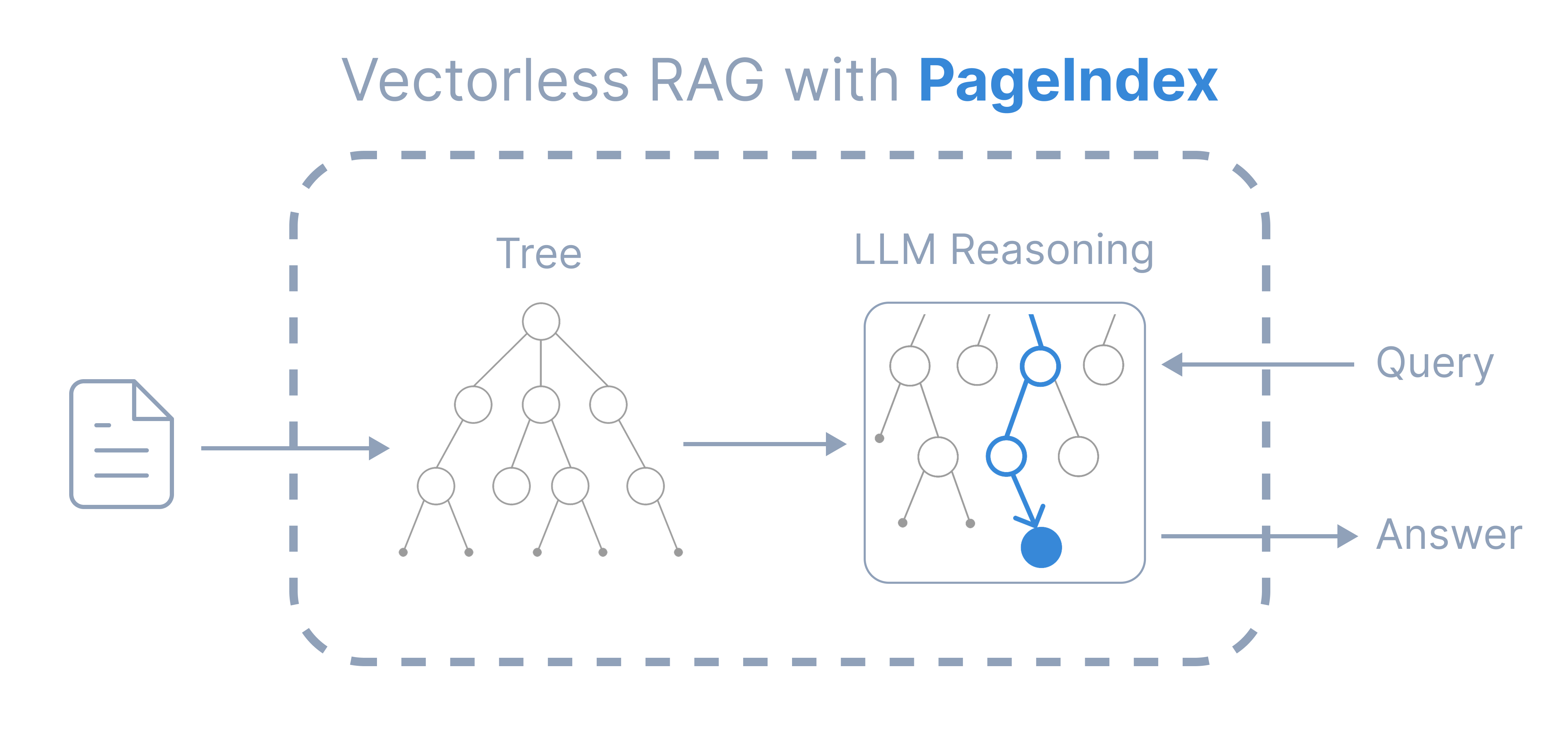
PageIndex discards this paradigm by substituting vector indexes with hierarchical tree structures. Instead of slicing documents into arbitrary chunks, the engine extracts a structural tree matching the physical layout of the document. The language model operates as an expert reader, navigating through tree branches to target precise sections. This approach eliminates vector black boxes, producing traceable references for every retrieved insight.
💡 Core Architectural Insight: PageIndex replaces opaque vector spaces with explicit tree structures, transforming retrieval into a model-driven path-reasoning task across hierarchical directories, neutralizing context boundary fractures caused by chunking.
2. Core Architecture and Data Flow Analysis
Execution flow in PageIndex splits into two primary phases: index generation and agentic reasoning retrieval. The layout parser extracts the document's structure, while the tree builder compiles the hierarchical representation. During runtime, client queries trigger an execution engine that guides the LLM through the tree nodes.
[ PDF Document ] ---> [ Layout Parser ] ---> [ Tree Index Builder ]
                                                       │
                                                       ▼
[ Client / SDK ] ---> [ Agentic Chat Engine ] <---> [ Hierarchical Tree ]
Index generation intentionally decouples from heavy reasoning models. Document layout extraction handles the structural heavy lifting, leaving the index model to merely summarize and refine node descriptions. This design keeps indexing fast, processing hundreds of pages in seconds while keeping costs minimal. The chat model handles heavier reasoning, traversing the tree dynamically to synthesize answers.
3. Tech Stack and Performance Benchmarking
| Evaluation Dimension | PageIndex (This Solution) | Traditional RAG Paradigm | Enterprise Alternatives | Production Infrastructure Benefit | |---|---|---|---|---|> | Index Medium | Hierarchical Tree Structure | Vector DB (Milvus/Pinecone) | Native Long-Context LLMs | Eliminates vector noise, slashes storage overhead | | Retrieval Mechanism | LLM Tree-Path Reasoning | Cosine Similarity Nearest Neighbor | Full Raw Token Window Injection | Guarantees code-grade traceable source references | | Long-Doc Scaling | PageIndex File System Layer | Bounded by Chunk Size & Top-K | Limited by Context Windows & Attention Decay | Handles million-word enterprise corpuses smoothly | | Cost Profile | One-time offline indexing, dynamic query | Continuous vector sync and high-dim search | Massive token expenses per conversational request | Dramatically reduces persistent chat API billing |
PageIndex reduces operational overhead by bypassing complex vector database lifecycles. Its file-level tree indexing layer supports multi-document corpus reasoning, avoiding the context loss typical of fragmented vector retrieval when analyzing massive PDF sets.
4. Hands-On Minimal Production Loop
Developers can deploy the PageIndex runtime locally using the Python SDK. Local mode executes indexing and querying entirely on local hardware.
Install the official package via terminal:
pip install -U pageindex
Initialize the client and execute a retrieval run:
import os
from pageindex import PageIndexClient

# Configure API credentials
os.environ["OPENAI_API_KEY"] = "your-openai-key"

# Initialize the PageIndex client
# 'index' defines the model building the tree; 'chat' defines the reasoning search model
client = PageIndexClient(
    index="gpt-5.6-luna",
    chat="gpt-5.6-sol",
)

# Submit target PDF document and capture the unique document identifier
doc_id = client.submit_document("report.pdf")["doc_id"]

# Execute a tree-reasoning natural language query against the document
answer = client.chat("What was the 2023 operating margin?", doc_id=doc_id)
print(answer)
Executing this script triggers local layout parsing, builds the structural tree index, and engages the LLM reasoning agent to fetch the exact operating margin alongside explicit references.
5. Production Gotchas and Mitigation Strategies
Deploying PageIndex into high-concurrency production environments requires addressing specific operational failure modes.
⚠️ Production Gotcha [Model Role Misconfiguration]: Avoid assigning expensive frontier reasoning models to the index parameter (
index=). Tree construction relies on layout extraction parsers; basic models handle node summarization efficiently. Utilizing expensive models for tree building triggers non-linear cost spikes without yielding accuracy improvements.⚠️ Production Gotcha [Cold-Start Latency Control]: Initial submission of large PDFs triggers layout analysis and tree node summarization, incurring multi-second to minute-level blocking delays for documents exceeding hundreds of pages. Production systems must offload
submit_documentexecution to asynchronous task queues to prevent stalling synchronous API client threads.