
1. The Core Bottleneck
LLM-driven user interface generation faces severe throughput limits and latency penalties in production environments. Historically, developers forced models to emit deeply nested JSON payloads or verbose Markdown blocks, requiring the frontend to parse and map everything into interactive components after the fact. This approach squandered precious token budgets on brackets, quotes, and repetitive keys while inflating the context window. Worse still, browsers were forced to wait for complete JSON closure before rendering anything, resulting in prolonged blank screens and jittery UX.
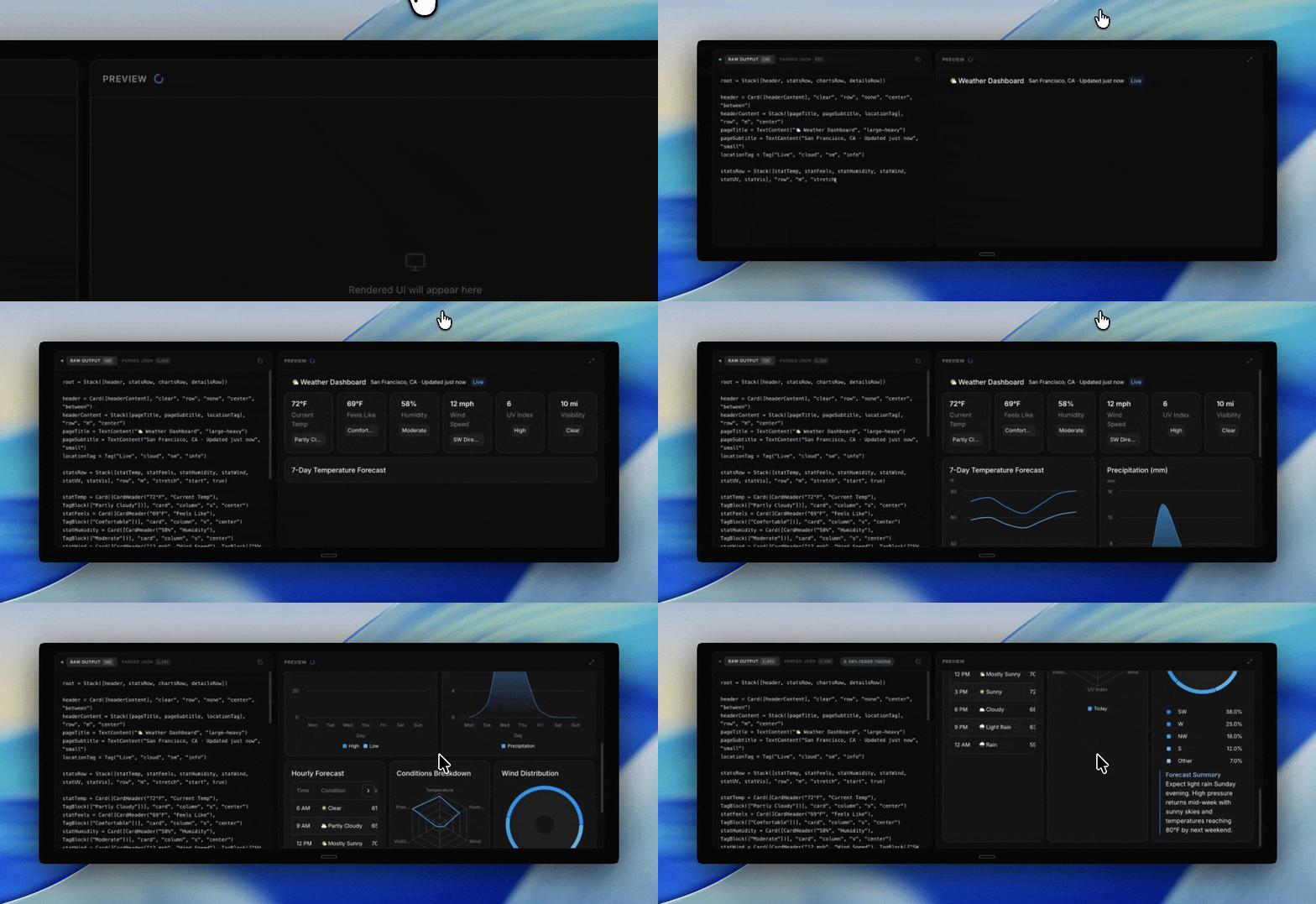
OpenUI bypasses standard data interchange formats by introducing OpenUI Lang, a domain-specific streaming language built exclusively for generated UI. The language strips out redundant syntax from traditional serialization formats, mapping model outputs directly to compact component declarations and property streams. Client-side parsers begin incremental rendering the exact moment the first token arrives, eliminating blocking wait states.
💡 Core Architectural Insight: OpenUI replaces generic JSON with a domain-specific streaming DSL, shifting structural LLM output overhead into high-density incremental byte streams.
2. Core Architecture and Data Flow
OpenUI adopts a decoupled modular design centered around @openuidev/lang-core, which remains entirely independent of any specific frontend framework. The architecture converts a developer's component library into a strict system prompt and translates live token streams back into virtual or native DOM nodes during inference.
[ Component Library ] ---> [ System Prompt Generator ] ---> [ LLM Inference ]
                                                                   │
                                                                   ▼
[ Client Renderer ] <--- [ Progressive Parser ] <--- [ OpenUI Lang Stream ]
Engineers define standard component sets within their codebase. The system parses TypeScript interfaces or component metadata to automatically assemble rigorous instruction sets for the model. Upon receiving user input, the LLM streams OpenUI Lang text back. The client runtime parser captures data chunks, executes lexical analysis, and mounts elements directly into React, Vue, Svelte, or Angular render trees. This stateless pipeline drops parsing overhead to microseconds.
3. Technical Selection and Hardcore Benchmarks
| Evaluation Dimension | This Solution (OpenUI) | Legacy Implementation | Alternative Competitors | Production Impact |
|---|---|---|---|---|
| Payload Overhead | Minimal (OpenUI Lang) | Extreme (Nested JSON) | Moderate (Custom Markdown) | Saves up to 67% in Token costs |
| Rendering Latency | Millisecond incremental streaming | Blocking full-response wait | Block-based chunk parsing | Eliminates long blank screens |
| Framework Coupling | Framework-agnostic core | Deeply bound to single framework | Tied to specific cloud platforms | Seamless integration with existing stacks |
| Component Scalability | Runtime declarations, auto prompts | Manual static mapping tables | Static component registry | Zero-friction extension via types |
These engineering facts speak for themselves. Traditional JSON approaches time out under heavy concurrent load or throttled networks, whereas a specialized parser combined with a streaming pipeline distributes compute and render costs evenly across the timeline.
4. Hands-On Minimal Production Loop
Initializing a complete OpenUI chat application requires only standard terminal commands. The scaffold comes pre-configured with streaming transport adapters and the UI Lang runtime.
# Initialize a project using the official CLI scaffold
npx @openuidev/cli@latest create --name genui-chat-app

# Navigate to the working directory
cd genui-chat-app

# Inject valid API credentials
echo "OPENAI_API_KEY=sk-your-key-here" > .env

# Boot up the local development server
npm run dev
Once booted, developers can explore the streaming chat interface using the built-in React component library. Below is a minimal abstraction of core rendering logic from @openuidev/react-ui:
import { OpenUIProvider, ChatSurface } from '@openuidev/react-ui';
import '@openuidev/react-ui/styles.css';

export default function App() {
  return (
    // Inject the core OpenUI context provider
    <OpenUIProvider endpoint="/api/chat">
      <div className="flex h-screen w-full bg-slate-950 text-white">
        {/* Render the standard chat surface supporting streamed component generation */}
        <ChatSurface
          defaultModel="gpt-4o"
          enableStreaming={true}
        />
      </div>
    </OpenUIProvider>
  );
}
Executing npm run dev and visiting http://localhost:3000 launches a conversational app capable of rendering live charts and forms. UI outputs grow dynamically as tokens arrive.
5. Production Gotchas and Pitfalls
Deploying OpenUI to production requires careful mitigation of distinct failure modes. The primary risk stems from model hallucinations causing syntax deviations. Weaker open-source models occasionally emit malformed tags outside the OpenUI Lang specification, crashing the client-side parser.
⚠️ Gotcha Warning [Model Hallucinations & Syntax Drift]: Never rely on unaligned lightweight models in production. Enforce server-side syntax validation middleware or mandate fine-tuned, high-capacity models to guarantee compliant outputs.
Another hidden risk involves context bloat caused by undisciplined component libraries. Injecting dozens of complex business components into system prompts consumes valuable conversation memory and triggers model confusion during selection.
⚠️ Gotcha Warning [Context Pollution via Bloated Component Registries]: Modularize component libraries by view context. Inject only the minimal subset of components required for a specific route, and prohibit global registration of unpruned component sets.