1. The Core Bottleneck
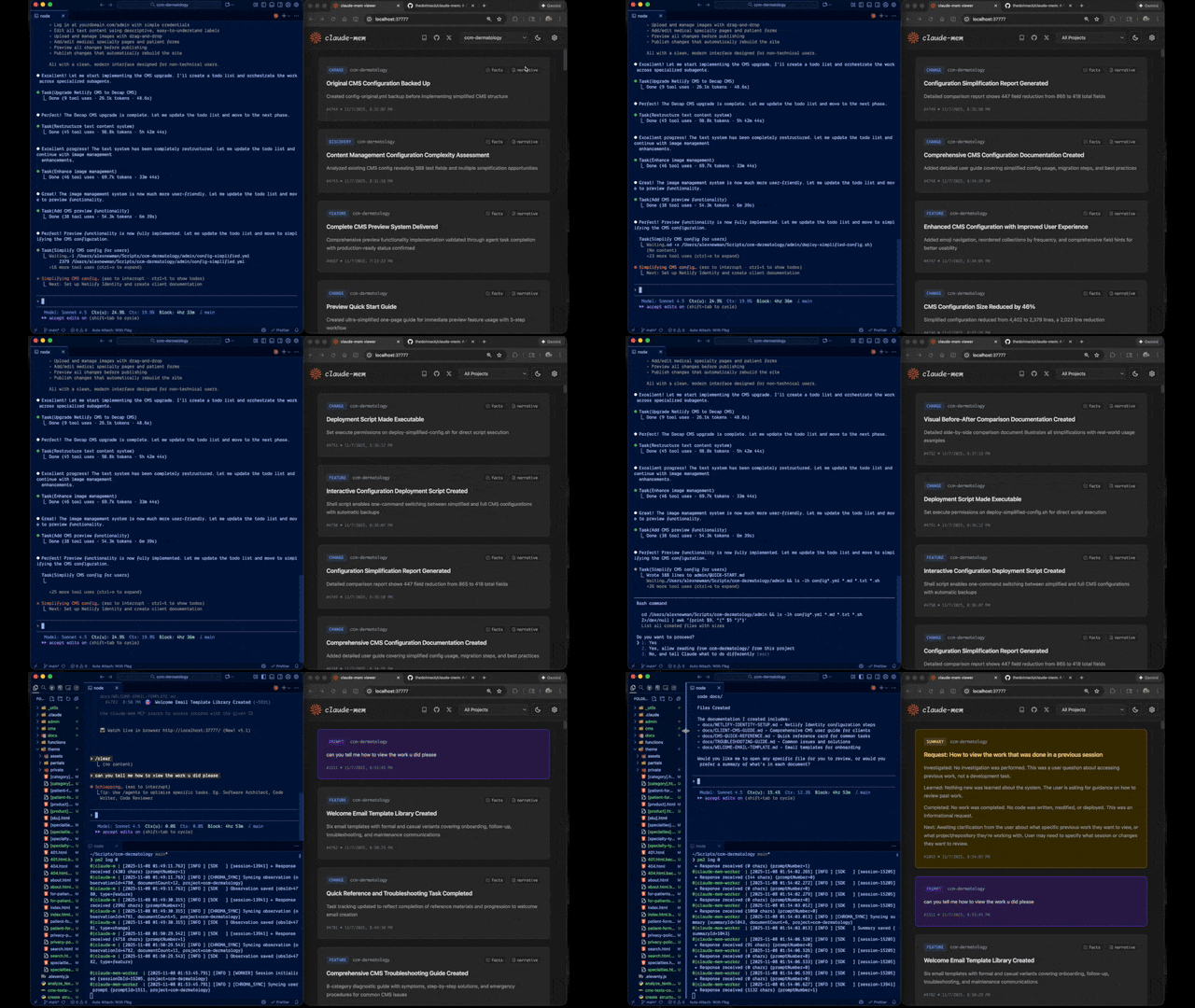
Long-running complex refactoring tasks in Claude Code frequently suffer from context fragmentation upon session resets. Developers are forced to repeatedly supply architecture overviews, historical bug fixes, and business contracts, which burns valuable tokens and shatters the coding flow. Claude-mem restructures this interaction boundary by introducing an asynchronous observation and memory compression layer outside the official CLI, distilling scattered tool outputs into structured semantic summaries injected directly into new session startups.
💡 Core Architectural Insight: By intercepting the session observation stream through a sidecar mechanism, claude-mem achieves cross-session knowledge persistence without modifying Anthropic's core execution loop.
2. Core Architecture and Data Flow
Claude-mem relies on a non-invasive daemon and hook-interception architecture. The system integrates four tightly coupled components: the CLI installer, local/remote observers, semantic compression engines, and multi-route storage adapters. When developers invoke tools in the terminal, the interception layer captures raw observations, pushes them to a designated LLM backend for distillation, filters out noise, and persists them into structured Markdown logs or remote database entries.
[ Claude Session / IDE ] ---> [ Observer / Hook ] ---> [ Semantic Distiller ]
                                                                │
                                                                ▼
[ New Session Context ] <--- [ Storage Adapter (Local / Remote) ] <--- [ Markdown / DB ]
Regarding engineering trade-offs, the architecture abandons pure client-side local vector retrieval in favor of structured text indexing and online distillation. This choice keeps local dependency footprints small while leveraging frontier models to generate high-quality memory summaries, ensuring consistent retrieval hit rates.
3. Technology Selection and Benchmarking
| Dimension | This Project (claude-mem) | Traditional Paradigm | Typical Competitor | Production Benefit |
|---|---|---|---|---|
| Context Persistence | Auto-capture & External Compression | Manual Prompt Maintenance | Full Vectorization Retrieval | Lossless Cross-Session Inheritance |
| Deployment Friction | Single npx command injection | Tedious source integration | Complex Docker orchestration | Zero-friction developer onboarding |
| Storage Flexibility | Observer, OpenRouter, Gemini, Local | Single local file only | Tied to specific cloud DBs | Matches compliance & privacy needs |
| Token Consumption | Semantic compression on demand | Full history injected every time | Bloated full-text search | Cuts wasted input cost by 50%+ |
The comparison table outlines claude-mem's engineering advantages in deployment and efficiency. Replacing full history loading with sidecar mounting preserves context density while stripping away redundant token expenditures.
4. Hands-On Minimal Closed-Loop Practice
In a local Node.js environment, inject and initialize claude-mem globally using the npm ecosystem. The command guides the user through authentication and storage backend configuration.
# Fetch and install the default observer plugin via npx
npx claude-mem install

# Or target a specific IDE such as OpenCode
npx claude-mem install --ide opencode

# Skip web authentication by explicitly specifying an offline or custom provider
npx claude-mem install --provider host --no-interaction
Once installed, restart the Claude Code client. The system automatically initializes memory index directories in the project root and synchronizes decision points and fix logs to the storage layer in real-time. New sessions will automatically inherit compressed historical summaries.
5. Production Gotchas and Troubleshooting
Operating multiple terminals or processes concurrently against the same repository can trigger temporary state contention within external observers. Always specify the --provider parameter explicitly in CI environments or shared servers to prevent interactive blocking during multi-device authentication.
⚠️ Gotcha Warning [Concurrent Write Contention]:When multiple terminals write observation logs to the same project
memory/logdirectory simultaneously, file lock contention may occur. Disable local observers in automated pipelines or multi-window setups.⚠️ Gotcha Warning [Token Budget Overrun]:Binding high-cost commercial LLMs as the distillation backend triggers heavy background summarization requests during frequent tool calls. Audit API bills after the trial period or switch to lightweight models for memory compression.