
1. The Core Bottleneck: What Engineering Deadlock Does It Break?
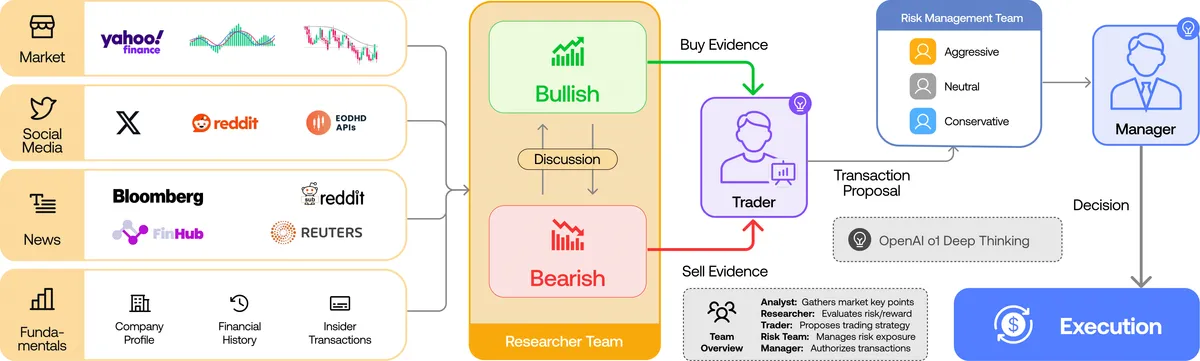
LLM adoption in quantitative finance has long been plagued by hallucinations and look-ahead bias. Traditional monolithic prompt architectures feed macro data, earnings parsers, and social sentiment into a single context window, saturating attention mechanisms and outputting noisy execution signals. Simultaneously, open-source backtesting frameworks frequently ingest future earnings or news published after the decision timestamp, manufacturing illusory paper returns. TradingAgents introduces a multi-agent graph orchestration paradigm, physically decoupling analyst teams, risk management, and traders, while enforcing a point-in-time data contract that restricts all agents to historical facts published strictly prior to the execution timestamp.
💡 Core Architectural Insight: Replacing single black-box prompts with a distributed graph state machine decomposes financial decision-making into deterministically verifiable pipelines.
2. Architecture and Data Flow Analysis
TradingAgents is driven by a LangGraph state machine underneath, routing market data across modular components. The framework maintains a unified decision context during runtime, where specialized agents consume designated data sources in parallel or series before converging at the portfolio manager and trader nodes for synthesis.
[ CLI / Config ] ---> [ Point-in-Time Router ] ---> [ Memory & Checkpoint Layer ]
                               │
        ┌──────────────────────┼──────────────────────┐
        ▼                      ▼                      ▼
[ Fundamentals ]      [ Sentiment Analyst ]   [ Technical Analyst ]
        │                      │                      │
        └──────────────────────┼──────────────────────┘
                               ▼
                    [ Risk Management Team ]
                               │
                               ▼
                    [ Execution & Trade Log ]
The fundamental analyst interfaces with raw SEC EDGAR filings, the sentiment analyst scrapes Twitter and Reddit noise, and the technical analyst calculates MACD and RSI indicators. Intermediate outputs from all modules persist to disk via decision logs, supporting fault-tolerant checkpoint resumption and multi-round iterative reasoning.
3. Technology Selection and Hardcore Comparison
| Evaluation Dimension | This Framework (TradingAgents) | Traditional Paradigm | Typical Competitor | Production Benefit |
|---|---|---|---|---|
| Architectural Pattern | Multi-Agent State Machine (LangGraph) | Monolithic LLM Serial Prompt | Rule Engine + Single Model | Modular separation prevents attention decay |
| Look-Ahead Defense | Strict Point-in-Time Data Contract | Real-time Global Data Ingestion | Static CSV Offline Files | Eliminates future leaks for realistic backtests |
| Credential Integration | Native ChatGPT Plus/Pro Plan Support | High-Cost API Quota Dependency | Locked to Single Proprietary API | Drastically cuts LLM operational infrastructure costs |
| State Persistence | CLI Checkpoint Resume & Fault Recovery | In-Memory Ephemeral Storage | Stateless Without Audit Trails | Enables long-horizon complex backtests & debugging |
TradingAgents bypasses the expensive route of relying solely on API keys by allowing developers to run directly via ChatGPT Plus or Pro account sessions, reducing the token billing barrier for multi-agent debates.
4. Hands-on Geek Practice: Building a Minimal Closed Loop
Deploying TradingAgents locally requires Python 3.10 or higher. Install the source package and configure baseline runtime dependencies to launch automated non-interactive CLI decision flows.
# Clone the official repository
git clone https://github.com/TauricResearch/TradingAgents.git
cd TradingAgents

# Install core dependencies and development tools
pip install -e .

# Configure environment variables with OpenAI or compatible endpoint keys
export OPENAI_API_KEY="sk-your-api-key-here"

# Run the automated analysis pipeline for a specific ticker and date
python -m tradingagents.main --ticker AAPL --date 2026-10-24
Upon successful execution, the system generates a single-page HTML comprehensive analysis report locally, containing fundamental scores, technical indicator paths, sentiment polarity readings, and the risk management team's final execution conclusion.
5. Production Gotchas and Deployment Warnings
Directly invoking multiple large language models concurrently under high loads triggers severe network throughput bottlenecks. Yahoo Finance data feeds experience periodic rate-limiting or schema changes; production environments must configure multi-tier proxies and exponential backoff retry strategies for all network requests.
⚠️ Gotcha Warning [Data Feed Rate Limiting]: When the Yahoo Finance news feed drops, the system falls back to Yahoo search scraping. Without proper proxy egress configured, high-frequency requests will trigger IP bans, halting the entire analysis graph.
⚠️ Gotcha Warning [Token Consumption Runaway]: Multi-agent parallel discussions generate massive internal dialogue logs. Failing to bound model temperature and max token limits in configuration files can multiply single-trade decision API costs far beyond initial projections.