
1. The Core Bottleneck: What Engineering Pain Point Does It Break?
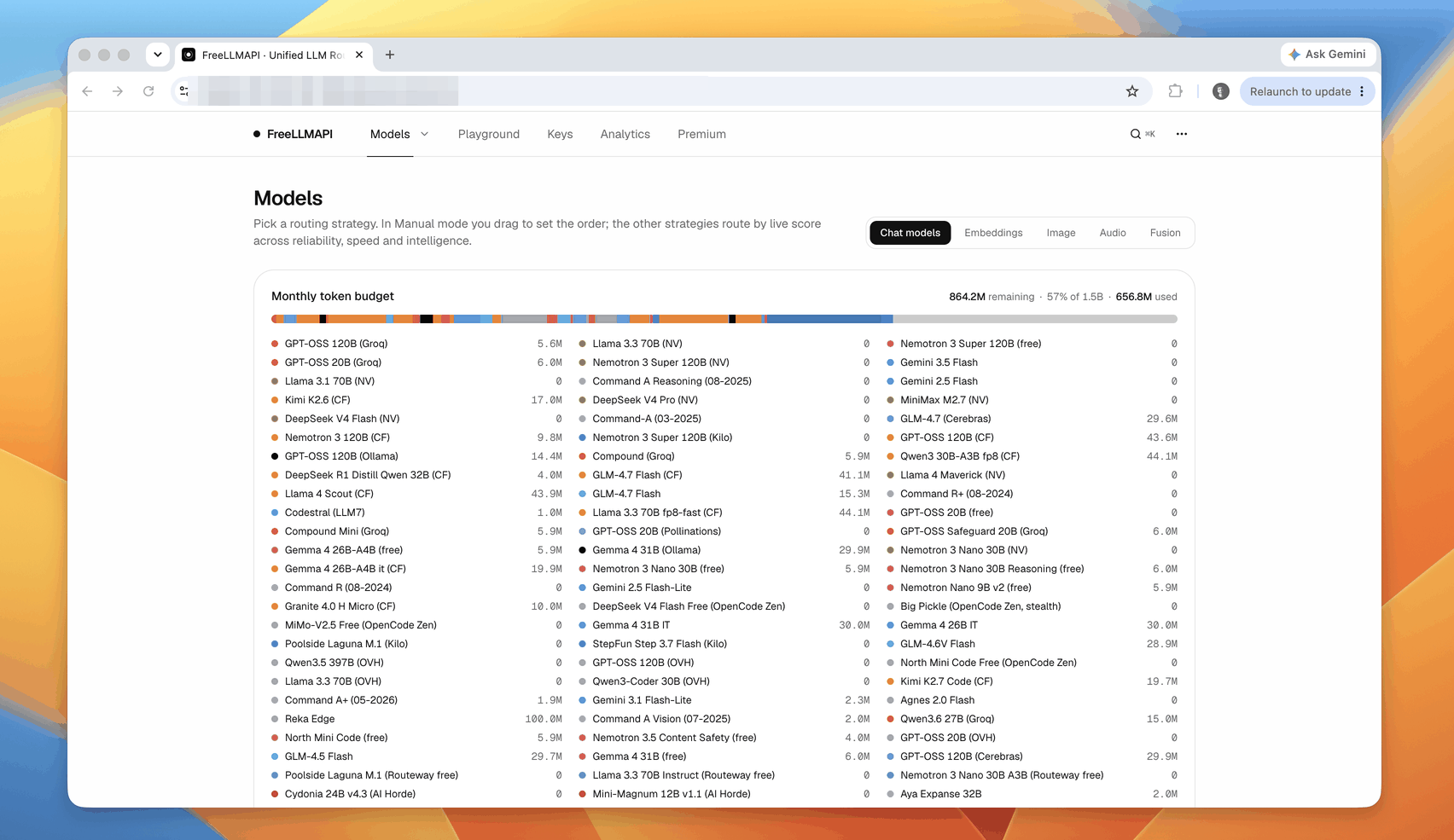
AI research labs universally offer free tiers providing millions of monthly tokens and thousands of daily requests. Individually, these tiers serve as mere development toys. Combined, they accumulate into roughly 7.4 billion tokens per month of working inference capacity across 474 model families and 635 provider endpoints.
However, manual integration introduces severe friction. Developers must manage thirty-four distinct SDKs, handle thirty-four different rate-limit schemas, and monitor thirty-four failure points. This heavy glue-code overhead prevents engineers from utilizing free tiers in production workflows.
FreeLLMAPI collapses this complexity into a single local daemon exposing standard /v1 endpoints. Pointing any OpenAI-compatible client library at the local proxy enables transparent routing across whichever providers have configured keys, handling failovers automatically.
💡 Architectural Core Insight: By normalizing heterogeneous vendor interfaces and integrating a signed feed mechanism, FreeLLMAPI transforms fragmented free APIs into a resilient, self-healing virtual inference cluster.
2. Core Architecture and Data Flow Analysis
The internal architecture comprises an encrypted key vault, a dynamic routing engine, a signed catalog synchronizer, and a compatibility translation layer. Keys remain encrypted at rest. The routing engine tracks real-time usage quotas per provider. When a client initiates a chat, embedding, image, or audio request, the gateway intercepts it, selects the optimal endpoint based on current health and remaining budget, and executes the request. If a provider returns a rate-limit error, execution falls over to the next available provider instantaneously.
[ Client / CLI / Agent ]
           │
           ▼ (OpenAI Compatible API)
[ FreeLLMAPI Gateway ] ---> [ Encrypted Key Vault ]
           │
           ├──> [ Dynamic Routing Engine ] ---> [ Provider A (Google) ]
           │                                  ---> [ Provider B (Groq) ]
           │                                  ---> [ Provider C (Cerebras) ]
           ▼
[ Signed Feed Synchronizer ] <---> [ freellmapi.co Catalog ]
The free-tier landscape shifts constantly as providers launch models, retire endpoints, or alter quotas. FreeLLMAPI bypasses manual git pull updates by pulling a signed model catalog directly from the upstream registry. Free installations consume monthly snapshots where new models arrive thirty days post-launch, while premium instances receive immediate same-day catalog updates.
3. Technical Selection and Hardcore Performance Comparison
| Evaluation Dimension | FreeLLMAPI Approach | Traditional Implementation | Typical Competitor Solutions | Production Benefits |
|---|---|---|---|---|
| Interface Protocol | OpenAI-compatible standard | Proprietary vendor SDKs | Hardcoded custom gateways | Zero code modifications needed |
| Quota Management | Encrypted vault & usage tracking | Manual scripts & monitoring | Basic round-robin without state | Prevents throttling & token waste |
| Model Synchronization | Signed feed incremental updates | Manual config edits & Git Pull | Static configuration files | Eliminates 404 errors from stale models |
| Failover Mechanism | Dynamic multi-provider fallback | Single point of failure exceptions | Client-side retry reliance | Guarantees pipeline continuity |
| Maintenance Overhead | Single daemon & desktop app | Dozens of client dependencies | Custom load-balancing code | Reduces multi-vendor overhead by 90% |
These metrics demonstrate that traditional multi-vendor integrations force developers to write extensive custom state management and retry logic. FreeLLMAPI encapsulates these concerns inside the proxy layer, maximizing free resource utilization.
4. Hands-on Geek Guide: Building a Minimal Closed-Loop
Deploying FreeLLMAPI locally and executing calls via Python requires a running instance. The following Docker Compose configuration deploys the backend server:
# docker-compose.yml production deployment setup
version: '3.8'
services:
  freellmapi:
    image: ghcr.io/tashfeenahmed/freellmapi:latest
    ports:
      - "8080:8080" # Map local proxy port to container internal port
    environment:
      - ENCRYPTION_KEY=your_secure_encryption_key_here # Secret key for encrypting local credential store
    restart: unless-stopped
After initializing the container, input provider API keys via the dashboard or REST API. The following Python script verifies OpenAI compatibility:
import os
from openai import OpenAI

# Initialize OpenAI client pointing base_url to the local FreeLLMAPI gateway
client = OpenAI(
    base_url="http://localhost:8080/v1",
    api_key="dummy_key_or_user_token" # Gateway authenticates using stored provider keys
)

# Execute standard chat completion request; router handles optimal endpoint selection
response = client.chat.completions.create(
    model="auto", # 'auto' triggers dynamic routing across available free endpoints
    messages=[
        {"role": "system", "content": "You are a rigorous systems engineer."},
        {"role": "user", "content": "Explain the execution overhead of virtual memory paging."}
    ],
    temperature=0.2
)

# Print inference output returned by the model
print(response.choices[0].message.content)
Executing this Python script routes the request through the local proxy to an available free provider (such as Groq or Google), returning a standardized completion response.
5. Production Gotchas and Mitigation Strategies
Deploying multi-provider free aggregation gateways in production environments requires mitigating physical constraints and synchronization latency.
⚠️ Gotcha Warning 1: Cold Starts and Throttling Jitter on Free Providers: Certain free providers (such as Hugging Face or serverless edge nodes) spin down instances after periods of inactivity, causing cold-start latencies exceeding 2 seconds on initial calls. Applications must configure appropriate request timeouts to prevent cascading failures.
⚠️ Gotcha Warning 2: Encryption Overhead Under High Concurrency: FreeLLMAPI decrypts provider API keys per request lifecycle. High concurrent request volumes introduce CPU overhead during decryption cycles. Production deployments should enable in-memory key caching or offload ultra-high throughput tasks to dedicated commercial or local endpoints via custom provider configurations.