
1. The Core Bottleneck: What Engineering Flaw Does It Smash?
Mainstream AI coding agents process tasks while generating massive amounts of mechanical fluff, such as "The reason why..." and "I'd recommend using...". These verbose explanations directly inflate input and output token consumption. Developers pay for lengthy agent rationales while enduring unnecessary context overhead when reading massive log files, test outputs, and JSON responses.
Caveman adopts a minimalist paradigm, forcing agents to drop all non-essential decorative prose. Code blocks, terminal commands, file paths, and exact error messages remain intact, while only the narrative text surrounding these core technical assets undergoes compression. This strategy drastically reduces per-interaction compute overhead while maintaining diagnosis and fix accuracy.
💡 Core Architectural Insight: Reshaping agent expression protocols rather than tweaking underlying model weights squeezes out the water in token economics while keeping baseline inference quality intact.
2. Core Architecture and Data Flow Analysis
Caveman's engineering architecture splits into three progressive tiers: Skill rule files, Local Proxy, and Runtime Middleware. Users can deploy single components or the full stack based on infrastructure requirements.
[ AI Agent / Client ] ---> [ Local Proxy / Middleware ] ---> [ Token Compression Engine ] ---> [ LLM Provider ]
                                     │                                                              |
                                     └─────────────<── [ Original Backup Store ] <──────────────────┘
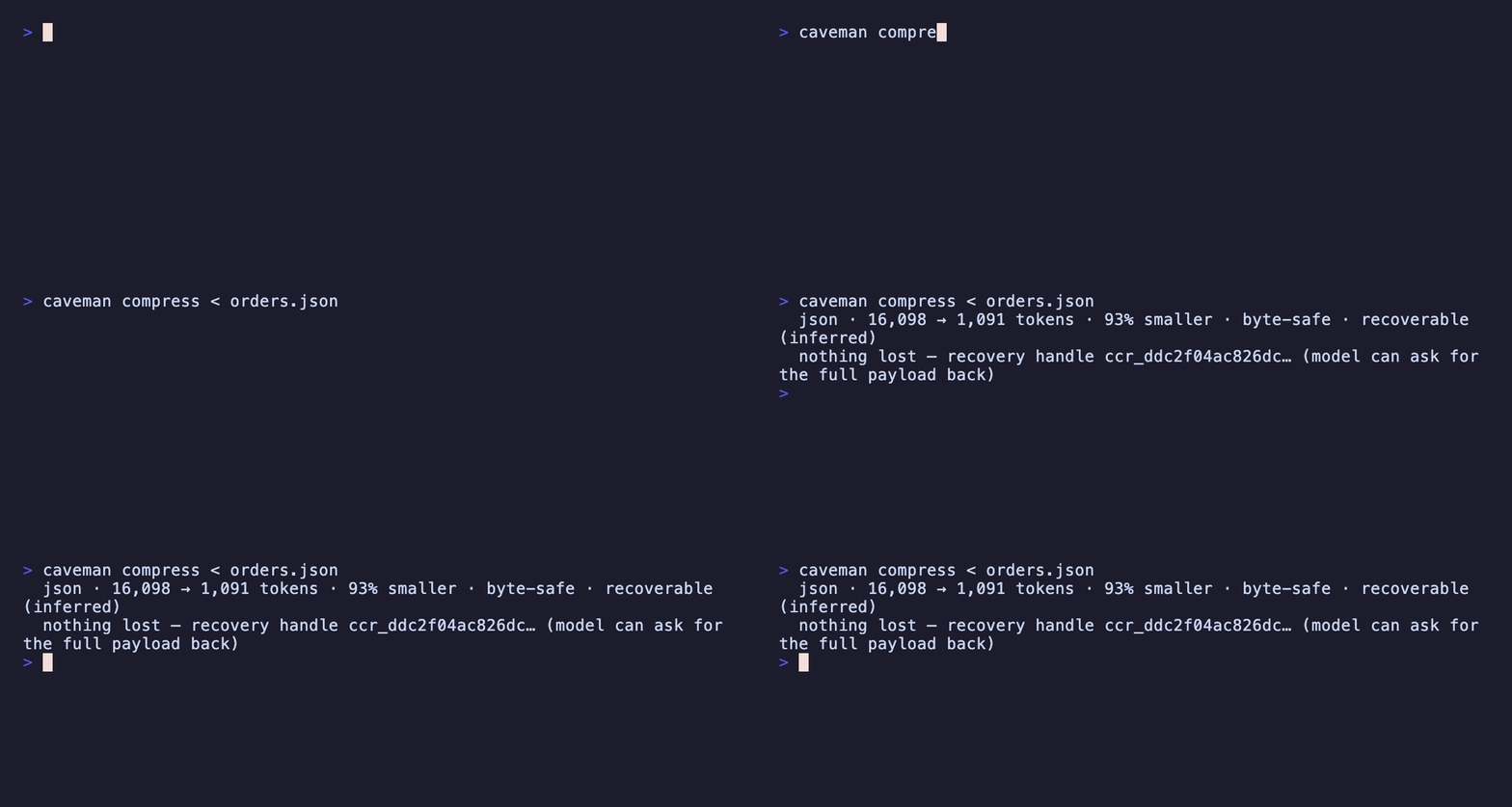
In the low-level data flow, the Local Proxy intercepts communication streams between the agent and AI providers. When agents ingest logs, test outputs, or heavy JSON payloads, the middle layer executes dynamic distillation, stripping redundant characters and compressing core data. All compressed original bytes write to a local backup store in real-time, allowing large models to instantly retrieve original context via lightweight pointers without breaking state machine coherence.
3. Tech Stack and Performance Benchmarking
| Evaluation Dimension | This Solution (caveman) | Traditional Paradigm | Typical Competitor | Production Yield |
|---|---|---|---|---|
| Integration Cost | Instant activation via single CLI command | Manual prompt template adjustment & fine-tuning | Paid third-party commercial gateway proxy | Zero-运维 switch, minute-level deployment |
| Token Compression Ratio | 1.4x to 2.4x (up to 3x verified) | 1.0x (No optimization) | 1.1x to 1.3x (Standard lossless compression) | Slash over one-third of monthly API bills |
| Agent Compatibility | Native support for 30+ major IDE & CLI agents | Locked to specific vendor model endpoints | Restricted to specific frameworks (e.g., LangChain plugins) | Zero disruption to existing developer toolchains |
| Context Safety | Real-time local byte backup, model recallable | Full transmission without state loss protection | Blind dropping leads to hallucination spikes | Zero degradation in code fix accuracy |
The architectural advantage lies in decoupling prompt constraints from communication pipelines. Traditional approaches rely on manual, unstable system prompt tuning, whereas Caveman combines rules, proxies, and middleware to achieve structural slimming at the earliest point of system invocation.
4. Zero-to-Production Hands-on Guide
Initialize the global Skill rules by executing the quick setup command in your terminal:
# Install skills registry globally and register the caveman rule file
npx skills add JuliusBrussee/caveman -g
To intercept read streams in production environments, start the local proxy service:
# Install the caveman CLI tool and initialize environment hooks
npm install -g @caveman-ai/cli && caveman setup --install

# Launch a specific agent wrapper (e.g., Claude Code)
caveman claude
Integrate middleware within custom TypeScript/Node.js agent applications:
import { createCavemanMiddleware } from '@caveman-ai/middleware';
import { OpenAI } from 'openai';

// Initialize the OpenAI client instance
const openai = new OpenAI({ apiKey: process.env.OPENAI_API_KEY });

// Wrap API calls to perform byte distillation on tool outputs at the transport layer
const cavemanMiddleware = createCavemanMiddleware({
  compressionLevel: 'aggressive',
  backupStore: './.caveman_cache'
});

async function runAgentTask(prompt: string) {
  // Pass execution context while middleware handles token density on input/output
  const response = await openai.chat.completions.create({
    model: 'gpt-4o',
    messages: [{ role: 'user', content: prompt }],
  });
  return response;
}
Running this script strips redundant natural language payloads before hitting the LLM at the transport layer, while preserving original code and error traces in the cache directory for model retrieval.
5. Production Gotchas and Pitfalls
Deploying in high-concurrency production environments requires caution regarding local storage growth and edge-case text parsing.
⚠️ Pitfall Warning [Local Backup Store Bloat]: During frequent execution of long-text tests, agents may rapidly accumulate raw data within the
.caveman_cachedirectory. Ensure scheduled cleanup jobs are configured in deployment scripts or restrict maximum cache lifecycles via CLI parameters.⚠️ Pitfall Warning [Strict Type Schema Collisions]: When middleware processes strictly typed JSON Schema outputs, overly aggressive token distillation can cause edge properties to undergo erroneous pruning. Explicitly skip specific structs using white-list configurations in code blocks dealing with complex object trees.