
1. The Core Bottleneck: What Engineering Flaw Does It Fix?
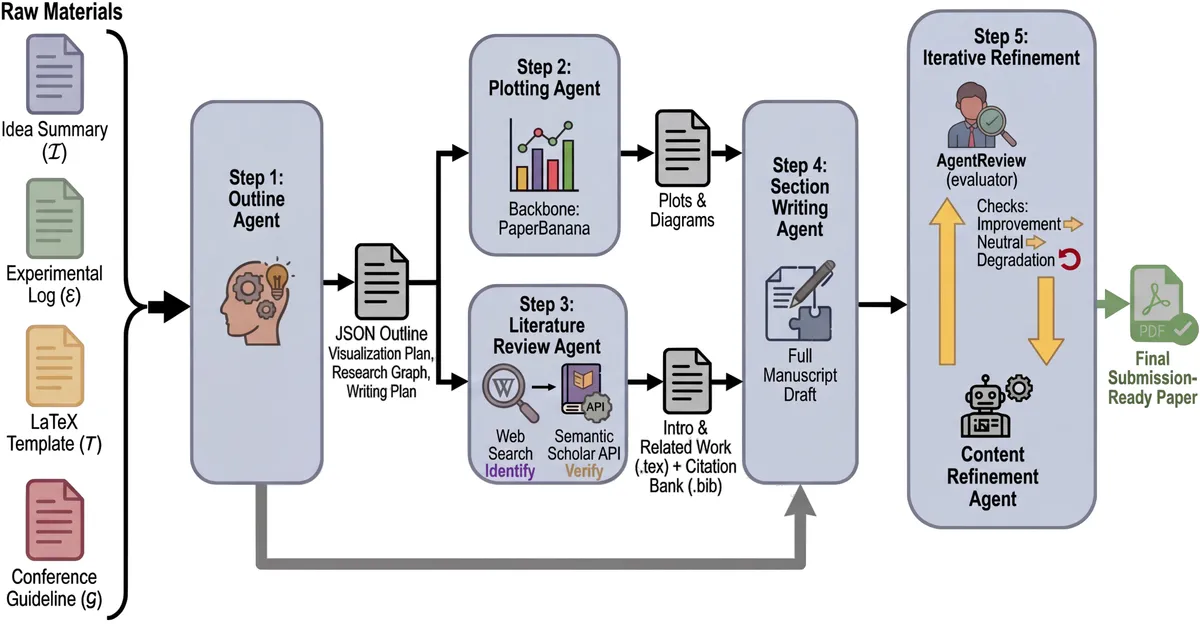
AI researchers are frequently bogged down by the tedious mechanics of academic writing, where raw code implementations and experimental logs fail to translate smoothly into structured arguments. Traditional single-prompt generation approaches lack state management, resulting in broken LaTeX syntax, missing references, and dropped figures. PaperOrchestra introduces a multi-agent task collaboration design, decomposing the writing workflow into independent sub-tasks including outline planning, literature synthesis, section drafting, content reflection, and plotting.
💡 Core Architectural Insight: By embedding LLMs into specialized agent state machines, this framework eliminates the context contamination and logical fragmentation typical of monolithic text generation.
2. Architecture & Data Flow Analysis
The core logic resides within the methods/ and utils/ directories. The framework ingests raw material directories and target conference LaTeX template directories, dispatching tasks via a unified gateway to specialized agents. The literature review module interfaces with the Semantic Scholar API to dynamically filter and assemble background citations. Plotting and section writing agents run concurrently, injecting structured text and generated visuals into the LaTeX template for final rendering.
[ CLI / Streamlit Demo ] ---> [ Raw Materials & Template Parser ] ---> [ State Manager ]
                                                                        │
         ┌──────────────────────────────────────────────────────────────┘
         ▼
[ Dynamic Execution Engine ] ---> [ Outline Agent ] ---> [ Literature Review Agent ]
                                                         │
                                                         ▼
[ LaTeX Compiler ] <--- [ Plotting Agent ] <--- [ Section Writing & Refinement Agent ]
The execution flow utilizes explicit state persistence. Each agent's output undergoes compliance checks via a validation module; if reference formatting errors or logical gaps are detected, the system triggers a reflection agent for localized rewriting.
3. Technical Selection & Hardcore Benchmark
| Dimension | paper-orchestra | Monolithic Prompting | Scripted API Pipelines | Production Benefit |
|---|---|---|---|---|
| Paradigm | Multi-agent state machine | Single LLM invocation | Python scripts chaining APIs | Lower failure radius, retry logic |
| Literature | Dynamic Semantic Scholar lookup | Static model memory | Hardcoded reference lists | Real-time relevance and citation accuracy |
| Templates | Custom LaTeX subfolders | Plain text manual formatting | Single hardcoded template | Seamless target conference compliance |
| Plotting | Code-generated plots & diagrams | Text descriptions only | No native plotting capability | Automated IEEE/ACM-compliant visuals |
The architecture decouples compute units, containing LLM stochasticity within localized agents and preventing the cascading failures seen in monolithic long-form generation.
4. Hands-on Practice: Building the Minimal Closed Loop
Environment initialization relies on Conda with a mandatory Python 3.11 runtime. Clone the repository and execute the following commands to provision the isolated virtual environment.
# Create and activate the dedicated Conda environment
conda create -n paper_orchestra python=3.11
conda activate paper_orchestra

# Install all required project dependencies
pip install -r requirements.txt
Create a .env configuration file in the project root containing your LLM API keys and academic search credentials:
SEMANTIC_SCHOLAR_API_KEY=your_semantic_scholar_api_key
OPENAI_API_KEY=your_openai_api_key
GEMINI_API_KEY=your_gemini_api_key
Launch the paper generation pipeline via the Python CLI:
python paper_writing_cli.py \
  --raw_materials_dir /path_to_your_raw_materials/ \
  --latex_template_dir templates/cvpr2025 \
  --output_dir ./output_paper \
  --use_plotting true
Upon successful execution, the output directory will contain complete LaTeX source files along with all required .bib and figure assets.
5. Production Gotchas & Mitigation Strategies
Generating large-scale LaTeX documents concurrently risks hitting API rate limits and network drops. Developers must ensure sufficient Semantic Scholar quotas within the .env file; otherwise, the literature review module degrades, outputting manuscripts lacking cutting-edge citations.
⚠️ Gotcha Warning [API Rate Limits]: High-frequency calls to citation endpoints easily trigger 429 throttling. Developers should implement exponential backoff retry logic and tune concurrent thread counts within the retrieval module.
LaTeX template directory structures must strictly adhere to official subfolder conventions. When supplying custom conference templates, missing macro declarations will cause the compilation agent to throw syntax errors during final rendering.
⚠️ Gotcha Warning [Template Compilation Failures]: Placing custom LaTeX templates inside the
templates/directory requires complete.clsor.stystyle files to prevent the generation pipeline from hanging due to missing packages.