
1. The Core Bottleneck: What Engineering Dead Ends Does It Break?
Mobile test automation historically relied on brittle element IDs and hardcoded coordinates. UI redesigns instantly invalidate existing test scripts. Traditional Appium setups demand expensive maintenance overhead, while pure visual agents driven by raw pixels and coordinates suffer from excessive latency, frequently exceeding ten seconds per step.
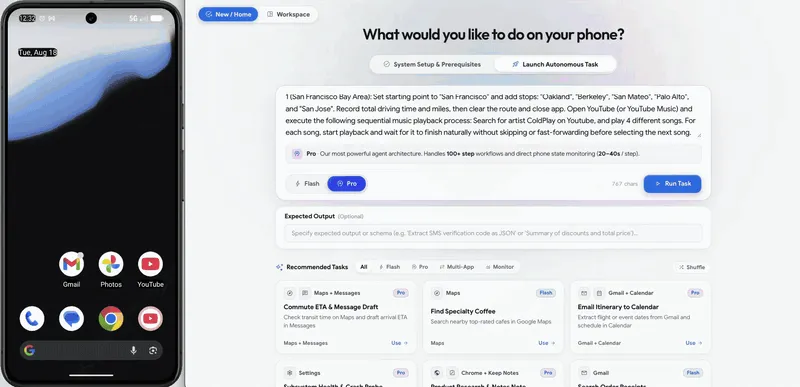
Google Artemis implements a multimodal targeting strategy that prioritizes structured element indices when available, while falling back gracefully to coordinate and visual matching for custom interfaces. The system utilizes asynchronous history summaries to power a reactive observe-and-act loop running at 3 to 5 seconds per step, balancing precision with execution throughput.
💡 Architecture Core Insight: Protocol standards directly bridge the gap between AI coding environments and hardware layers, eliminating intermediary service overhead and granting IDEs native device awareness and diagnostic capabilities.
2. Architecture & Data Flow Analysis
Artemis decouples the control plane from the execution plane. AI IDEs dispatch structured natural language instructions to the gateway via the Model Context Protocol. The gateway parses these instructions and invokes underlying adb and scrcpy toolchains for binary interaction with physical hardware.
[ Antigravity / Claude Code ] ---> [ MCP Server ] ---> [ Gateway / Parser ]
                                                            │
                                                            ▼
[ Logcat / Screenshots ] <--- [ Device State ] <--- [ Dynamic Execution Engine ]
The core execution engine validates targets before executing individual actions. When encountering blocking popups, network latency, or incomplete page renders, the executor flags blocked actions and passes the state back to the operator or AI planner for context recovery. This long-running exploratory stability design drives its 99%+ multi-step task completion rate on Google Research's AndroidWorld benchmark.
3. Technology Selection & Comparative Hardcore Metrics
| Evaluation Dimension | This Solution (artemis) | Traditional Paradigm (Appium) | Pure Vision AI Agent | Production Gains |
|---|---|---|---|---|
| Targeting Mechanism | Structured Index + Visual/Coord Fallback | Static XPath / Element IDs | Pure Pixel Coordinates | Reduces 80% of element obsolescence rework |
| Execution Latency | 3-5 seconds per step | 1-2 seconds per step (Fragile) | 10-15 seconds per step | Optimal balance between stability and speed |
| IDE Integration | Native Model Context Protocol | No native support, independent clients | Custom WebUI or IDE extension | Developers drive real devices directly inside coding environments |
| Environment Setup | Python uv zero-conflict bootstrap | Complex WebDriver driver versioning | Heavy multimodal inference containers | Newcomer ramp-up shortened from hours to 2 minutes |
The architectural trajectory of Artemis confirms that pure vision models lacking structured tree data fail in production environments. By combining hybrid indexing with the MCP protocol, the project maps AI inference outputs directly to deterministic Android system API calls.
4. Hands-on Geek Guide: Building the Minimal Production Loop
Verify that an Android device or emulator with USB Debugging enabled is connected. The project includes startup scripts that automatically detect and install ADB, scrcpy, FFmpeg, and Python uv dependencies.
Run the following commands to clone the repository and invoke the initialization wizard:
# Clone the repository and enter working directory
git clone https://github.com/google/artemis.git && cd artemis

# Run one-click installation and dependency bootstrap
./start.sh
To execute a single test task directly from the CLI, invoke the runner via uv:
# Launch Artemis CLI to execute natural language mobile automation tasks
uv run artemis run "Open Settings, find Battery and tell me current level" --profile flash
Upon CLI launch, the system connects to the device, retrieves the current view hierarchy, translates natural language instructions into action sequences dispatched to the device, and streams step execution counts and state logs directly to the terminal.
5. Production Deployment Gotchas & Prevention Strategies
Deploying Artemis at scale for automated regression testing or CI pipelines requires accounting for physical hardware operational constraints.
⚠️ Gotcha Warning: Battery Thermal Protection and Sleep States Extended exploratory testing sessions cause physical test devices to overheat or trigger screen locks. Ensure screen timeout is disabled via adb and connect devices to a constant power supply before test execution.
⚠️ Gotcha Warning: Hardcoded MCP Paths When manually configuring MCP settings for Claude Desktop or Antigravity, absolute paths inside JSON blocks must point directly to the project's actual virtual environment Python executable, otherwise subprocesses throw ModuleNotFoundError exceptions.
Systematically configuring IDE rule files and MCP environment variables enables engineering teams to establish an end-to-end automated loop spanning requirement drafting, code implementation, physical device verification, and log telemetry.