
1. The Core Bottleneck: What Engineering Deadlock Does It Break?
AI engineering teams face a stark reality: the fragmentation of multi-vendor APIs and the exponential explosion of inference costs. When production systems mix OpenAI, Anthropic, Gemini, and local open-source models, developers are forced to build brittle adapter layers to handle divergent request payloads and error codes. Meanwhile, high-frequency coding agents like Claude Code or Codex generate massive, uncontrollable token consumption. Traditional API key management tools fail to enforce granular, identity-based and case-specific budget caps.
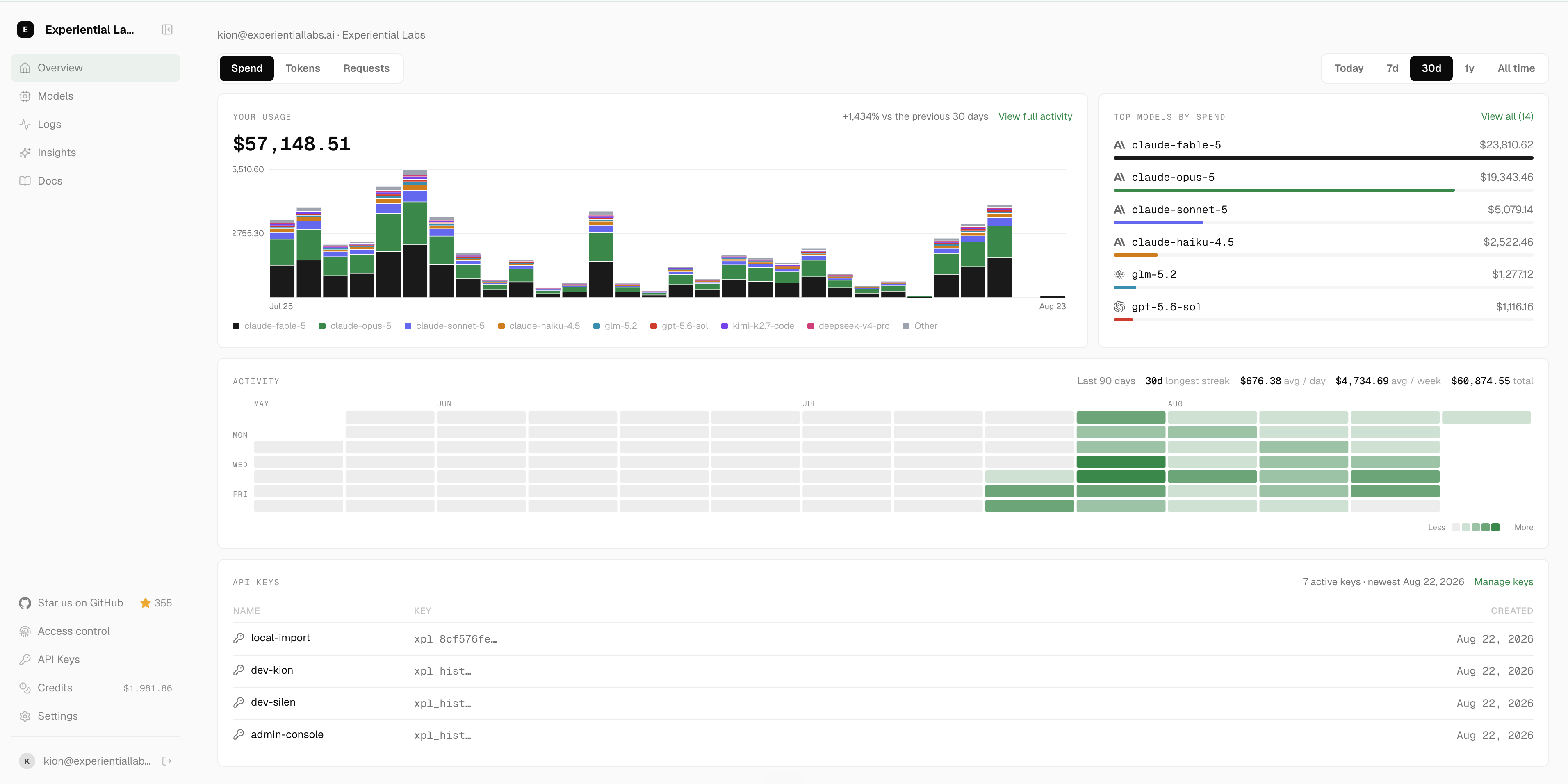
Experiential cuts straight through this bottleneck. Rather than relying on superficial prompt engineering wrappers, it approaches the problem from network infrastructure and data flow. It delivers an open-source framework combining gateway routing, traffic capture, and a local model fine-tuning loop. Engineers can repoint existing client code to a local or hosted gateway port, instantly gaining unified authentication, budget enforcement, and production traffic capture.
💡 Core Architectural Insight: Experiential elevates the AI gateway from a simple reverse proxy to a training data harvester, converting expensive online production traffic directly into the core asset for training lightweight custom routers.
2. Core Architecture and Data Flow Analysis
Experiential relies on a compiled native data plane for ultra-low latency and high throughput. The system comprises a local gateway, an identity and budget control module, an OpenTelemetry trace collector, and a dynamic model optimization pipeline. When a client initiates a chat completion request, it hits the local loopback port where the gateway parses the target model based on public aliases, verifies command budgets against the active identity, and securely dispatches the payload to the designated inference provider.
[ Client / CLI / Agent ] ---> [ Gateway / Parser (exp) ] ---> [ Identity & Budget Filter ]
                                                                         │
                                                                         ▼
[ Local / Open Source Model ] <--- [ Optimized Router Engine ] <--- [ Telemetry & Trace Capture ]
On the engineering trade-off front, the project eschews heavy service frameworks in favor of a lightweight design. Configuration and credentials persist locally within .exp/settings.toml, allowing zero-friction startup. Additionally, the traffic capture module hooks directly into macOS local application networking to intercept underlying traces from mainstream coding agents without degrading runtime performance.
3. Technology Selection and Hardcore Benchmarking
| Evaluation Dimension | This Solution (experiential) | Traditional Paradigm | Typical Competitor | Production Benefit |
|---|---|---|---|---|
| API Compatibility | Unified OpenAI-compatible API for all models | Custom SDKs and adapter logic per vendor | Traditional multi-tenant API gateway (e.g., LiteLLM) | Eliminates client refactoring costs; zero friction model switching |
| Traffic Capture | Native OTLP trace capture and export | Manual application-level logging and metrics | Enterprise APM platforms | Automatically gathers fine-tuning datasets, bypassing manual cleaning |
| Cost Reduction Path | Traffic capture -> Router build -> Open source fine-tune | Static hardcoded routing rules or manual tuning | Static load balancers | Migrates high-frequency simple tasks to low-cost local models |
| Setup & Deployment | Single pip install followed by exp |
Complex Docker Compose and DB dependencies | Cloud-hosted control planes | Reduces local environment pollution and infrastructure overhead |
| Identity & Budget | Built-in alias and command budget enforcement | Application-layer custom validation logic | API gateway rate-limit plugins | Prevents runaway agent scripts from exhausting API quotas instantly |
From an architectural standpoint, Experiential avoids reinventing a general network proxy. Instead, it targets the specific vertical of AI coding agent traffic governance. Unlike traditional proxy routers like LiteLLM, it bridges the gap between production traffic and local model fine-tuning via tools like Tinker, transforming itself from a mere traffic filter into an LLM distillation factory.
4. Hands-on Geek Practice: Building the Minimal Loop
Set up the minimal environment on a dev machine by installing the core CLI package and launching the local gateway:
# Install the experiential core library
pip install experiential

# Start the local OpenAI-compatible gateway (first run triggers the setup wizard)
exp
Once the gateway outputs the temporary key and listener address, execute the following Python script to invoke the local private gateway using the official router loader:
import exp

# Load project router config using exp.load_router, managing client lifecycle automatically
with exp.load_router("my-project") as client:
    # Send an inference request via the standard chat completions interface
    response = client.chat.completions.create(
        model="my-project",
        messages=[{"role": "user", "content": "hello"}],
    )
    # Print the resulting response text
    print(response.choices[0].message.content)
To verify gateway connectivity via standard curl, configure the environment variable and dispatch a payload:
# Configure the auth key generated by the local gateway
export EXP_GATEWAY_KEY="xpl_..."

# Send a standard OpenAI-formatted request to the local gateway
curl http://127.0.0.1:8000/v1/chat/completions \
  -H "Authorization: Bearer $EXP_GATEWAY_KEY" \
  -H 'Content-Type: application/json' \
  -d '{"model":"opus-5","messages":[{"role":"user","content":"Help me"}]}'
5. Production Gotchas and Avoidance Strategies
Deploying Experiential into production or high-intensity development environments requires careful attention to networking constraints and dependency quirks.
⚠️ Gotcha Warning [macOS Network Capture Limits]: The
exp capturemodule remains experimental, designed exclusively to capture local traffic from desktop apps like Codex and Claude Code. This feature relies heavily on macOS system environments and certificate trust authorizations, which may fail under complex corporate VPNs or strict network isolation policies. For production server deployments, stick exclusively to gateway mode rather than desktop capture mode.⚠️ Gotcha Warning [Telemetry Default Reporting]: Experiential enables anonymous PostHog product telemetry by default. While the project explicitly excludes prompts, traces, credentials, and customer content, air-gapped or strictly compliant enterprise environments must manually execute
exp config telemetry disableduring initial setup to prevent compliance violations.