1. The Core Bottleneck
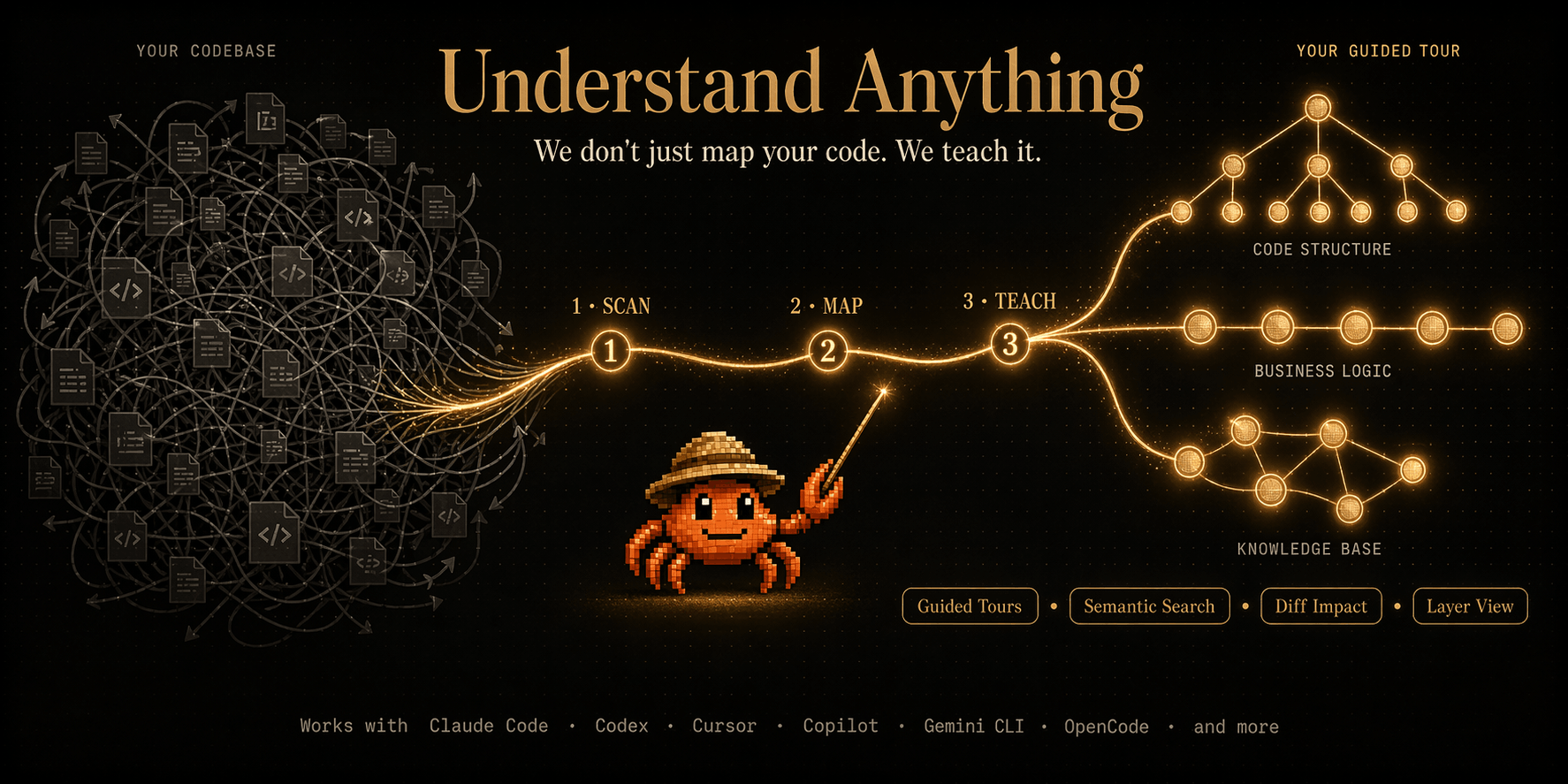
Onboarding onto legacy codebases with hundreds of thousands of lines forces developers into tedious manual searches across disparate files. Understand-Anything replaces this inefficient paradigm by deploying a multi-agent pipeline that parses raw source files into structured, interactive knowledge graphs, making dependencies and structural boundaries instantly transparent.
💡 Architectural Insight: Translating static source code into structured topological graphs transforms implicit code coupling into explicit, navigable system maps.
2. Core Architecture and Data Flow
The runtime mechanism relies on a coordinated multi-agent workflow. When a developer triggers the analysis command, a static gateway parser scans the target directory to extract file, function, and class metadata. This metadata flows into the dynamic execution engine, where agents infer implicit dependencies before persisting the result into a local JSON knowledge graph.
[ CLI Terminal / Claude Code ] ---> [ Gateway / Static Parser ] ---> [ Memory Layer ]
                                              │
                                              ▼
                                  [ Dynamic Execution Engine ]
                                              │
                                              ▼
                               [ .ua/knowledge-graph.json ]
Architectural trade-offs favor an incremental analysis model. The initial full-scan run consumes significant token resources, but subsequent executions rely on diff-based incremental updates to re-analyze only modified files, striking a balance between compute overhead and state freshness.
3. Technical Selection and Comparative Matrix
| Dimension | Understand-Anything | Traditional Paradigm | Alternative RAG Solutions | Production Impact |
|---|---|---|---|---|
| Context Building | Multi-agent graph generation | Manual code review & grep | Basic vector chunking | Global system perspective |
| UI & Interaction | Interactive web dashboard | IDE text search & jumps | Static Markdown reports | Multi-layered visual drill-down |
| Update Mechanism | Incremental diff analysis | Full re-indexing or manual | Per-query index rebuilding | Lower token burn & cold start |
| Localization | Native multi-language output | Third-party translation | Single language support | Seamless global team adoption |
This architecture bypasses the limitations of traditional text-retrieval RAG, enabling engineers to inspect domain flows and structural layers visually rather than guessing execution paths through raw log files.
4. Hands-on Geek Guide: Building the Minimal Loop
Deploying and executing Understand-Anything within a local environment requires installing the package through the Claude Code plugin registry.
# 1. Add the plugin to the Claude Code marketplace
/plugin marketplace add Egonex-AI/Understand-Anything

# 2. Install the core plugin
/plugin install understand-anything

# 3. Analyze the codebase and generate the knowledge graph in English
/understand --language en

# 4. Launch the interactive visualization dashboard
/understand-dashboard

# 5. Query specific system workflows via CLI chat
/understand-chat How does the payment processing loop work?
Executing /understand generates a hidden .ua/ directory containing .ua/knowledge-graph.json, powering the local web dashboard with color-coded architectural layers and semantic search capabilities.
5. Production Gotchas and Mitigation Strategies
Deploying agentic tools in enterprise repositories requires careful resource management to avoid runaway execution costs.
⚠️ Gotcha Warning [Token Budget Exhaustion]: Running the initial
/understandcommand on massive enterprise repositories triggers full-file ingestion that can consume substantial token quotas. Mitigate this by utilizing local model providers like Ollama during initialization or executing under a high-tier subscription plan.⚠️ Gotcha Warning [Stale Graph State]: Heavy structural refactoring can cause local cache drift inside
.ua/knowledge-graph.json. If node links become out of sync, delete the.ua/directory manually and execute a fresh initialization scan.