1. The Core Bottleneck: What Engineering Deadlock Was Broken?
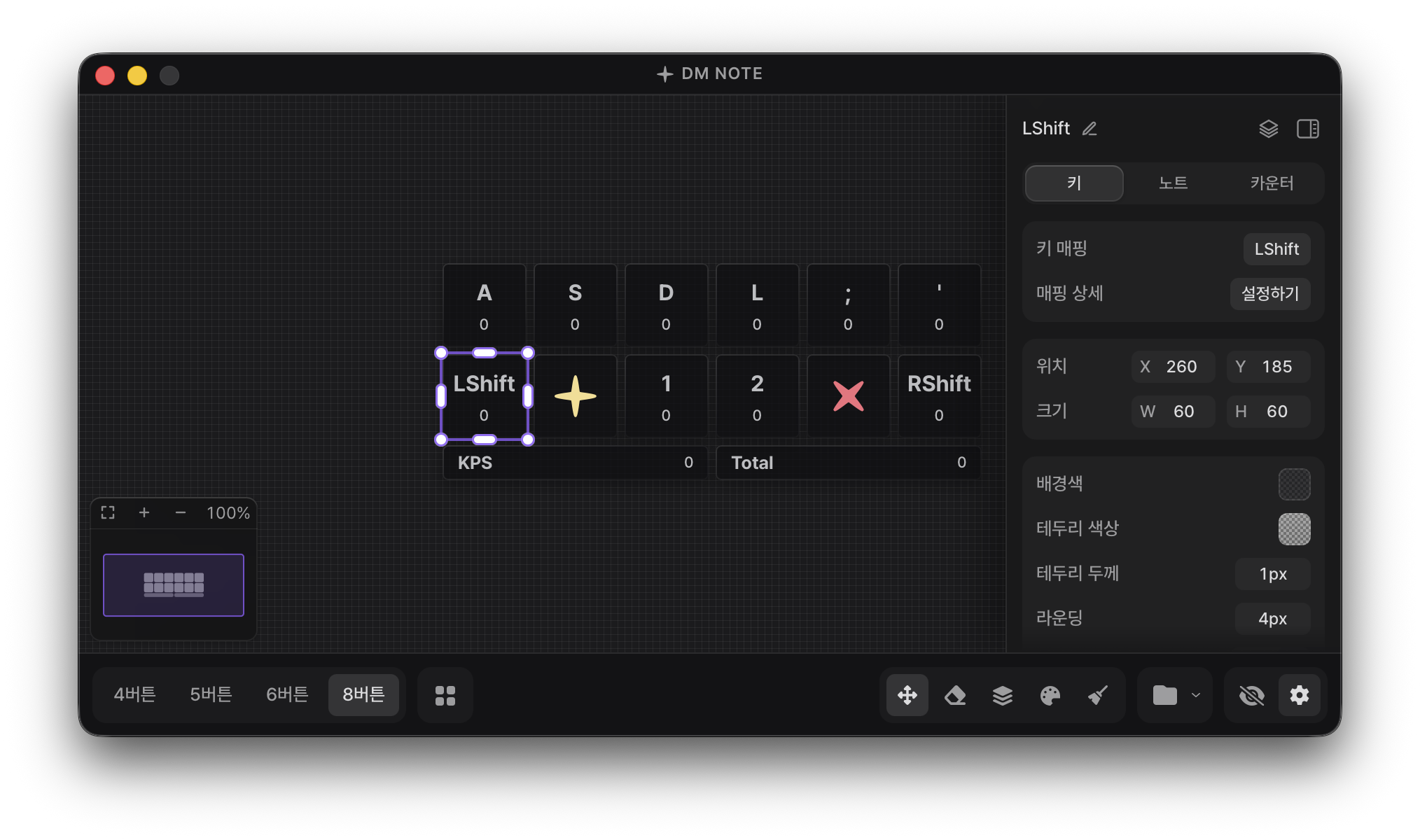
Rhythm game players and live streamers have long faced a persistent dilemma. Key visualizers built on traditional web stacks rely heavily on Electron, causing memory consumption to plateau at hundreds of megabytes. More critically, the JavaScript event loop introduces inherent scheduling jitter when handling high-frequency multi-key combos, creating a visible lag between physical keystrokes and on-screen rendering. DmNote abandons the heavy web-wrapper approach entirely, utilizing a Rust backend to intercept raw input events directly from operating system driver layers.
💡 Core Architecture Insight: Leveraging Rust to capture system-level raw input hooks while delegating visual composition to a lightweight React 19 and Vite 7 stack achieves native response times paired with declarative UI productivity.
2. Core Architecture and Low-Level Data Flow
DmNote adopts a decoupled desktop topology. A Tauri core written in Rust resides in the background, listening to platform-specific low-level input APIs. Windows systems invoke the Raw Input API, while macOS captures global input events. Captured hardware interrupts and key states pass through an internal memory queue, dispatched via Tauri's asynchronous event bus directly into the React 19 rendering tree.
[ Raw Input API / macOS Global Event ] ---> [ Tauri Rust Backend ]
                                                     │
                                                     ▼
[ OBS Browser Source ] <--- [ React 19 + Tailwind View Layer ] <--- [ Async Event Bus ]
The low-level data flow prioritizes non-blocking execution paths. During heavy typing bursts, the Rust backend aggregates local state and aligns timestamps to minimize IPC crossing frequency. The frontend utilizes Tailwind CSS 3 for dynamic grid rendering combined with custom CSS injection, maintaining 60fps to 120fps animation smoothness while holding CPU usage near zero.
3. Technology Stack and Hardcore Benchmarking
| Dimension | This Solution (DmNote) | Legacy Paradigm | Alternative Competitor | Production Benefit |
|---|---|---|---|---|
| Runtime Base | Tauri (Rust + Webview) | Electron (Chromium) | Python + PyQt | Over 70% reduction in memory footprint |
| Input Capture | Raw Input API / OS Native | DOM KeyDown Listeners | Pure Python Hook Libs | Eliminates keyboard dropouts and latency |
| Render Engine | React 19 + Vite 7 | Raw DOM manipulation | Pygame loop | Lightning-fast hot reloading, extensible UI |
| Binary Size | 20MB - 40MB range | 150MB+ | 80MB - 120MB | Ultra-lightweight CI/CD pipelines and distribution |
| ASIO Audio Support | Native Steinberg ASIO SDK | No audio binding | Third-party wrappers | Perfect for low-latency pro audio setups |
The benchmark breakdown demonstrates how the Tauri architecture decisively outperforms Electron in resource footprints and latency control when handling high-frequency inputs.
4. Hands-On Geek Guide: Zero to Minimal Production Loop
Verify that Node.js, Git, and the Rust compilation toolchain are installed on the host machine. For Windows users requiring professional ASIO audio cue output, ensure LLVM is installed via system package managers.
# Clone the official repository to local workspace
git clone https://github.com/DmNote-App/DmNote.git

# Navigate into the project root directory
cd DmNote

# Install frontend and Tauri dependency trees
npm install

# Launch the development server with ASIO backend features enabled
npm run tauri:dev
Executing npm run tauri:dev instructs the Tauri CLI to compile the Rust Cargo workspace and spin up the Vite development server concurrently. Developers can modify React components or tweak Tailwind styles with instantaneous hot-reloading reflected on the key overlay window.
5. Production Gotchas and Pitfalls
Running desktop overlays directly inside resource-heavy games can still impose GPU rendering tax. The optimal engineering pattern is leveraging OBS dedicated modes.
⚠️ Pitfall Warning: Game Frame Drops: Overlaying local windows directly inside exclusive fullscreen games may trigger compositor context switching, causing stutter. Production setups must utilize the OBS Browser Source mode, offloading the renderer to the streaming instance.
⚠️ Pitfall Warning: Untrusted Plugin Assets: Unofficial community CSS or plugins might contain malicious script injections. Manual source code audits are mandatory before ingesting external assets into the asset pipeline.