
1. The Core Bottleneck: What Engineering Flaw Does It Destroy?
Developers constantly face a frustrating visual compromise when asking LLMs to generate system architecture or sequence diagrams. The resulting output is invariably cluttered with generic rounded boxes and drop shadows, or rendered via brittle Mermaid syntax that breaks across themes. Turning these drafts into production-ready graphics requires thirty minutes of manual layout adjustment in Figma, or simply abandoning the diagram entirely. This visual debt stems from the fundamental inability of standard LLMs to respect typographic hierarchy and brand constraints.
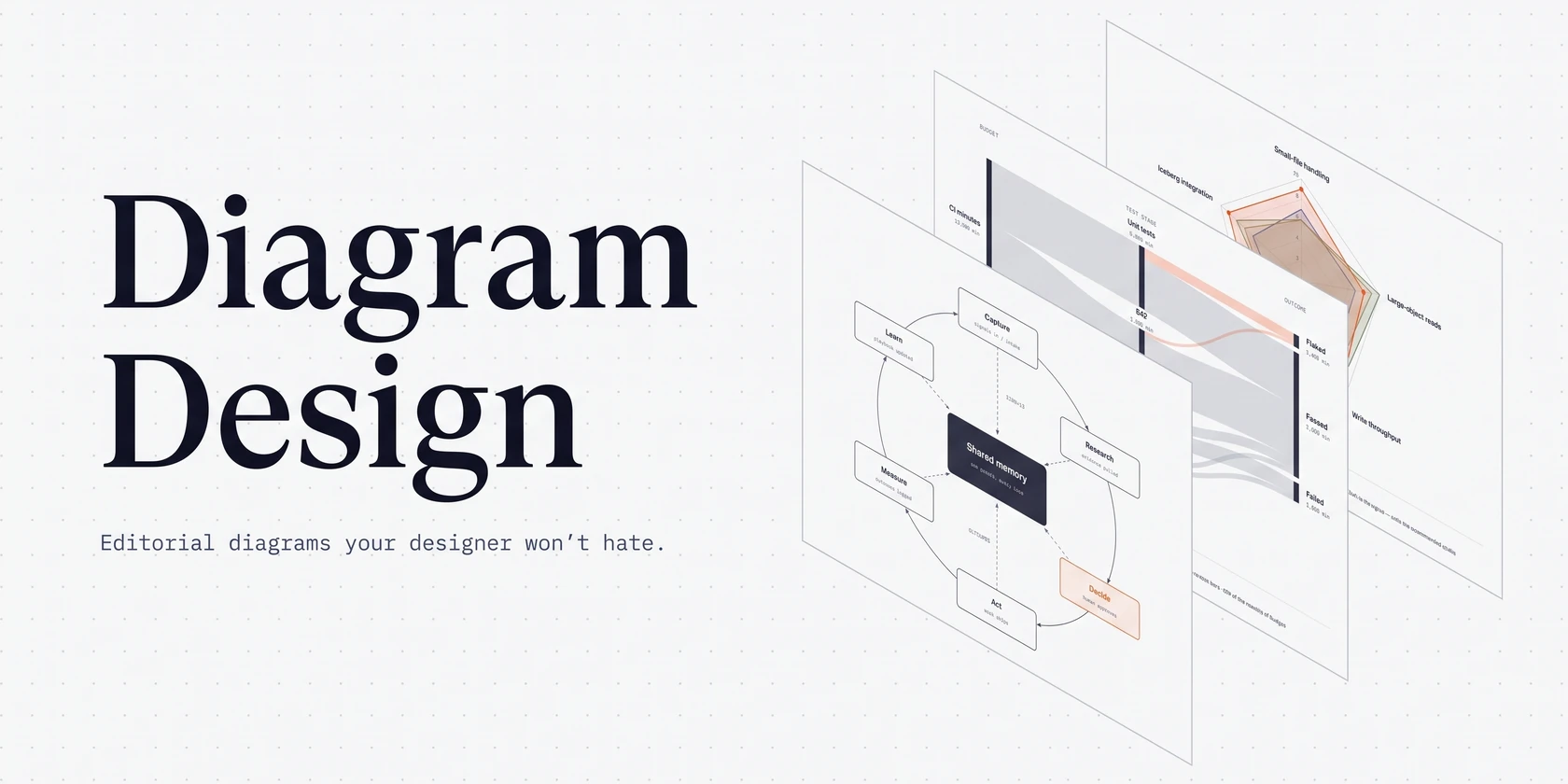
diagram-design hardcodes layout constraints directly into agent hosts like Claude Code. The project strips away all external font dependencies, JavaScript runtimes, and bloated charting libraries. Every node relies on raw grid alignment and precise whitespace. The accent color is strictly reserved for the one or two critical components the reader must inspect first, eliminating decorative color blocks that carry zero information density.
💡 Core Architectural Insight: Decoupling behavior from layout via semantic system patterns allows agents to reuse existing topologies for queues, policy traces, and trust boundaries without expanding the total type count.
2. Core Architecture & Data Flow Analysis
diagram-design operates natively within agent-compatible hosts such as Claude Code, Codex, Factory Droid, and Pi. When a user issues a diagramming request, the agent parses the command and extracts brand color specifications and typographic baselines by reading the target website. The layout engine loads the corresponding grammar, transforming unstructured text descriptions into structured nodes. The dynamic execution engine maps these nodes into over twenty static SVG layout templates, outputting a self-contained HTML file directly on disk.
[ Client / CLI ] ---> [ Gateway / Parser ] ---> [ Memory Layer ]
                               │
                               ▼
                     [ Dynamic Execution Engine ]
                               │
                               ▼
                     [ Static SVG & HTML Output ]
The entire pipeline incurs zero server-side rendering overhead and requires no runtime state synchronization. Version 2.0 introduces a feedback loop featuring a shared-memory hub, utilizing write-backs to calibrate subsequent diagram layouts. The ten new layout grammars added in v2.5.10, including Sankey, fishbone, and Wardley maps, run entirely on single-file SVG architecture, guaranteeing sub-millisecond rendering in any modern browser.
3. Technology Selection & Hardcore Benchmarks
| Dimension | diagram-design | Traditional Workflow (Figma) | Typical Competitor (Mermaid.js) | Production Impact |
|---|---|---|---|---|
| Build Dependencies | Zero external deps, pure static SVG | Requires full design suite environment | Relies on frontend JS runtime parsing | Eliminates version conflicts |
| Visual Quality | Editorial typography, brand-matched | High quality but entirely manual | Rigid styling, ubiquitous rounded boxes | Maintains visual consistency |
| Generation Speed | Automated via agent within 60 seconds | 30 minutes to hours of manual drafting | Seconds, but layout breaks frequently | Frees up core engineering bandwidth |
| Maintainability | Self-contained HTML, easily inlineable | Binary source files hard to collaborate | Pure text source, hard to deep-customize | Git-friendly, clear version tracking |
This benchmark matrix exposes the structural failures of legacy toolchains. Figma devours valuable engineering hours, while Mermaid sacrifices typographic aesthetics and customization space. diagram-design occupies the precise vacuum between them, leveraging LLM text processing to output production-ready vector diagrams instantly.
4. Hands-on Geek Guide: Building the Minimal Closed Loop
Ensure a compatible agent host such as Claude Code is installed locally. Clone the repository and mount the skill definition into the designated agent path.
# Clone the repository to a local staging directory
git clone https://github.com/cathrynlavery/diagram-design.git

# Navigate to the root directory to inspect skill configurations
cd diagram-design

# Register diagram-design into your Claude Code available skills
# Assuming custom agent skills reside in ~/.claude/skills/
cp -r skills/diagram-design ~/.claude/skills/
During daily development or documentation writing, issue drawing commands directly to the agent. The minimal trigger example below instructs the skill to generate a system architecture diagram:
# This represents a natural language prompt issued to the agent
# In production, Claude Code automatically executes the underlying SVG assembly logic
prompt = """
Using the diagram-design skill, generate an architecture diagram for the current auth service.
Components: API Gateway, OAuth2 Auth Service, Redis Token Cache, User PostgreSQL.
Requirements: Use minimal dark theme, strictly follow full-editorial visual standards,
and assign the accent color exclusively to the OAuth2 token validation path.
"""

# The agent internally invokes layout grammars and produces self-contained HTML output
# Target file is automatically written to ./output/architecture.html
Once execution completes, open the generated output/architecture.html file directly in any browser to inspect the zero-dependency, shadow-free, vector architecture diagram.
5. Production Gotchas & Deployment Pitfalls
Integrating this tool into automated production pipelines requires accounting for specific operational edge cases. While the templates eliminate frontend bundling, failing to grant correct scraping permissions to target brand websites will cause the system to fall back to generic default palettes.
⚠️ Gotcha Warning [Dynamic Sizing and Responsive Breakpoints]: Because outputs consist of strictly inline static SVG files, viewing large state machines or data flow graphs inside narrow mobile viewports will trigger horizontal overflow. The mitigation is to explicitly pass aspect ratio parameters in the agent prompt or wrap the generated HTML inside a semantic CSS container featuring
overflow-x: auto.⚠️ Gotcha Warning [Grammar Incompatibility Across Upgrades]: Version 2.5.10 introduces ten brand-new layout grammars including Wardley maps and dependency graphs. Stale local skill caches will cause agent runtimes to throw undefined reference exceptions when invoking these newly added topologies. Always purge local agent skill index caches and restart sessions immediately after pulling repository updates.