
1. The Core Bottleneck: What Engineering Flaw Does It Break?
Modern software engineers face a brick wall when applying for positions. Recruiters deploy Applicant Tracking Systems (ATS) running keyword filters, while candidates retaliate with shotgun mass-applications, burning compute cycles and time in a zero-sum game. This black-box submission loop leaves resumes stranded in silence, entirely severing the feedback mechanism.
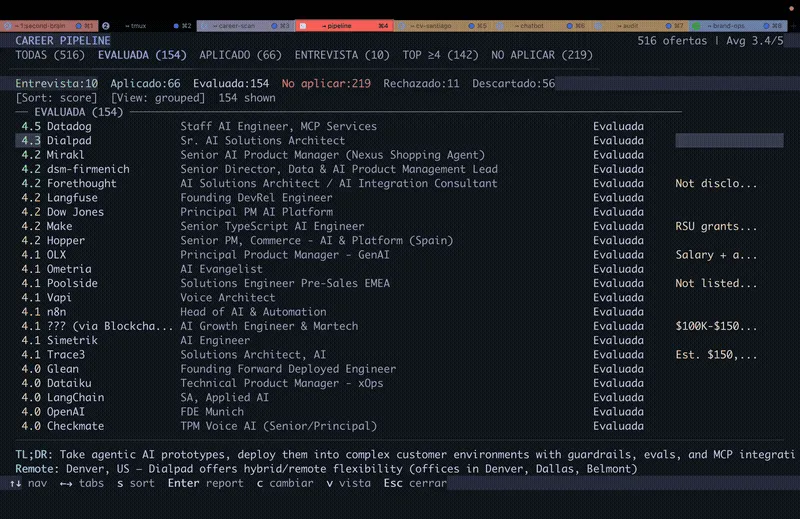
The breakout strategy of career-ops is deliberately constrained. It refuses to spin up a cloud SaaS silo to create another data monopoly. Instead, it pushes the entire filtering logic down to the developer's local iron. When a job URL is fed into the system, the local agent intercepts it, extracting real-time features regarding job validity and skill alignment. The local runtime scores the alignment across multiple axes, instantly dropping non-fit listings while outputting precise resume adaptations and drafting answers for survivors. This design turns an asymmetric information gap into a deterministic, auditable local workflow.
💡 Core Architectural Insight: By shifting hiring decisions left to the client's local environment, career-ops uses a deterministic state machine to isolate uncontrollable external ATS noise, restoring absolute developer control over the funnel.
2. Core Architecture and Data Flow Analysis
career-ops adopts a clean, decoupled topology. The system consists of a local gateway parser, a persistent memory state layer, and a dynamic execution engine. Once the developer triggers a terminal command, the underlying pipeline executes a strict lifecycle management schedule.
[ CLI Terminal ] ---> [ Local Gateway / Parser ] ---> [ State & Memory Layer ]
                                                            │
                                                            ▼
                        [ Dynamic Execution Engine ] <------+|
The ingestion tier receives raw job description text via unified parsing adapters, scrubbing out HTML noise and marketing fluff. The state layer persists candidate assets, including structured resumes, core project histories, and past application logs. The execution engine schedules the designated inference model for vector space matching, outputting precise fit scores, listing status, and targeted revision strategies. All intermediate artifacts reside in the local file system, completely eliminating third-party telemetry exposure risks.
3. Technology Selection and Hardcore Benchmarking
| Dimension | This Project (career-ops) | Traditional Approach | Typical Commercial SaaS | Production Yield |
|---|---|---|---|---|
| Runtime Environment | Local CLI Terminal | Web SaaS Platforms | Cloud-native Multi-tenant | Zero data leaks & zero server ops |
| Data Ownership | 100% Local Plaintext | Vendor Databases | Proprietary Cloud DB | Prevents resume harvesting for training |
| Model Execution | Local Offline Models | Heavy Cloud APIs | Bound to Single LLM API | Eliminates token bills and network lag |
| Automation Boundary | Assisted Draft Generation | Blind Mass-Apply | Automated Form Clicking | Ensures human-in-the-loop final submit |
This technology stack strips away the middleman markups common in commercial software. For engineers who prioritize sovereignty, shifting from a black-box cloud service to a purely local execution stack eliminates latency while locking down security perimeters.
4. Hands-on Geek Guide: Building the Minimal Loop
Initialize and bootstrap the career-ops agent environment directly inside your Node.js workspace. The command checks dependencies and scaffolds the configuration layout.
# Initialize and spin up the local career-ops agent directly in your terminal
npx @santifer/career-ops init
With initialization complete, use the following production script snippet to schedule the local execution engine for feature alignment and resume slicing against a target role:
import { CareerOpsEngine } from '@santifer/career-ops';

// Instantiate the local agent engine, injecting user profile paths
const engine = new CareerOpsEngine({
  configPath: './config/user-profile.yaml',
  localModel: 'llama3:8b' // Specify the local inference runtime backend
});

async function evaluateTargetRole() {
  // Fetch raw job description text from the target source
  const rawJobDescription = await engine.fetchJobDescription('https://example.com/target-job');

  // Execute feature alignment and validity filtering
  const analysisResult = await engine.evaluate(rawJobDescription);

  if (analysisResult.isFit) {
    // Generate a tailored resume block specifically for this listing
    const tailoredCv = await engine.tailorCV(analysisResult);
    console.log('Match confirmed. Tailored resume generated at:', tailoredCv.outputPath);
  } else {
    console.log('Intercepted: Low skill alignment. Application overhead saved.');
  }
}

evaluateTargetRole();
Upon executing this script, structured match scores output directly to the terminal. If the listing clears validation, the local workspace generates re-ordered resume segments and draft answers, holding steady until human confirmation.
5. Production Gotchas and Pitfalls
Running large language models and automated parsing pipelines locally introduces sharp edge cases. Hardware allocation and network states are frequent failure zones.
⚠️ Gotcha Warning: Local VRAM OOM: Invoking large open-source models (such as the 70B class) for resume parsing without setting proper quantization flags will trigger local GPU out-of-memory errors or cause CPU inference deadlocks. Fall back to an 8B or 14B Q4_K_M quantized build on constrained dev rigs, or route requests to a lightweight remote API fallback.
⚠️ Gotcha Warning: Raw DOM Parsing Contamination: Scraping heavily obfuscated job boards without text cleaning will inject layout artifacts into the embedding space, causing systematic match score drift. Always pass raw inputs through the built-in sanitization hooks to filter out structural styles and dynamic script clutter prior to model evaluation.