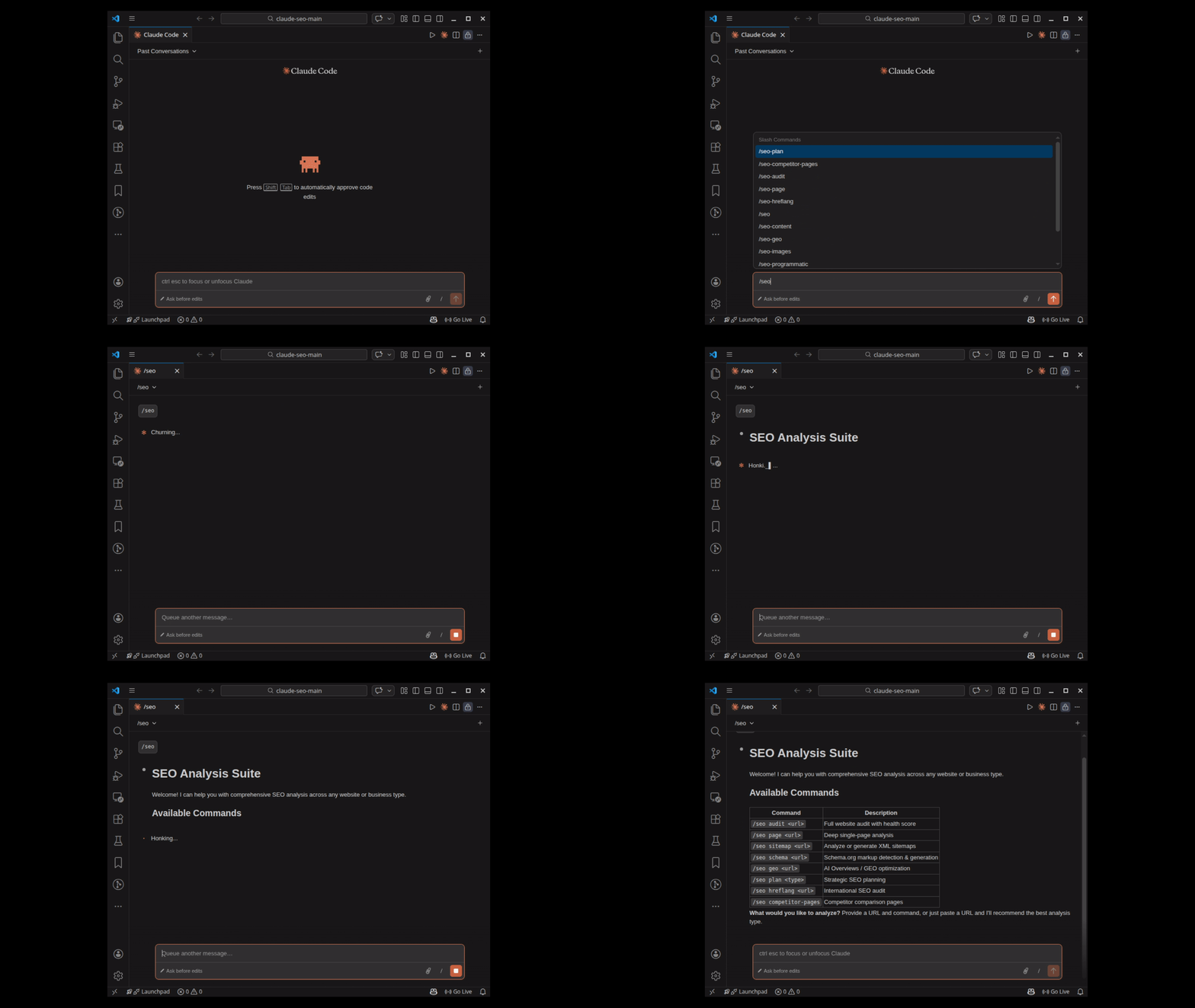
1. The Core Bottleneck: What Engineering Flaw Does It Solve?
Traditional search engine optimization remains hindered by legacy SaaS architectures. Tools like Ahrefs, Semrush, and Screaming Frog isolate critical diagnostic data behind proprietary web dashboards, forcing developers into context switching between web consoles and their local codebases. Furthermore, their rule engines skew toward marketing audits rather than hard engineering verifications. When confronted with modern generative search architectures (SearchGPT, Perplexity, Google AI Overviews), legacy crawl engines completely lack diagnostic primitives for emerging protocols such as llms.txt, IPTC algorithmic image labeling, and Agentic Browser readability standards.
AgriciDaniel/claude-seo eliminates this layer of friction by running directly inside the Claude Code runtime environment. Instead of treating SEO as post-facto content scoring, it reframes visibility as an automated end-to-end integration test executed locally against application code, routing rules, and rendered assets.
💡 Architectural Insight: Re-architects SEO verification into an actionable E2E testing harness, fanning out 19 specialized sub-agents inside local terminal workflows to produce falsifiable, code-level pull-request recommendations.
Every recommendation emitted by /seo audit incorporates primary-source references straight from Google Developer guidelines, dependency trees, and explicit failure conditions. Rather than tracking opaque proprietary scores, engineers receive measurable criteria detailing exactly how a fix can be verified upon deployment.
2. Core Architecture & Underlying Execution Flow
claude-seo integrates into Claude Code as a standardized plugin. The stack combines a routing dispatcher, an isolated Python virtual environment, a local Playwright headless Chromium runner, and 19 domain-specific sub-agents executing concurrently.
[ Developer Terminal ]
         │ (e.g. /seo audit https://target.site)
         ▼
[ Claude Code CLI Plugin Host ]
         │
         ├─► [ Isolated Env Manager ] ──► [ Playwright Headless Cluster ]
         │                                  (DOM / SSR / Network Traffic)
         ▼
[ SEO Router & Orchestrator ]
         │
         ├─► [ Agent Fan-Out Dispatcher ]
         │         │
         │         ├─► Agent 01: Core Web Vitals (Agentic Category)
         │         ├─► Agent 02: Schema.org AST Parser & Deprecation
         │         ├─► Agent 03: GEO (Passage Citability / llms.txt)
         │         ├─► Agent 04: Content E-E-A-T & Machine Drift
         │         └─► ... [Up to 19 Parallel Sub-Agents]
         │
         ▼
[ Evidence & Falsifiability Engine ] ──► [ Google Official Spec Align ]
         │
         ▼
[ Local Markdown / Patch Generator ] ──► Output Action Plan to Repo
The runtime execution path is governed by three primary operations:
- Data Ingestion Tier: Headless Playwright workers execute inside Claude Code's plugin directory. This isolated sandbox avoids leaking dependencies into the host OS while capturing dynamic DOM trees, HTTP headers, redirects, and network payloads.
- Context Routing & Fan-out Engine: Incoming audit commands trigger horizontal dispatching across up to 19 worker threads. For instance,
Agent 02uses a dedicated Abstract Syntax Tree (AST) parser to check JSON-LD declarations against deprecated Google schema types, whileAgent 03evaluates the site against Generative Engine Optimization (GEO) criteria, validatingllms.txtendpoints and passage-level citability. - Evidence Synthesis & Falsifiability Processor: Observations are unified into an action plan containing explicit leading indicators and failure-check formulas, mapping diagnostics directly to Git code remediation.
This topology favors local compute and absolute privacy over remote cloud crawlers, exchanging shared SaaS infrastructure for local token-driven parallel execution.
3. Technology Matrix: Architectural Trade-Offs
Comparing claude-seo against established desktop scrapers and enterprise web platforms exposes distinct engineering trade-offs:
| Technical Metric | claude-seo Architecture | Screaming Frog Pattern | Commercial SaaS (Ahrefs/Semrush) | Production Advantage |
|---|---|---|---|---|
| Runtime & Host | Native Claude Code Plugin + Sandboxed Playwright | Java monolith desktop application | Proprietary cloud infrastructure | Zero code leakage; works directly inside local Git repositories |
| Concurrency Paradigm | 19 sub-agents running 26 discrete sub-skills in parallel | Multi-threaded network IO with serial rule processing | Asynchronous distributed batch queues | Condenses full-domain audits from hours to minutes |
| Generative Search Protocol | Native validation for llms.txt, GEO citability, Agentic specs |
Unstructured raw text and basic meta tags only | Third-party approximations without source mappings | Immediate discoverability coverage for AI-first crawlers |
| Output Artifacts | Code-level recommendations with falsifiable checks | Raw CSV / XLSX dumps requiring manual translation | High-level dashboard health scores | Actionable instructions mapped directly to code PRs |
By executing parallel evaluation logic directly within the developer CLI, claude-seo eliminates the disconnect between digital marketing reporting and technical remediation.
4. Hands-on Implementation: Minimal Working Pipeline
Installation requires Claude Code version 1.0.33 or later. The sequence below provisions dependencies in an isolated sandbox without polluting global paths.
Environment Setup & Diagnostics
# 1. Register the public plugin marketplace repository
/plugin marketplace add AgriciDaniel/claude-seo

# 2. Install the plugin package
/plugin install claude-seo@agricidaniel-claude-seo

# 3. Provision sandboxed Python virtual environment and Playwright Chromium
/seo setup

# 4. Verify system dependencies and browser runtime readiness
/seo doctor
Minimal Reproduction Script
This pipeline script demonstrates automated invocation of single-page technical, structured data, and generative search checks:
#!/usr/bin/env bash
set -euo pipefail

# Define target endpoint and output target
TARGET_URL="https://example.com"
REPORT_DIR="./audit-artifacts"
mkdir -p "${REPORT_DIR}"

echo "[*] Launching Claude Code Headless SEO Pipeline..."

# Stream commands into the interactive CLI runner
# Arguments breakdown:
# /seo page: Executes localized DOM, technical SSR, and content checks
# /seo schema: Runs Schema.org AST validation and flags deprecated keys
# /seo geo: Tests passage citability and parses /llms.txt adherence
# /seo audit: Executes broad horizontal fan-out across 19 sub-agents
claude <<EOF
/seo page ${TARGET_URL}
/seo schema ${TARGET_URL}
/seo geo ${TARGET_URL}
/seo audit ${TARGET_URL}
EOF

echo "[+] Audit completed. Diagnostic payloads generated."
Expected Execution Output
Upon job completion, the terminal displays consolidated recommendations backed by leading indicators:
[+] 17 Specialist Agents Spawned Successfully.
── Priority Action Item 01 ──────────────────────────────
Category: AI Search Optimization (GEO)
Target: https://example.com/llms.txt
Observation: Missing primary-source documentation endpoint.
Citability Score: 42/100 (Failed passage extraction threshold)
Recommendation:
  - Expose a validated /llms.txt mapping key product architectures.
  - Apply IPTC TrainedAlgorithmicMedia tag on /assets/hero.webp.
Falsifiability Check:
  - Probe with Perplexity / Google AI Overview queries.
  - Verify llms.txt HTTP 200 response with text/markdown Content-Type.
Leading Indicator: 14-day increase in non-branded referral bot crawls.
─────────────────────────────────────────────────────────
5. Production Gotchas & Operational Mitigations
Operating agentic pipelines locally introduces specific edge cases regarding headless browser states and LLM API economics:
⚠️ Gotcha Warning [Containerized Environments & Playwright Binaries]: Running
/seo setupinside lean Linux containers or headless CI runners frequently throws initialization failures due to missing operating system libraries (libnss3,libgbm1,libasound2). Ensure all headless Chromium dependencies are installed via package managers during the Docker image build stage before executing the setup script.⚠️ Gotcha Warning [Token Depletion on Massive DOM Trees]: Fanning out 19 sub-agents simultaneously on deeply nested Single Page Applications (SPAs) dumps extensive DOM states into context windows, rapidly consuming context budgets and driving up Claude API costs. Constrain early-stage production pipelines to targeted commands (
/seo page,/seo schema) rather than running unbounded/seo auditexecutions across multi-thousand-page sites.
Furthermore, dynamic SPAs relying on late client-side hydration can trick the DOM extraction pipeline if assets render after the standard load event. Specify concrete DOM wait targets when testing complex client-rendered frameworks to prevent inaccurate diagnostics regarding absent metadata.